

[Jan 25, 2024] Reliable DEA-C01 Exam Tips Test Pdf Exam Material
New 2024 DEA-C01 Test Tutorial (Updated 67 Questions)
NEW QUESTION # 16
Which output is provided by both theSYSTEM$CLUSTERING_DEPTHfunction and theSYSTEM$CLUSTERING_INFORMATIONfunction?
- A. total_partition_count
- B. average_overlaps
- C. notes
- D. average_depth
Answer: D
Explanation:
Explanation
The output that is provided by both the SYSTEM$CLUSTERING_DEPTH function and the SYSTEM$CLUSTERING_INFORMATION function is average_depth. This output indicates the average number of micro-partitions that contain data for a given column value or combinationof column values. The other outputs are not common to both functions. The notes output is only provided by the SYSTEM$CLUSTERING_INFORMATION function and it contains additional information or recommendations about the clustering status of the table. The average_overlaps output is only provided by the SYSTEM$CLUSTERING_DEPTH function and it indicates the average number of micro-partitions that overlap with other micro-partitions for a given column value or combination of column values. The total_partition_count output is only provided by the SYSTEM$CLUSTERING_INFORMATION function and it indicates the total number of micro-partitions in the table.
NEW QUESTION # 17
Snowpipe loads data from files as soon as they are available in a stage. Automated data loads lever-age event notifications for cloud storage to inform Snowpipe of the arrival of new data files to load. Which Cloud hosted platform provides cross cloud support for automated data loading via Snow-pipe?
- A. GCP
- B. AWS
- C. AZURE
- D. None of the Above currently provide cross cloud support for Snowpipe.
Answer: B
Explanation:
Explanation
Cross-cloud support only available to accounts hosted on Amazon Web Services currently.
NEW QUESTION # 18
Data Engineer Loading File named snowdata.tsv in the /datadir directory from his local machine to Snowflake stage and try to prefix the file with a folder named tablestage, please mark the correct command which helps him to load the files data into snowflake internal Table stage?
- A. put file://c:\datadir\snowdata.tsv @%tablestage;
- B. put file:///datadir/snowdata.tsv @%tablestage;
- C. put file://c:\datadir\snowdata.tsv @tablestage;
- D. put file://c:\datadir\snowdata.tsv @~/tablestage;
Answer: A
Explanation:
Explanation
Execute PUT to upload (stage) local data files into an internal stage.
@% character combination identifies a table stage.
NEW QUESTION # 19
Regular views do not cache data, and therefore cannot improve performance by caching?
- A. FALSE
- B. TRUE
Answer: B
Explanation:
Explanation
Regular views do not cache data, and therefore cannot improve performance by caching.
NEW QUESTION # 20
Which Role that is dedicated to user and role management only?
- A. USERADMIN
- B. ORGADMIN
- C. SYSADMIN
- D. PUBLIC
- E. SECURITYADMIN
Answer: A
NEW QUESTION # 21
At what isolation level are Snowflake streams?
- A. Repeatable read
- B. Snapshot
- C. Read uncommitted
- D. Read committed
Answer: A
Explanation:
Explanation
The isolation level of Snowflake streams is repeatable read, which means that each transaction sees a consistent snapshot of data that does not change during its execution. Streams use time travel internally to provide this isolation level and ensure that queries on streams return consistent results regardless of concurrent transactions on their source tables.
NEW QUESTION # 22
Which privilege are required on an object (i.e. user or role) with USERADMIN Role can modify the object properties?
- A. MODIFY
- B. OPEARTE
- C. OWNERSHIP
- D. MANAGE GRANTS
Answer: C
NEW QUESTION # 23
Which methods will trigger an action that will evaluate a DataFrame? (Select TWO)
- A. DataFrame.random_split ( )
- B. DataFrame.collect ()
- C. DataFrame.show ()
- D. DateFrame.select ()
- E. DataFrame.col ( )
Answer: B,C
Explanation:
Explanation
The methods that will trigger an action that will evaluate a DataFrame are DataFrame.collect() and DataFrame.show(). These methods will force the execution of any pending transformations on the DataFrame and return or display the results. The other options are not methods that will evaluate a DataFrame. Option A, DataFrame.random_split(), is a method that will split a DataFrame into two or more DataFrames based on random weights. Option C, DataFrame.select(), is a method that will project a set of expressions on a DataFrame and return a new DataFrame. Option D, DataFrame.col(), is a method that will return a Column object based on a column name in a DataFrame.
NEW QUESTION # 24
While working with Multi Cluster Warehouses, Select the incorrect understanding of Data Engineer about its usage?
- A. When choosing the minimum number of clusters for a multi-cluster warehouse keep the default value as
1. - B. Multi-cluster warehouses are designed specifically for handling queuing and perfor-mance issues related to large numbers of concurrent users and/or queries.
- C. Multi-cluster warehouses generally improve query performance, particularly for larger, more complex queries.
- D. When choosing the maximum number of clusters for a multi-cluster warehouse set its value as large as possible.
- E. Unless you have a specific requirement for running in Maximized mode, multi-cluster warehouses should be configured to run in Auto-scale mode, which enables Snowflake to automatically start and stop clusters as needed.
Answer: C
Explanation:
Explanation
Resizing a warehouse generally improves query performance, particularly for larger, more complex queries.
Multi-cluster warehouses are designed specifically for handling queuing and performance issues re-lated to large numbers of concurrent users and/or queries. In addition, multi-cluster warehouses can help automate this process if your number of users/queries tend to fluctuate.
Rest all are correct understanding.
NEW QUESTION # 25
To view/monitor the clustering metadata for a table, Snowflake provides which of the following system functions?
- A. SYSTEM$CLUSTERING_DEPTH_KEY
- B. SYSTEM$CLUSTERING_KEY_INFORMATION (including clustering depth)
- C. SYSTEM$CLUSTERING_DEPTH
- D. SYSTEM$CLUSTERING_INFORMATION (including clustering depth)
Answer: C,D
Explanation:
Explanation
SYSTEM$CLUSTERING_DEPTH:
Computes the average depth of the table according to the specified columns (or the clustering key defined for the table). The average depth of a populated table (i.e. a table containing data) is always 1 or more. The smaller the average depth, the better clustered the table is with regards to the speci-fied columns.
Calculate the clustering depth for a table using two columns in the table:
SELECT SYSTEM$CLUSTERING_DEPTH('TPCH_PRODUCT', '(C2, C9)');
SYSTEM$CLUSTERING_INFORMATION:
Returns clustering information, including average clustering depth, for a table based on one or more columns in the table.
SELECT SYSTEM$CLUSTERING_INFORMATION('SAMPLE_TABLE', '(col1, col3)');
NEW QUESTION # 26
A Data Engineer has developed a dashboard that will issue the same SQL select clause to Snowflake every 12 hours.
---will Snowflake use the persisted query results from the result cache provided that the underlying data has not changed^
- A. 31 days
- B. 14 days
- C. 24 hours
- D. 12 hours
Answer: B
Explanation:
Explanation
Snowflake uses the result cache to store the results of queries that have been executed recently. The result cache is maintained at the account level and is shared across all sessions and users. The result cache is invalidated when any changes are made to the tables or views referenced by the query. Snowflake also has a retention policy for the result cache, which determines how long the results are kept in the cache before they are purged. The default retention period for the result cache is 24 hours, but it can be changed at the account, user, or session level. However, there is a maximum retention period of 14 days for the result cache, which cannot be exceeded. Therefore, if the underlying data has not changed, Snowflake will use the persisted query results from the result cache for up to 14 days.
NEW QUESTION # 27
Charles, A Lead Data engineer, with ACCOUNTADMIN role wants to configure the time travel for one of the Schema's object. He setup the MIN_DATA_RETENTION_TIME_IN_DAYS pa-rameter with Value 79 at account level but he figured out that DA-TA_RETENTION_TIME_IN_DAYS is already set with value 81 at account level. What would be the effective minimum data retention period for an object?
- A. 0
- B. 1
- C. 2
- D. There is no such MIN_DATA_RETENTION_TIME_IN_DAYS parameter
Answer: A
Explanation:
Explanation
A user with the ACCOUNTADMIN role can also set the MIN_DATA_RETENTION_TIME_IN_DAYS at the account level. This parameter setting enforc-es a minimum data retention period for databases, schemas, and tables. Setting MIN_DATA_RETENTION_TIME_IN_DAYS does not alter or replace the DA-TA_RETENTION_TIME_IN_DAYS parameter value. It may, however, change the effective data retention period for objects. When MIN_DATA_RETENTION_TIME_IN_DAYS is set at the ac-count level, the data retention period for an object is determined by MAX(DATA_RETENTION_TIME_IN_DAYS, MIN_DATA_RETENTION_TIME_IN_DAYS).
NEW QUESTION # 28
The following is returned fromSYSTEMCLUSTERING_INFORMATION () for a tablenamed orders with adate column named O_ORDERDATE: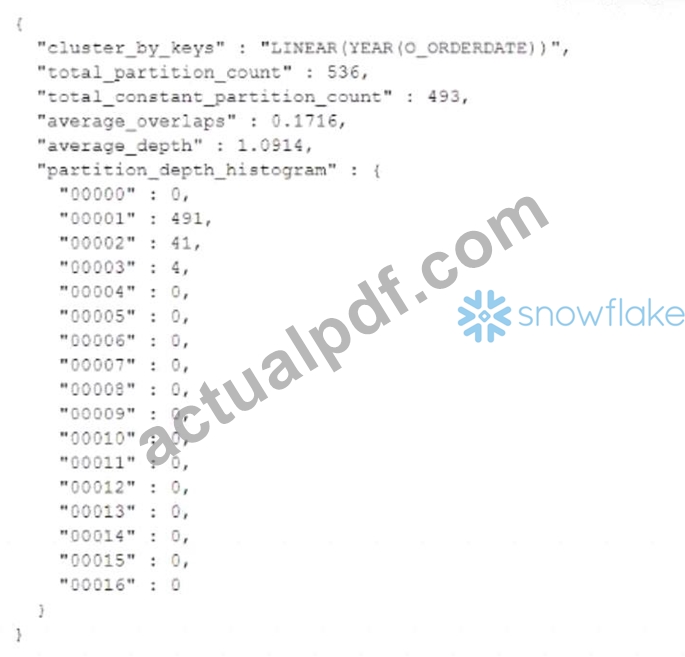
What does the total_constant_partition_count value indicate about this table?
- A. The data inO_ORDERDATEhas a very low cardinality as there are 493 micro-partitions where there is only a single distinct value in that column for all rows in the micro-partition
- B. The table is clustered very well on_ORDERDATE, as there are 493 micro-partitions that could not be significantly improved by reclustering
- C. The table is not clustered well on O_ORDERDATE, as there are 493 micro-partitions where the range of values in that column overlap with every other micro partition in the table.
- D. The data inO_ORDERDATEdoes not change very often as there are 493 micro-partitionscontaining rows where that column has not been modified since the row was created
Answer: C
Explanation:
Explanation
The total_constant_partition_count value indicates the number of micro-partitions where the clustering key column has a constant value across all rows in the micro-partition. However, this does not necessarily mean that the table is clustered well on that column, as there could be other micro-partitions where the range of values in that column overlap with each other. This is the case for the orders table, as the clustering depth is 1, which means that every micro-partition overlaps with every other micro-partition on O_ORDERDATE. This indicates that the table is not clustered well on O_ORDERDATE and could benefit from reclustering.
NEW QUESTION # 29
Assuming a Data Engineer has all appropriate privileges and context which statements would be used to assess whether the User-Defined Function (UDF), MTBATA3ASZ. SALES .REVENUE_BY_REGION, exists and is secure? (Select TWO)
- A. SHOW SECURE FUNCTIONS LIKE 'REVENUE 3Y REGION' IN SCHEMA SALES;
- B. SELECT IS_SECURE FROM SNOWFLAKE. INFCRXATION_SCKZMA. FUNCTIONS WHERE FUNCTI0N_3CHEMA = 'SALES' AND FUNCTI CN_NAXE = *ftEVEXUE_BY_RKXQH4;
- C. SHOW DS2R FUNCTIONS LIKE 'REVEX'^BYJIESION' IN SCHEMA SALES;
- D. SELECT IS_SEC"JRE FROM INFOR>LVTICN_SCHEMA. FUNCTIONS WHERE
FUNCTION_SCHEMA = 'SALES1 AND FUNGTZON_NAME = ' REVENUE_BY_REGION'; - E. SHOW EXTERNAL FUNCTIONS LIKE 'REVENUE_BY_REGION'IB SCHEMA SALES;
Answer: B,C
Explanation:
Explanation
The statements that would be used to assess whether the UDF, MTBATA3ASZ. SALES
.REVENUE_BY_REGION, exists and is secure are:
SHOW DS2R FUNCTIONS LIKE 'REVEX'^BYJIESION' IN SCHEMA SALES;: This statement will show information about the UDF, including its name, schema, database, arguments, return type, language, and security option. If the UDF does not exist, the statement will return an empty result set.
SELECT IS_SECURE FROM SNOWFLAKE. INFCRXATION_SCKZMA. FUNCTIONS WHERE
FUNCTI0N_3CHEMA = 'SALES' AND FUNCTI CN_NAXE = *ftEVEXUE_BY_RKXQH4;: This statement will query the SNOWFLAKE.INFORMATION_SCHEMA.FUNCTIONS view, which contains metadata about the UDFs in the current database. The statement will return the IS_SECURE column, which indicates whether the UDF is secure or not. If the UDF does not exist, the statement will return an empty result set. The other statements are not correct because:
SELECT IS_SEC"JRE FROM INFOR>LVTICN_SCHEMA. FUNCTIONS WHERE
FUNCTION_SCHEMA = 'SALES1 AND FUNGTZON_NAME = ' REVENUE_BY_REGION';: This statement will query the INFORMATION_SCHEMA.FUNCTIONS view, which contains metadata about the UDFs in the current schema. However, the statement has a typo in the schema name ('SALES1' instead of 'SALES'), which will cause it to fail or return incorrect results.
SHOW EXTERNAL FUNCTIONS LIKE 'REVENUE_BY_REGION' IB SCHEMA SALES;: This statement will show information about external functions, not UDFs. External functions are Snowflake functions that invoke external services via HTTPS requests and responses. The statement will not return any results for the UDF.
SHOW SECURE FUNCTIONS LIKE 'REVENUE 3Y REGION' IN SCHEMA SALES;: This
statement is invalid because there is no such thing as secure functions in Snowflake. Secure functions are a feature of some other databases, such as PostgreSQL, but not Snowflake. The statement will cause a syntax error.
NEW QUESTION # 30
Data Engineer is using existing pipe that automates data loads using event notifications, later he figured out the needs to modify pipe properties. For the same, He decided to recreate the pipe as best practice. He followed the below steps for the same.
1. Query the SYSTEM$PIPE_STATUS function and verify that the pipe execution state is RUN-NING.
2. Recreate the pipe (using CREATE OR REPLACE PIPE).
3. Query the SYSTEM$PIPE_STATUS function and verify that the pipe execution state is RUN-NING.
Which are the Missing recommended steps while Recreating Pipes for Automated Data Loads?
- A. Pause the pipe (using ALTER PIPE ... SET PIPE_EXECUTION_PAUSED = true) Pre & Post recreation & Resume after recreation (using ALTER PIPE ... SET PIPE_EXECUTION_PAUSED = false).
- B. Force the pipe to resume (using SYSTEM$PIPE_FORCE_RESUME).
- C. CREATE OR REPLACE PIPE command will recreate the PIPE successfully.
- D. Terminate the existing pipe (using ALTER PIPE ... SET PIPE_EXECUTION_TERMINATE = true) before recreation.
Answer: A
Explanation:
Explanation
Recreating a pipe (using a CREATE OR REPLACE PIPE statement) is necessary to modify most pipe properties.
Recreating Pipes for Automated Data Loads
When recreating a pipe that automates data loads using event notifications, it's recommended that Data Engineer complete the following steps:
1. Pause the pipe (using ALTER PIPE ... SET PIPE_EXECUTION_PAUSED = true).
2. Query the SYSTEM$PIPE_STATUS function and verify that the pipe execution state is PAUSED.
3. Recreate the pipe (using CREATE OR REPLACE PIPE).
4. Pause the pipe again.
5. Review the configuration steps for your cloud messaging service to ensure the settings are still accurate.
6. Query the SYSTEM$PIPE_STATUS function again and verify that the pipe execution state is RUNNING.
NEW QUESTION # 31
Which Snowflake objects does the Snowflake Kafka connector use? (Select THREE).
- A. Internal user stage
- B. Internal table stage
- C. Serverless task
- D. Pipe
- E. Storage integration
- F. Internal named stage
Answer: B,D,F
Explanation:
Explanation
The Snowflake Kafka connector uses three Snowflake objects: pipe, internal table stage, and internal named stage. The pipe object is used to load data from an external stage into a Snowflake table using COPY statements. The internal table stage is used to store files that are loaded from Kafka topics into Snowflake using PUT commands. The internal named stage is used to store files that are rejected by the COPY statements due to errors or invalid data. The other options are not objects that are used by the Snowflake Kafka connector.
Option B, serverless task, is an object that can execute SQL statements on a schedule without requiring a warehouse. Option C, internal user stage, is an object that can store files for a specific user in Snowflake using PUT commands. Option F, storage integration, is an object that can enable secure access to external cloud storage services without exposing credentials.
NEW QUESTION # 32
......
DEA-C01 Cert Guide PDF 100% Cover Real Exam Questions: https://examsboost.actualpdf.com/DEA-C01-real-questions.html
