

[Feb 14, 2022] 1z0-1072-21 Exam Dumps PDF Updated Dump from ActualPDF Guaranteed Success
Pass Your Oracle Exam with 1z0-1072-21 Exam Dumps
NEW QUESTION 95
An Oracle Cloud Infrastructure tenancy administrator is not able to delete a user in the tenancy.
What can cause this issue?
- A. User has multi-factor authentication (MFA) enabled.
- B. User needs to be deleted from federation Identity Provider (IdP)before deleting from IAM.
- C. User is member of an Identity and Access Management (IAM) group.
- D. Users can be blocked but not deleted.
Answer: A
NEW QUESTION 96
You are designing a shared storage solution for your company in Oracle Cloud Infrastructure. The proposed storage solution should allow users to create a hierarchical structure (similar to the directory structure in Linux or Windows based systems). The solution should provide data encryption and a large amount of storage space.
Which would be the best implementation strategy?
- A. Use file storage service. Create a file system and a mount target. Share the private IP of the mount target.
- B. Use block storage. Create and attach a large block storage volume to one compute instance. Assign a public IP to the compute instance. Store data on the block storage and access it by connecting to the compute instance.
- C. Use object storage. Create a single namespace and multiple buckets to create the hierarchical directory structure.
- D. Use object storage. Create multiple namespaces with one bucket each. Make the buckets publicly accessible.
Answer: A
NEW QUESTION 97
Which two are required to create an IPSec VPN connection? (Choose two.)
- A. name
- B. security list
- C. static route CIDR
- D. compute instance
Answer: B,C
NEW QUESTION 98
You have multiple applicationsinstalled on a compute instance and these applications generate a large amount of log files. These log files must reside on the boot volume for a minimum of 15 days and must be retained for at least 60 days. The 60-day retention requirement is causing an issue with available disk space.
What are the two recommended methods to provide additional boot volume space for this compute instance?
(Choose two.)
- A. Create and attach a block volume to the compute instance and copythe log files.
- B. Create a custom image and launch a new compute instance with a larger boot volume size.
- C. Write a custom script to remove the log files on a daily basis and free up the space on the boot volume.
- D. Create an object storage bucket and use a script that runs daily to move log files older than 15 days to the bucket.
- E. Terminate the instance while preserving the boot volume. Create a new instance from the boot volume and select a DenseIO shape to take advantage of local NVMe storage.
Answer: B,D
Explanation:
Explanation
These log files must resideon the boot volume for a minimum of 15 days so you have to increase the boot Volume
NEW QUESTION 99
Which three load-balancing policies can be used with a back end set? (Choose three.)
- A. IP Hash
- B. CPU Utilization
- C. Weighted Round Robin
- D. Throughput
- E. Least Connections
Answer: A,C,E
Explanation:
Explanation
References:
After you create a load balancer, you can apply policies to control traffic distribution to your backend servers.
The Load Balancing service supports three primary policy types:
Round RobinLeast ConnectionsIP Hash
NEW QUESTION 100
Within your tenancy you have a compute instance with a boot volume and a block volume attached. The boot volume contains the OS and the attached block volume contains the instance's important data. Logs on the boot volume have filled the boot volume and are causing issues with the OS.
What should you do to resolve this situation?
- A. Stop the instance that is full. Create a manual backup of the block storage before making changes.
Detach the block volume, create a new instance ofthe same shape with a larger custom boot volume and attach the block volume to the new instance. Configure the OS and any related application(s) to access the block volume under the same mount point as before. - B. Create a manual backup of the block storage instance. Create a custom imageof the full instance. Once that completes deploy the custom image to a new instance.
- C. Detach the block volume from the full instance. Create a new instance of the same shape with a larger boot volume and rsync the state of the boot volume between the instances. Attach the block volume to the new instance.
- D. Create a new instance with a larger boot volume size as well a new block volume which is the same size or larger than the one attached to the full instance. rsync the state of the boot volume and the state of the block volume between the two instances.
Answer: A
Explanation:
Explanation
https://docs.cloud.oracle.com/en-us/iaas/Content/Block/Tasks/resizingavolume.htm
NEW QUESTION 101
Your company has decided to move a few applications to Oracle Cloud and you have been asked to design it for both High Availability (HA) and Disaster Recovery (DR).
Which two should youconsider while designing your Oracle Cloud Infrastructure architecture? (Choose two.)
- A. Compartments
- B. Availability Domain
- C. Region
- D. Instance Shape
Answer: B,C
Explanation:
Explanation
References:https://blogs.oracle.com/cloud-infrastructure/migration-and-disaster-recovery-in-the-oracle-cloud-wi
NEW QUESTION 102
Which two configuration formats does Terraform support? (Choose two.)
- A. YAML
- B. HCL
- C. JSON
- D. XML
Answer: B,C
Explanation:
Explanation
References:
Terraform configuration filescan use either of two formats: Terraform domain-specific language (HashiCorp Configuration Language format [HCL]), which is the recommended approach, or JSON format if the files need to be machine-readable.
NEW QUESTION 103
Which two features are offered natively on Oracle Cloud Infrastructure Database Cloud Service (DBCS)?(Choose two.)
- A. backup to Object Storage
- B. Data Guard in Async mode within a region
- C. GoldenGate replication between two regions
- D. Data Guard in Maximum Protection mode
Answer: A,B
Explanation:
Explanation
Data Guard in Maximum Performance protection mode is supported notsimply Maximum Protection mode, however, you can configure additional protection modes and transport types by logging on to the DB system and accessing Data Guard command-line interface( DGMGRL).
NEW QUESTION 104
A financial firm is designing an application architecture for its online trading platform that must have high availability and fault tolerance.
Their solutions architect configured the application to use an Oracle Cloud InfrastructureObject Storage bucket located in the US West (us-phoenix-1) region to store large amounts of financial data. The stored financial data in the bucket must not be affected even if there is an outage in one of the Availability Domains or a complete region.
What should the architect do to avoid any costly service disruptions and ensure data durability?
- A. Copy the Object Storage bucket to a block volume.
- B. Create a new Object Storage bucket in another region and configure lifecycle policy to move data every
5 days. - C. Create a replication policy to send data to a different bucket in another OCI region.
- D. Create a lifecycle policy to regularly senddata from Standard to Archive storage.
Answer: B
NEW QUESTION 105
You are running your warehouse using Autonomous Data Warehouse (ADW) service and you noticed that a newly configured batch job is always running in serial even through nothing else is running in the database.All your jobs are configured to run with parallelism enabled.
What could be the reason for this batch job to run in serial?
- A. The new batch job runs on database tables that are not enable for parallel execution.
- B. The parallelism of batchjob depends on the number of ADW databases involved in the query.
- C. The new batch job is connected to LOW consumer group.
- D. The batch job depends on only one table and parallelism cannot be enabled on single-table queries.
- E. Parallelism on the database iscontrolled by the application, not the database.
Answer: C
NEW QUESTION 106
In what two ways does Oracle Cloud Infrastructure (OCI) file storage service differ from OCI object storage and block volume services?
- A. Block volume service Is NVMe based, while file storage service is not.
- B. File storage mount target does not provide a private IP address, while the object storage bucket provides one.
- C. File Storage uses the network file system (NFS) protocol, whereas block volume uses iSCSI.
- D. You can move object storage buckets, block volumes and file storage mount targets between compartments.
Answer: C,D
Explanation:
Explanation
The mount target provides the IP address or DNS name that is used together with a unique export path to mount the file system.
You can move mount targets from one compartment to another.
NEW QUESTION 107
Which two statements are true about Database Cloud Service (DBCS)? (Choose two.)
- A. You cannot manage the database as sys/sysdba.
- B. Data Guard as a Service is offered among regions.
- C. You can manageOracle parameters at a global system level.
- D. You have full control over backup schedule and retention.
Answer: C,D
Explanation:
Explanation
References:https://cloud.oracle.com/database/faq#backup
Can I set up Data Guard across Availability Domains?Yes, you can set up Data Guard in the same or different Availability Domains in a region. However, Oracle recommends that you set up your Data Guard configuration across Availability Domains.Can I set up Data Guard across Oracle Cloud Infrastructure regions?Yes, you can set up Data Guard across regions,
"but the Database Cloud Service Data Guard feature currently does not support it. " You can manually set up Data Guard across regions by logging on to your host and using DGMGRL. You must enable an internet gateway on the primary and standby DB system VCN for Data Guard to transport logs across regions. Learn more about DGMGRL.
To configure a Data Guard system across regions or between on-premises and Oracle Cloud Infrastructure DB systems, you must access the database host directly and use the DGMGRL utility.
https://docs.cloud.oracle.com/iaas/Content/Database/Tasks/usingdataguard.htm
NEW QUESTION 108
What happens after you successfully run the following command on your Oracle Cloud Infrastructure Container Engine for Kubernetes (OKE) using the YAML file defined below?
kubectl create -f definition.yml
YAMLfile - definition.yml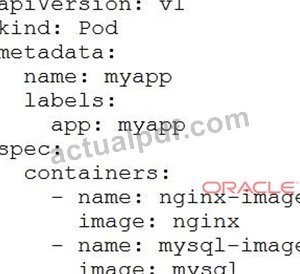
- A. No Pod gets created.
- B. Two Pods with a container each are created.
- C. A single Pod with two containers is created.
- D. A single Pod with a single container is created.
Answer: C
NEW QUESTION 109
Which two statements are true about an Oracle Cloud Infrastructure object storage bucket? (Choose two.)
- A. You can associate a bucket with only a single compartment
- B. You can associate a bucket with multiple compartments
- C. You cannot change a bucket from private topublic after it is created
- D. You cannot edit or append data to an object, but you can replace the entire object
Answer: A,D
Explanation:
Explanation
A bucket is associated with a single compartment.
You can't edit or append data to an object, but you can replace the entire object.
NEW QUESTION 110
You are running an online gaming application hosted on a VM.Standard2.1 instance shape in Oracle Cloud Infrastructure. As the game becomes popular, you identify network throughput as a bottleneck on your instance when uploading user data.
D18912E1457D5D1DDCBD40AB3BF70D5D
Though you want to resolve the issue, you want to observe the demand for a week before adding new application instances.
Which action is the most efficient way to resolve this issue?
- A. Add a secondary virtual networkinterface card (VNIC).
- B. Delete the instance while preserving boot volume and spin up a new higher network bandwidth instance with this boot volume.
- C. Change shape of the instance to a higher network bandwidth instance.
- D. Change the performance tier ofattached block volume to High Performance.
Answer: C
NEW QUESTION 111
You developed a microservices based application that runs on Oracle Cloud Infrastructure (OCI) Container Engine for Kubernetes (OKE). You want to provide access to this clusterto other team members.
What should you do to provide access to this cluster using as fewest steps as possible?
- A. Create a group in OCI Infrastructure Access Management (IAM). Create a policy to grant access to the OKEcluster. Create individual users and access token for each team member. Other team members should use OCI Cloud Shell to generate the kubeconfig into their own cloud shell environment and access the cluster using kubectl from cloud shell.
- B. Create a groupin OCI Infrastructure Access Management (IAM). Create a policy to grant access to the OKE cluster. Create a cluster role and cluster role binding to provide access to the cluster for each team member. Other team members should install oci cli and kubectllocally on their laptop. Use the oci cli to generate the kubeconfig and use kubectl to access the cluster.
- C. Create a group in OCI Infrastructure Access Management (IAM). Create a policy to grant access to the OKE cluster. Other team members should install oci cli and kubectl locally on their laptop. Use the oci cli to generate the kubeconfig and use kubectl to access the cluster.
- D. Create a group in OCI Infrastructure Access Management (IAM). Create a policy to grant access to the OKE cluster. Other team members shoulduse OCI Cloud Shell to generate the kubeconfig into their own cloud shell environment and access the cluster using kubectl from cloud shell.
Answer: A
NEW QUESTION 112
Whichtwo choices are true for Autonomous Data Warehouse (ADW)? (Choose two.)
- A. Billingfor storage continues when ADW is stopped
- B. Billing for compute stops when ADW is stopped
- C. Billing stops for both CPU usage and storage usage when ADW is stopped
- D. Billing stops only when the ADW is terminated
Answer: A,B
Explanation:
Explanation
When Autonomous Databas instance is stopped,
CPU billing is halted based on full-hour cycles of usage
Billing for storage continues as long as the service instance exists.
and When AutonomousDatabase instance is started, the CPU billing is initiated
NEW QUESTION 113
Your company is developing a newdatabase application in Oracle Cloud Infrastructure. You need to test application functionality including a hardware failure scenario. Since the application is still in the development phase, you want to minimize infrastructure costs.
Which database service deployment option meets this requirement?
- A. Autonomous Data Warehouse (ADW) system as it provides auto fail over functionality
- B. single node baremetal system
- C. two node real application cluster (RAC) system
- D. two node bare metal system with data guard enabled
Answer: C
NEW QUESTION 114
You have one database-style application that frequently makes many random reads and writes across the dataset.
Which storage offering supports this application?
- A. Block Storage Service
- B. File Storage Service
- C. Object Storage Service
- D. Archive Storage Service
Answer: A
NEW QUESTION 115
You are about to upload log file (5 TiB size) to Oracle Cloud Infrastructure object storage and have decided to use multipart upload capability for a more efficient and resilientupload.
Which two statements are true about multipart upload? (Choose two.)
- A. You do not have to commit the upload after you have uploaded all the object parts
- B. Individual object parts can be as small as 10 MiB or as large as 50 GiB
- C. The maximum size for an uploaded object is 10 TiB
- D. While a multipart upload is still active, you cannot add parts even if the total number of parts is less than
10,000
Answer: B,C
Explanation:
Explanation
With multipart upload, you split the object you want to upload into individual parts. Individual parts can be as large as 50 GiB or as small as 10 MiB. (Object Storage waives the minimum part size restriction for the last uploaded part.) Decide what part number you want to use for each part. Part numbers can range from 1 to
10,000. You do notneed to assign contiguous numbers, but Object Storage constructs the object by ordering part numbers in ascending order.
The maximum size for an uploaded object is 10 TiB
While a multipart upload is still active, you can keep adding parts as long as thetotal number is less than
10,000.
https://docs.cloud.oracle.com/en-us/iaas/Content/Object/Tasks/usingmultipartuploads.htm
NEW QUESTION 116
You deployed a web server in Oracle Cloud Infrastructure using an ephemeral public IP. After a few changes in your web server configuration, you rebooted the server and a new public IP was associated to your instance.
What should you doto prevent this from happening again?
- A. Create a reserved public IP and associate it with the hosts file of your web server
- B. Create a reserved public IP and associate it with the security list that your complete instance is using
- C. Create a reserved public IP and associate it with the subnet of your compute instance
- D. Create a reservedpublic IP and associate it with the VNIC of your compute instance
Answer: D
Explanation:
Explanation
A public IP address is an IPv4 address that is reachable from the internet. If a resourcein your tenancy needs to be directly reachable from the internet, it must have a public IP address. Depending on the type of resource, there might be other requirements.
There are two types of public IPs:
Ephemeral: Think of it as temporary and existingfor the lifetime of the instance.
Reserved: Think of it as persistent and existing beyond the lifetime of the instance it's assigned to. You can unassign it and then reassign it to another instance whenever you like. Exception: reserved public IPs on public load balancers.
To create a new reservedpublic IP in your pool
Confirm you're viewing the region and compartment where you want to create the reserved public IP.
Open the navigation menu. Under Core Infrastructure, go to Networking and click Public IPs.
Click Create Reserved Public IP.
Enter the following:
Name: An optional friendly name for the reserved public IP. The name doesn't have to be unique, and you can change it later. Avoid entering confidential information.
Compartment: Leave as is.
Tags:Optionally, you can apply tags. If you have permissionsto create a resource, you also have permissions to apply free-form tags to that resource. To apply a defined tag, you must have permissions to use the tag namespace. For more information about tagging, see Resource Tags. If you are not sure if you should apply tags, skip this option (you can apply tags later) or ask your administrator.
Click Create Reserved Public IP.
To assign a reserved public IP to a private IP
Prerequisite: The private IP must not have an ephemeral or reserved public IP already assigned to it. If it does, first delete the ephemeral public IP, or unassign the reserved public IP.
Confirm you're viewing the compartment that contains the instance with the private IP you're interested in.
Open the navigation menu. Under Core Infrastructure, go to Compute and click Instances.
Click the instance to view its details.
Under Resources, click Attached VNICs.
The primary VNIC and any secondary VNICs attached to the instance are displayed.
Click the VNIC you're interested in.
Under Resources, click IP Addresses.
The VNIC's primary private IP and any secondary private IPs are displayed.
For the private IP you're interested in, click the Actions icon (three dots), and then click Edit.
In the Public IP Address section, for Public IP Type, select the radio button for Reserved Public IP.
Enter the following:
Compartment: The compartment that contains the reserved public IP you want to assign.
Reserved Public IP: The reserved public IP you want to assign. You have three choices:
Create a new reserved public IP. You may optionally provide a friendly name for it. The name doesn't have to be unique, and you can change it later. Avoid entering confidential information.
Assign a reserved public IP that is currently unassigned.
Move a reserved publicIP from another private IP.
Click Update.
NEW QUESTION 117
......
New Real 1z0-1072-21 Exam Dumps Questions: https://examsboost.actualpdf.com/1z0-1072-21-real-questions.html
