

Quality 100-150 PDF Dumps - 100-150 Exam Questions
Most UptoDate Cisco 100-150 Exam Dumps PDF 2025
NEW QUESTION # 18
Move each protocol from the list on the left to its correct example on the right.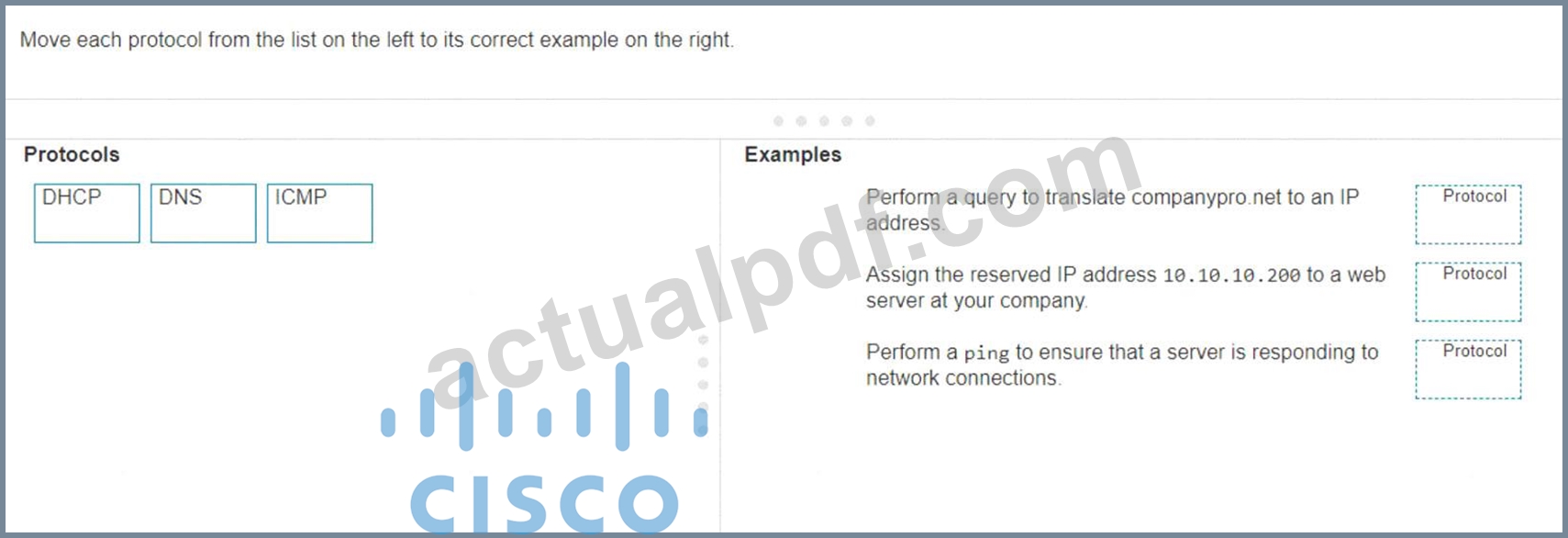
Answer:
Explanation: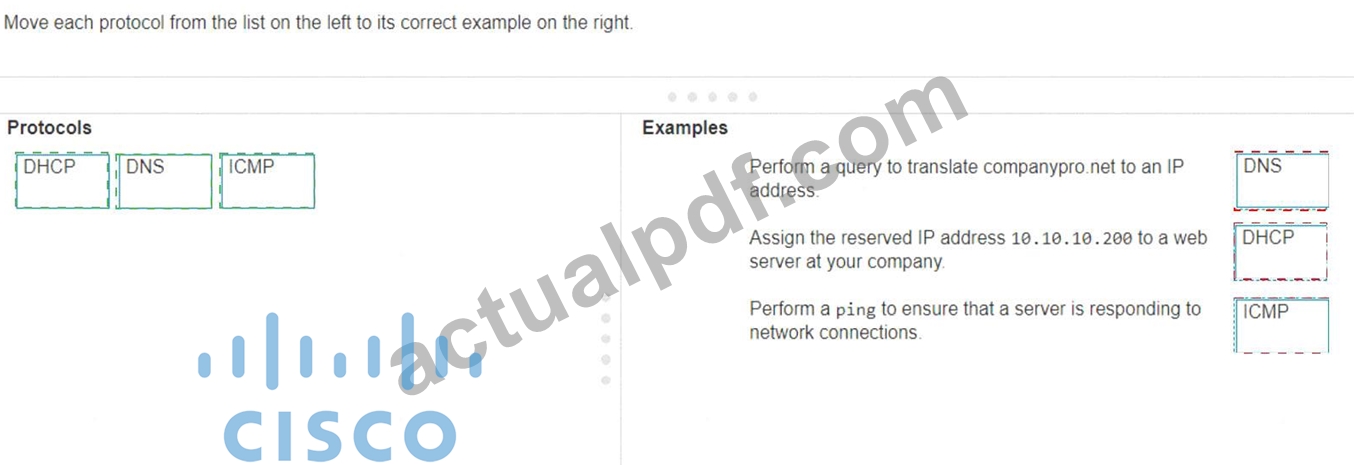
Explanation:
The correct matching of the protocols to their examples is as follows:
* DHCP: Assign the reserved IP address 10.10.10.200 to a web server at your company.
* DNS: Perform a query to translate companypro.net to an IP address.
* ICMP: Perform a ping to ensure that a server is responding to network connections.
Here's how each protocol corresponds to its example:
* DHCP (Dynamic Host Configuration Protocol) is used to assign IP addresses to devices on a network. In this case, DHCP would be used to assign the reserved IP address 10.10.10.200 to a web server.
* DNS (Domain Name System) is used to translate domain names into IP addresses. Therefore, to translate companypro.net to an IP address, DNS would be utilized.
* ICMP (Internet Control Message Protocol) is used for sending error messages and operational information indicating success or failure when communicating with another IP address. An example of this is using the ping command to check if a server is responding to network connections.
These protocols are essential for the smooth operation of networks and the internet.
* Perform a query to translate companypro.net to an IP address.
* DNS (Domain Name System): DNS is used to resolve domain names to IP addresses.
* Assign the reserved IP address 10.10.10.200 to a web server at your company.
* DHCP (Dynamic Host Configuration Protocol): DHCP is used to assign IP addresses to devices on a network.
* Perform a ping to ensure that a server is responding to network connections.
* ICMP (Internet Control Message Protocol): ICMP is used by network devices to send error messages and operational information, and it is the protocol used by the ping command.
* DNS (Domain Name System): DNS translates human-friendly domain names like "companypro.net" into IP addresses that computers use to identify each other on the network.
* DHCP (Dynamic Host Configuration Protocol): DHCP automatically assigns IP addresses to devices on a network, ensuring that no two devices have the same IP address.
* ICMP (Internet Control Message Protocol): ICMP is used for diagnostic or control purposes, and the ping command uses ICMP to test the reachability of a host on an IP network.
References:
* DNS Basics: What is DNS?
* DHCP Overview: What is DHCP?
* ICMP and Ping: Understanding ICMP
NEW QUESTION # 19
You want to store files that will be accessible by every user on your network.
Which endpoint device do you need?
- A. Hub
- B. Access point
- C. Server
- D. Switch
Answer: C
Explanation:
To store files that will be accessible by every user on a network, you would need a server.
A server is a computer system that provides data to other computers.
It can serve data to systems on a local network (LAN) or a wide network (WAN) over the internet.
In this context, a file server would be set up to store and manage files, allowing users on the network to access them from their own devices1.
Reference:
What is a Server?
Understanding Servers and Their Functions
A server is a computer designed to process requests and deliver data to other computers over a local network or the internet. In this case, to store files that will be accessible by every user on the network, a file server is the appropriate endpoint device. It provides a centralized location for storing and managing files, allowing users to access and share files easily.
A). Access point: Provides wireless connectivity to a network.
C). Hub: A basic networking device that connects multiple Ethernet devices together, making them act as a single network segment.
D). Switch: A networking device that connects devices on a computer network by using packet switching to forward data to the destination device.
Thus, the correct answer is B. Server.
Reference: =
File Server Overview (Cisco)
Server Roles in Networking (Cisco)
NEW QUESTION # 20
DRAG DROP
Move the security options from the list on the left to its characteristic on the right. You may use each security option once, more than once, or not at all. Note: You will receive partial credit for each correct answer.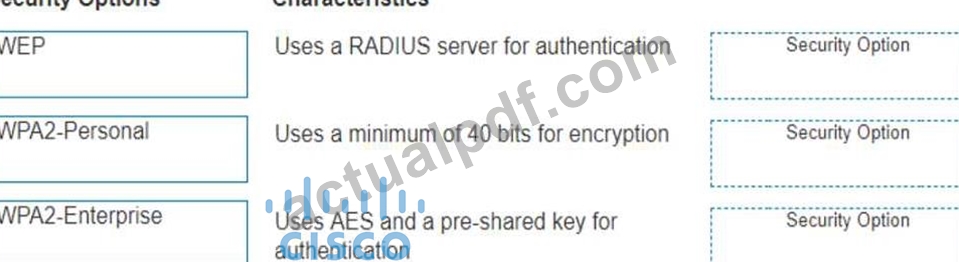
Answer:
Explanation: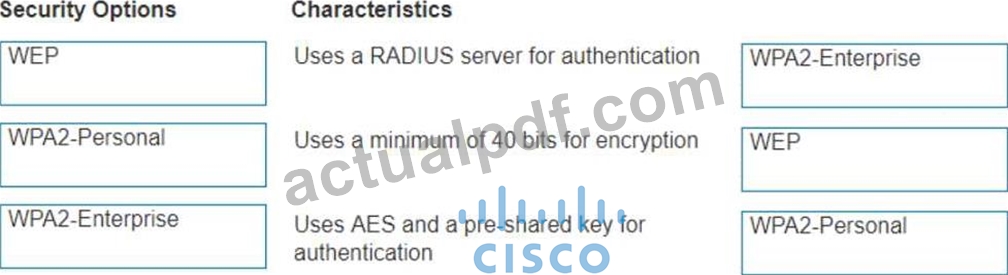
Explanation:
The correct matching of the security options to their characteristics is as follows:
WPA2-Enterprise: Uses a RADIUS server for authentication
WEP: Uses a minimum of 40 bits for encryption
WPA2-Personal: Uses AES and a pre-shared key for authentication
Here's why each security option matches the characteristic:
WPA2-Enterprise uses a RADIUS server for authentication, which provides centralized Authentication, Authorization, and Accounting (AAA) management for users who connect and use a network service.
WEP (Wired Equivalent Privacy) is an outdated security protocol that uses a minimum of 40 bits for encryption (and up to 104 bits), which is relatively weak by today's standards.
WPA2-Personal (Wi-Fi Protected Access 2 - Personal) uses the Advanced Encryption Standard (AES) for encryption and a pre-shared key (PSK) for authentication, which is shared among users to access the network.
These security options are essential for protecting wireless networks from unauthorized access and ensuring data privacy.
NEW QUESTION # 21
How does low bandwidth affect network performance?
- A. Decreases latency
- B. Has no effect on latency
- C. Increases latency
- D. Increases throughput
Answer: C
NEW QUESTION # 22
Examine the connections shown in the following image. Move the cable types on the right to the appropriate connection description on the left. You may use each cable type more than once or not at all.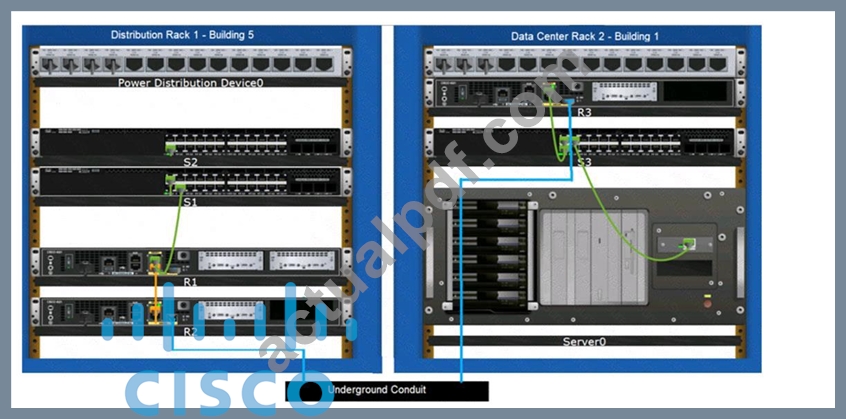
Answer:
Explanation: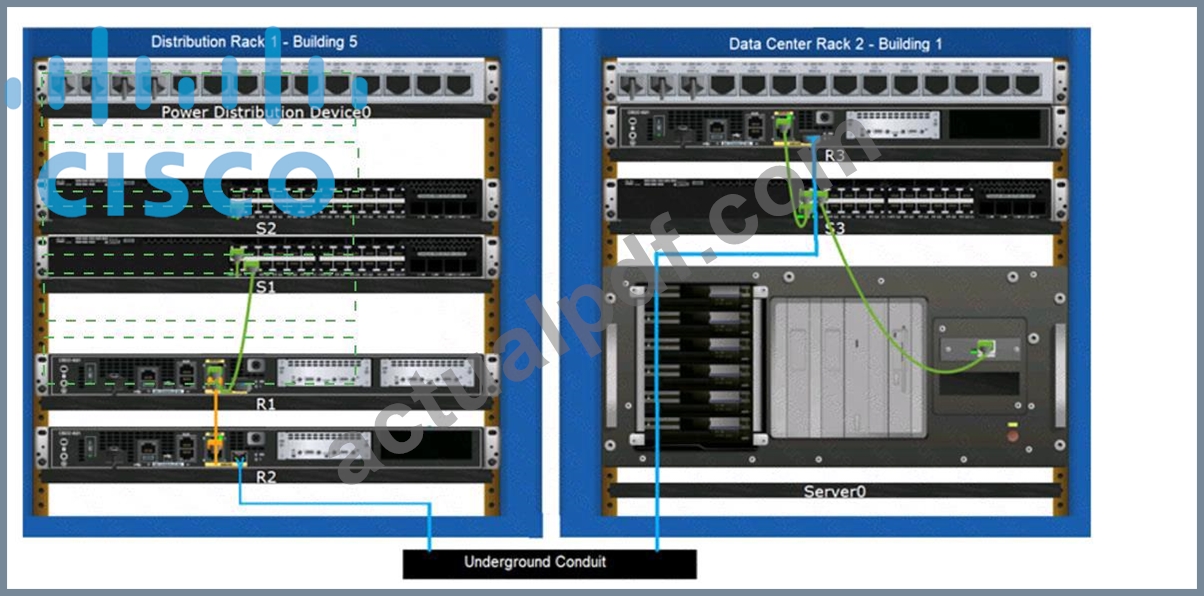
Explanation:
Based on the image description provided, here are the cable types matched with the appropriate connection descriptions:
Connects Switch S1 to Router R1 Gi0/0/1 interface Cable Type: = Straight-through UTP Cable Connects Router R2 Gi0/0/0 to Router R3 Gi0/0/0 via underground conduit Cable Type: = Fiber Optic Cable Connects Router R1 Gi0/0/0 to Router R2 Gi0/0/1 Cable Type: = Crossover UTP Cable Connects Switch S3 to Server0 network interface card Cable Type: = Straight-through UTP Cable The choices are based on standard networking practices where:
* Straight-through UTP cables are typically used to connect a switch to a router or a network interface card.
* Fiber optic cables are ideal for long-distance, high-speed data transmission, such as connections through an underground conduit.
* Crossover UTP cables are used to connect similar devices, such as router-to-router connections.
These matches are consistent with the color-coded cables in the image: green for switch connections, yellow for router-to-router connections within the same rack, and blue for inter-rack connections. The use of these cables follows the Ethernet cabling standards.
* Connects Switch S1 to Router R1 Gi0/0/1 interface:
* Cable Type: Straight-through UTP Cable
* Explanation: A straight-through UTP cable is typically used to connect different types of devices, such as a switch to a router.
* Connects Router R2 Gi0/0/0 to Router R3 Gi0/0/0 via underground conduit:
* Cable Type: Fiber Optic Cable
* Explanation: Fiber optic cables are used for long-distance connections, such as those through an underground conduit between buildings.
* Connects Router R1 Gi0/0/0 to Router R2 Gi0/0/1:
* Cable Type: Crossover UTP Cable
* Explanation: A crossover UTP cable is typically used to connect similar devices directly, such as router to router connections.
* Connects Switch S3 to Server0 network interface card:
* Cable Type: Straight-through UTP Cable
* Explanation: A straight-through UTP cable is typically used to connect a switch to an end device, such as a server.
* Straight-through UTP Cable: Used to connect different devices (e.g., switch to router, switch to server).
* Crossover UTP Cable: Used to connect similar devices directly (e.g., router to router, switch to switch).
* Fiber Optic Cable: Used for long-distance and high-speed connections, often between buildings or data centers.
References:
* Network Cable Types and Uses: Cisco Network Cables
* Understanding Ethernet Cabling: Ethernet Cable Guide
NEW QUESTION # 23
Which command will display all the current operational settings configured on a Cisco router?
- A. show version
- B. show protocols
- C. show running-config
- D. show startup-config
Answer: C
Explanation:
The show running-config command is used on a Cisco router to display the current operational settings that are actively configured in the router's RAM. This command outputs all the configurations that are currently being executed by the router, which includes interface configurations, routing protocols, access lists, and other settings. Unlike show startup-config, which shows the saved configuration that the router will use on the next reboot, show running-config reflects the live, current configuration in use.
Reference: = The information is supported by multiple sources that detail the use of Cisco commands, particularly the show running-config command as the standard for viewing the active configuration on a Cisco device123.
show running-config: This command displays the current configuration running on the router. It includes all the operational settings and configurations applied to the router.
show protocols: This command shows the status of configured protocols on the router but not the entire configuration.
show startup-config: This command displays the configuration saved in NVRAM, which is used to initialize the router on startup, but not necessarily the current running configuration.
show version: This command provides information about the router's software version, hardware components, and uptime but does not display the running configuration.
Reference: Cisco IOS Commands: Cisco IOS Commands
NEW QUESTION # 24
DRAG DROP
Move each cloud computing service model from the list on the left to the correct example on the right. Note: You will receive partial credit for each correct answer.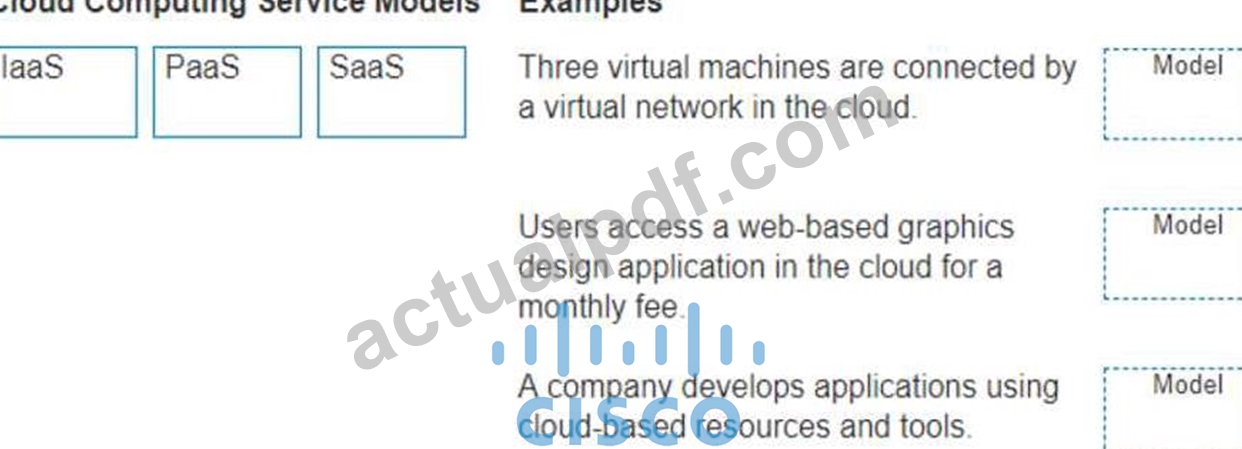
Answer:
Explanation: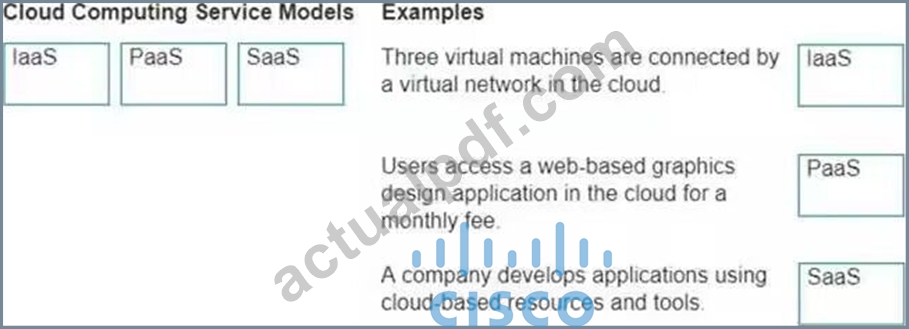
Explanation:
Three virtual machines are connected by a virtual network in the cloud.
Model: IaaS (Infrastructure as a Service)
IaaS provides virtualized computing resources over the internet, including virtual machines, storage, and networks.
Users access a web-based graphics design application in the cloud for a monthly fee.
Model: SaaS (Software as a Service)
SaaS delivers software applications over the internet, typically on a subscription basis, accessible via a web browser.
A company develops applications using cloud-based resources and tools. Model: PaaS (Platform as a Service)
PaaS provides a platform allowing customers to develop, run, and manage applications without dealing with the infrastructure.
IaaS (Infrastructure as a Service): Provides virtualized hardware resources that customers can use to build their own computing environments.
PaaS (Platform as a Service): Offers a platform with tools and services to develop, test, and deploy applications.
SaaS (Software as a Service): Delivers fully functional applications over the internet that users can access and use without managing the underlying infrastructure.
Reference: Cloud Service Models: Understanding IaaS, PaaS, SaaS
NIST Definition of Cloud Computing: NIST Cloud Computing
NEW QUESTION # 25
What is the primary use of ICMP in network management?
- A. Secure file transfer
- B. Error reporting and diagnostics
- C. Assigning IP addresses
- D. Translating domain names to IP addresses
Answer: B
NEW QUESTION # 26
Which two statements are true about the IPv4 address of the default gateway configured on a host? (Choose 2.) Note: You will receive partial credit for each correct selection.
- A. The IPv4 address of the default gateway must be the first host address in the subnet.
- B. The default gateway is the IPv4 address of the router interface connected to the same local network as the host.
- C. Hosts learn the default gateway IPv4 address through router advertisement messages.
- D. The same default gateway IPv4 address is configured on each host on the local network.
- E. The default gateway is the Loopback0 interface IPv4 address of the router connected to the same local network as the host.
Answer: B,D
Explanation:
*Statement B: "The same default gateway IPv4 address is configured on each host on the local network." This is true because all hosts on the same local network (subnet) use the same default gateway IP address to send packets destined for other networks.
*Statement D: "The default gateway is the IPv4 address of the router interface connected to the same local network as the host." This is true because the default gateway is the IP address of the router's interface that is directly connected to the local network.
*Statement A: "The IPv4 address of the default gateway must be the first host address in the subnet." This is not necessarily true. The default gateway can be any address within the subnet range.
*Statement C: "The default gateway is the Loopback0 interface IPv4 address of the router connected to the same local network as the host." This is not true; the default gateway is the IP address of the router's physical or logical interface connected to the local network.
*Statement E: "Hosts learn the default gateway IPv4 address through router advertisement messages." This is generally true for IPv6 with Router Advertisement (RA) messages, but not typically how IPv4 hosts learn the default gateway address.
References:
*Cisco Default Gateway Configuration: Cisco Default Gateway
NEW QUESTION # 27
Which protocol allows you to securely upload files to another computer on the internet?
- A. NTP
- B. SFTP
- C. HTTP
- D. ICMP
Answer: B
Explanation:
SFTP, or Secure File Transfer Protocol, is a protocol that allows for secure file transfer capabilities between networked hosts. It is a secure extension of the File Transfer Protocol (FTP). SFTP encrypts both commands and data, preventing passwords and sensitive information from being transmitted openly over the network. It is typically used for secure file transfers over the internet and is built on the Secure Shell (SSH) protocol1.
Reference: =
* What Is SFTP? (Secure File Transfer Protocol)
* How to Use SFTP to Safely Transfer Files: A Step-by-Step Guide
* Secure File Transfers: Best Practices, Protocols And Tools
The Secure File Transfer Protocol (SFTP) is a secure version of the File Transfer Protocol (FTP) that uses SSH (Secure Shell) to encrypt all commands and data. This ensures that sensitive information, such as usernames, passwords, and files being transferred, are securely transmitted over the network.
* ICMP (Internet Control Message Protocol) is used for network diagnostics and is not designed for file transfer.
* NTP (Network Time Protocol) is used to synchronize clocks between computer systems and is not related to file transfer.
* HTTP (HyperText Transfer Protocol) is used for transmitting web pages over the internet and does not inherently provide secure file transfer capabilities.
Thus, the correct protocol that allows secure uploading of files to another computer on the internet is SFTP.
Reference: =
* Cisco Learning Network
* SFTP Overview (Cisco)
NEW QUESTION # 28
A help desk technician receives the four trouble tickets listed below.
Which ticket should receive the highest priority and be addressed first?
- A. Ticket 3: A user reports that response time for a cloud-based application is slower than usual.
- B. Ticket 2: An online webinar is taking place in the conference room. The video conferencing equipment lost internet access.
- C. Ticket 4: Two users report that wireless access in the cafeteria has been down for the last hour.
- D. Ticket 1: A user requests relocation of a printer to a different network jack in the same office. The jack must be patched and made active.
Answer: B
Explanation:
When prioritizing trouble tickets, the most critical issues affecting business operations or high-impact activities should be addressed first.
Here's a breakdown of the tickets:
Ticket 1: Relocation of a printer, while necessary, is not urgent and does not impact critical operations.
Ticket 2: An ongoing webinar losing internet access is critical, especially if the webinar is time-sensitive and involves multiple participants.
Ticket 3: Slower response time for a cloud-based application is important but typically not as urgent as a complete loss of internet access for a live event.
Ticket 4: Wireless access down in the cafeteria affects users but does not have the same immediate impact as a live webinar losing connectivity.
Thus, the correct answer is B. Ticket 2: An online webinar is taking place in the conference room. The video conferencing equipment lost internet access.
Reference: =
IT Help Desk Best Practices
Prioritizing IT Support Tickets
NEW QUESTION # 29
DRAG DROP
Move each protocol from the list on the left to its correct example on the right.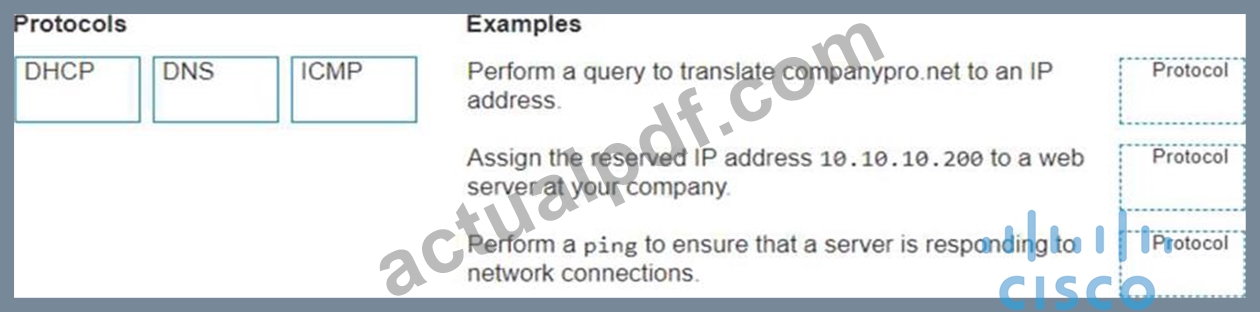
Answer:
Explanation: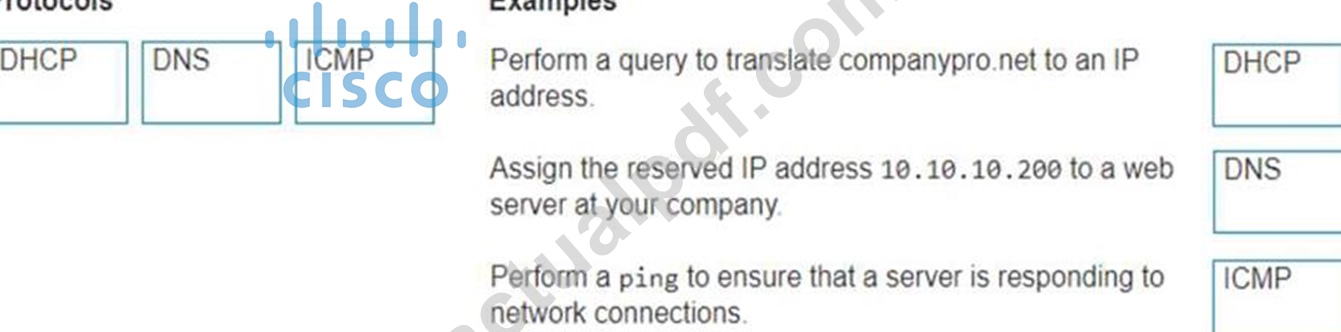
Explanation:
The correct matching of the protocols to their examples is as follows:
DHCP: Assign the reserved IP address 10.10.10.200 to a web server at your company.
DNS: Perform a query to translate companypro.net to an IP address.
ICMP: Perform a ping to ensure that a server is responding to network connections.
Here's how each protocol corresponds to its example:
DHCP (Dynamic Host Configuration Protocol) is used to assign IP addresses to devices on a network.
In this case, DHCP would be used to assign the reserved IP address 10.10.10.200 to a web server.
DNS (Domain Name System) is used to translate domain names into IP addresses. Therefore, to translate companypro.net to an IP address, DNS would be utilized.
ICMP (Internet Control Message Protocol) is used for sending error messages and operational information indicating success or failure when communicating with another IP address. An example of this is using the ping command to check if a server is responding to network connections.
These protocols are essential for the smooth operation of networks and the internet.
Perform a query to translate companypro.net to an IP address.
DNS (Domain Name System): DNS is used to resolve domain names to IP addresses.
Assign the reserved IP address 10.10.10.200 to a web server at your company.
DHCP (Dynamic Host Configuration Protocol): DHCP is used to assign IP addresses to devices on a network.
Perform a ping to ensure that a server is responding to network connections.
ICMP (Internet Control Message Protocol): ICMP is used by network devices to send error messages and operational information, and it is the protocol used by the ping command.
DNS (Domain Name System): DNS translates human-friendly domain names like "companypro.net" into IP addresses that computers use to identify each other on the network.
DHCP (Dynamic Host Configuration Protocol): DHCP automatically assigns IP addresses to devices on a network, ensuring that no two devices have the same IP address.
ICMP (Internet Control Message Protocol): ICMP is used for diagnostic or control purposes, and the ping command uses ICMP to test the reachability of a host on an IP network.
Reference: DNS Basics: What is DNS?
DHCP Overview: What is DHCP?
ICMP and Ping: Understanding ICMP
NEW QUESTION # 30
HOTSPOT
You plan to use a network firewall to protect computers at a small office. For each statement about firewalls, select True or False.
Note: You will receive partial credit for each correct selection.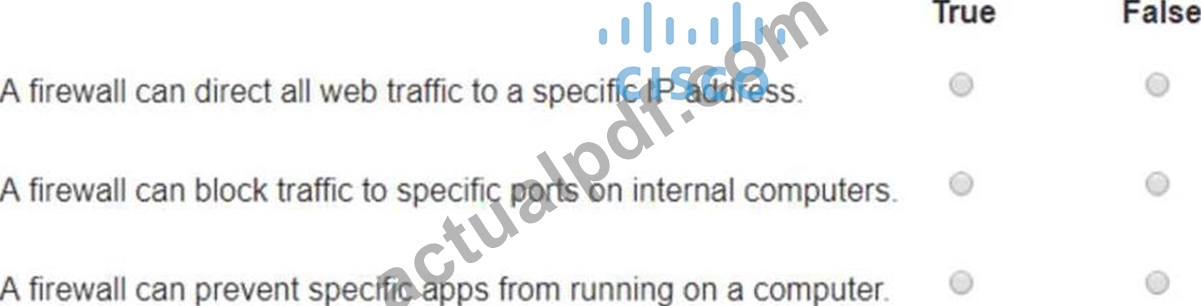
Answer:
Explanation: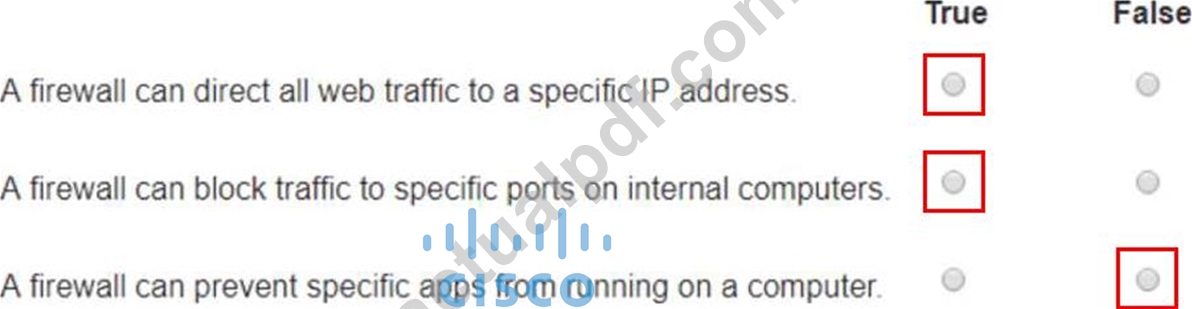
Explanation:
A firewall can direct all web traffic to a specific IP address.
True: Firewalls can be configured to perform Network Address Translation (NAT) and port forwarding, which can direct all web traffic (typically on port 80 and 443) to a specific internal IP address.
A firewall can block traffic to specific ports on internal computers.
True: Firewalls can be configured with access control lists (ACLs) or rules to block traffic to specific ports on internal computers, enhancing security by restricting unwanted or harmful traffic.
A firewall can prevent specific apps from running on a computer.
False: Firewalls typically control traffic flow and do not prevent specific applications from running on a computer. Application control is usually managed by endpoint security software or application control systems.
Directing Web Traffic: Firewalls can manage traffic redirection using NAT and port forwarding rules to route web traffic to designated servers or devices within the network.
Blocking Specific Ports: Firewalls can enforce security policies by blocking or allowing traffic based on port numbers, ensuring that only permitted traffic reaches internal systems.
Application Control: While firewalls manage network traffic, preventing applications from running typically requires software specifically designed for endpoint protection and application
management.
Reference: Understanding Firewalls: Firewall Capabilities
Network Security Best Practices: Network Security Guide
NEW QUESTION # 31
Which component of the AAA service security model provides identity verification?
- A. Auditing
- B. Authentication
- C. Accounting
- D. Authorization
Answer: B
Explanation:
The AAA service security model consists of three components: Authentication, Authorization, and Accounting.
*Authentication: This is the process of verifying the identity of a user or device. It ensures that only legitimate users can access the network or service.
*Authorization: This determines what an authenticated user is allowed to do or access within the network.
*Auditing/Accounting: This component tracks the actions of the user, including what resources they access and what changes they make.
Thus, the correct answer is C. Authentication.
References :=
*Cisco AAA Overview
*Understanding AAA (Authentication, Authorization, and Accounting)
NEW QUESTION # 32
Which component of the AAA service security model provides identity verification?
- A. Auditing
- B. Authentication
- C. Accounting
- D. Authorization
Answer: B
Explanation:
The AAA service security model consists of three components:
Authentication, Authorization, and Accounting.
* Authentication: This is the process of verifying the identity of a user or device. It ensures that only legitimate users can access the network or service.
* Authorization: This determines what an authenticated user is allowed to do or access within the network.
* Auditing/Accounting: This component tracks the actions of the user, including what resources they access and what changes they make.
Thus, the correct answer is C. Authentication.
Reference: =
* Cisco AAA Overview
* Understanding AAA (Authentication, Authorization, and Accounting)
NEW QUESTION # 33
Which wireless security option uses a pre-shared key to authenticate clients?
- A. WPA2-Personal
- B. WPA2-Enterprise
- C. 802.1q
- D. 802.1x
Answer: A
Explanation:
WPA2-Personal, also known as WPA2-PSK (Pre-Shared Key), is the wireless security option that uses a pre-shared key to authenticate clients. This method is designed for home and small office networks and doesn't require an authentication server. Instead, every user on the network uses the same key or passphrase to connect1.
Reference: =
* What is a Wi-Fi Protected Access Pre-Shared Key (WPA-PSK)?
* Exploring WPA-PSK and WiFi Security
* WPA2-Personal: This wireless security option uses a pre-shared key (PSK) for authentication. Each client that connects to the network must use this key to gain access. It is designed for home and small office networks where simplicity and ease of use are important.
* WPA2-Enterprise: Unlike WPA2-Personal, WPA2-Enterprise uses 802.1x authentication with an authentication server (such as RADIUS) and does not rely on a pre-shared key.
* 802.1x: This is a network access control protocol for LANs, particularly wireless LANs. It provides an authentication mechanism to devices wishing to attach to a LAN or WLAN.
* 802.1q: This is a networking standard that supports VLAN tagging on Ethernet networks and is not related to wireless security.
Reference:
* Cisco Documentation on WPA2 Security: Cisco WPA2
* Understanding Wireless Security: Wireless Security Guide
NEW QUESTION # 34
Which address is included in the 192.168.200.0/24 network?
- A. 192.168.201.13
- B. 192.168.200.13
- C. 192.168.199.13
- D. 192.168.1.13
Answer: B
Explanation:
*192.168.200.0/24 Network: This subnet includes all addresses from 192.168.200.0 to 192.168.200.255. The
/24 indicates a subnet mask of 255.255.255.0, which allows for 256 addresses.
*192.168.199.13: This address is in the 192.168.199.0/24 subnet, not the 192.168.200.0/24 subnet.
*192.168.200.13: This address is within the 192.168.200.0/24 subnet.
*192.168.201.13: This address is in the 192.168.201.0/24 subnet, not the 192.168.200.0/24 subnet.
*192.168.1.13: This address is in the 192.168.1.0/24 subnet, not the 192.168.200.0/24 subnet.
References:
*Subnetting Guide: Subnetting Basics
NEW QUESTION # 35
......
100% Free CCST 100-150 Dumps PDF Demo Cert Guide Cover: https://examsboost.actualpdf.com/100-150-real-questions.html
