

Exam Passing Guarantee Jun 28, 2025 TDS-C01 Exam with Accurate Quastions!
Test Engine to Practice Test for TDS-C01 Valid and Updated Dumps
Obtaining the Tableau Desktop Specialist certification through the TDS-C01 exam can benefit your career by demonstrating to employers and colleagues that you are proficient in using Tableau Desktop to analyze and visualize data. Tableau Desktop Specialist certification can also help you stand out in a competitive job market and increase your earning potential. Additionally, the knowledge and skills you gain from preparing for the exam can enhance your ability to analyze data and communicate insights effectively.
Tableau TDS-C01 certification is a great way to demonstrate your expertise in using Tableau Desktop, which is one of the most popular data visualization and business intelligence tools in the market today. The Tableau TDS-C01 exam is designed to test your knowledge and skills in various areas of Tableau Desktop, including data preparation, data analysis, visualization, and collaboration. Passing TDS-C01 exam can help you advance your career as a data analyst, business intelligence professional, or data scientist.
NEW QUESTION # 158
When creating an extract, what are three options for specifying how much data to extract? Choose three.
- A. Aggregate data for visible dimensions
- B. Compute Calculations Now.
- C. Hide all unused fields.
- D. Apply a filter.
- E. Append Data from Files
Answer: A,C,D
Explanation:
When creating an extract in Tableau, there are several options to control how much data is included in the extract. These options include hiding all unused fields to reduce the size of the extract, aggregating the data for visible dimensions to summarize it, and applying filters to extract only the data that meets certain criteria.
NEW QUESTION # 159
Which data type in Tableau does this icon represent?
Larger image
- A. String
- B. Boolean
- C. True or False
- D. Geographic
Answer: D
Explanation:
The following is the table for the data types in Tableau along with their icons: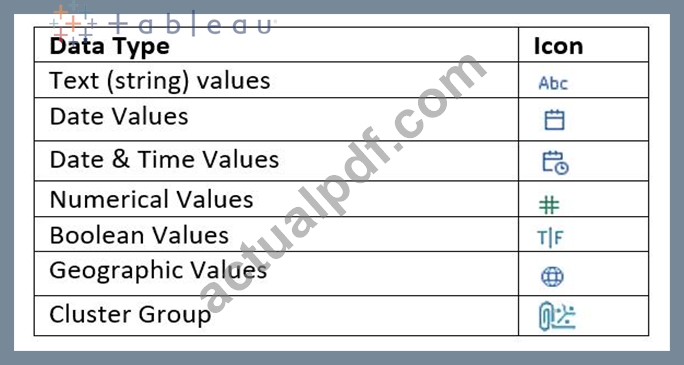
NEW QUESTION # 160
By default, measures placed in a view are aggregated. The type of aggregation applied ______________
- A. is always COUNT
- B. depends on the context of the view
- C. is always sum
- D. is always AVERAGE
Answer: B
Explanation:
By default, measures placed in a view are aggregated. Mostly you'll notice that the aggregation is SUM, but not ALWAYS.
The type of aggregation applied varies depending on the context of the view.
NEW QUESTION # 161
__________ is a technique in Tableau which will identify marks with similar characteristics
- A. Sets
- B. Clustering
- C. Grouping
- D. Union
Answer: B
Explanation:
Cluster analysis partitions marks in the view into clusters, where the marks within each cluster are more similar to one another than they are to marks in other clusters.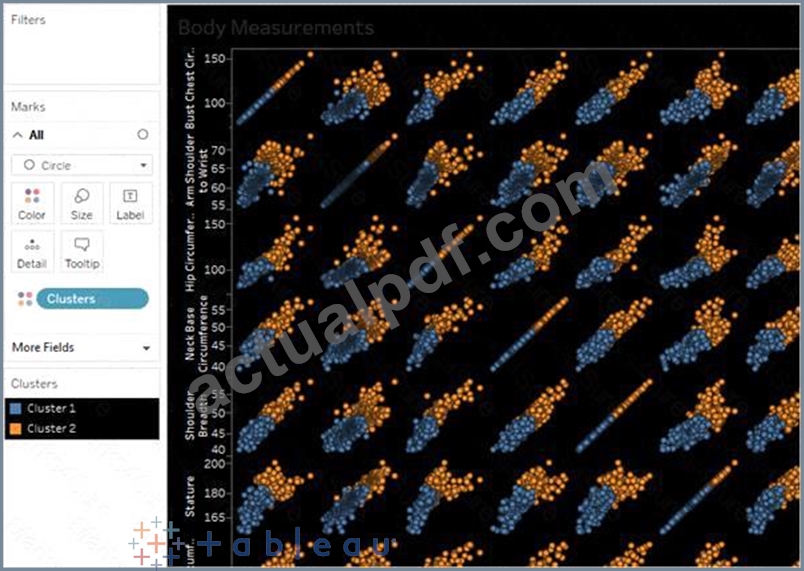
NEW QUESTION # 162
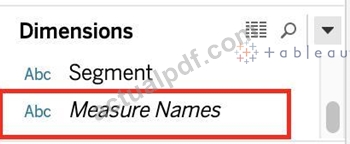
Which one of the following is a dimension?
- A. Measure Names
- B. Latitude
- C. Number of records
- D. Longitude
Answer: A
Explanation:
Explanation
Measure Names is a dimension. Latitude, Longitude, and Number of records are all measures.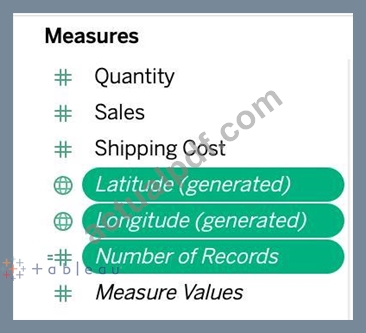
NEW QUESTION # 163
_________________ is useful when you need to change how the data source is configured on a sheet-by-sheet basis, and when you want to combine databases that don't allow relationships or joins
- A. Data Joining
- B. Data Blending
- C. Data segregation
- D. Union
Answer: B
Explanation:
Data blending is performed on a sheet-by-sheet basis and is established when a field from a second data source is used in the view. To create a blend in a workbook already connected to at least two data sources, bring a field from one data source to the sheet-it becomes the primary data source.
Switch to the other data source and use a field on the same sheet-it becomes a secondary data source. An orange linking icon will appear in the data pane, indicating which field(s) are being used to blend the data sources.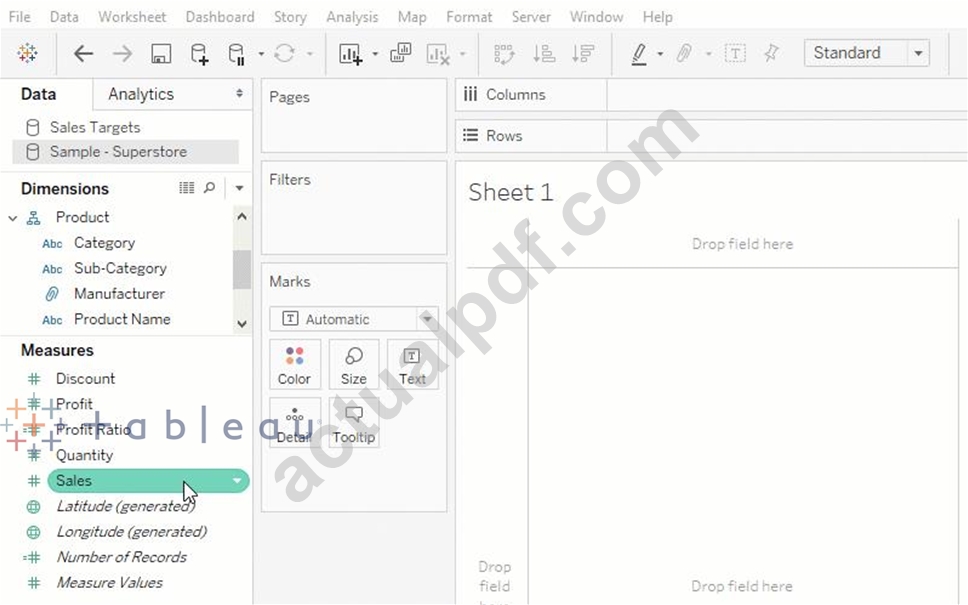
According to the official Tableau Documentation: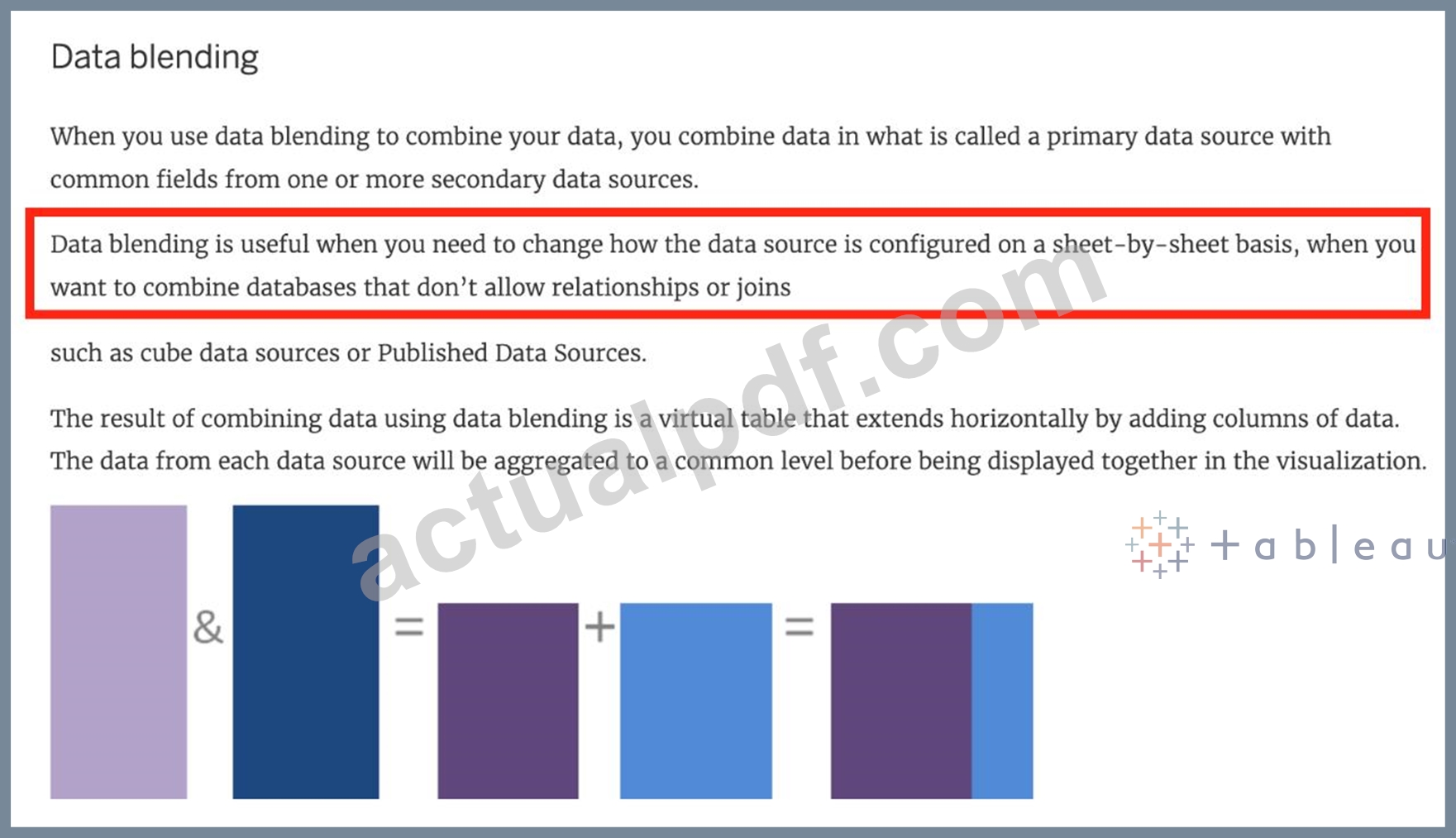
To read more about Data Blending, click on THIS link.
NEW QUESTION # 164
How can you format an axis as Bold in Tableau?
- A. By right clicking on the axis, choosing Edit Axis, and then setting its font to bold.
- B. By clicking on Format on the main menu bar, choosing field labels, and setting it to bold.
- C. By choosing the axis and selecting Command/Control + B on your keyboard
- D. By right clicking on the axis, choosing format, and then setting its font to bold.
Answer: D
NEW QUESTION # 165
Which of the following is true about 'Incremental refresh' when creating Extracts in Tableau?
- A. There is no difference, both are the same when using extracts. They are different when using live connections.
- B. It only adds rows that are new since the previous refresh.
- C. They can only be used with large datasets
- D. It replaces all of the contents in the extract
Answer: B
Explanation:
Extracts are saved subsets of data that you can use to improve performance or to take advantage of Tableau functionality not available or supported in your original data. When you create an extract of your data, you can reduce the total amount of data by using filters and configuring other limits. After you create an extract, you can refresh it with data from the original data.
When refreshing the data, you have the option to either do a full refresh, which replaces all of the contents in the extract, or you can do an incremental refresh, which only adds rows that are new since the previous refresh.
NEW QUESTION # 166
Which of the following are true about Dashboards in Tableau?
- A. Floating items can be layered over other objects
- B. A bar chart can be used a floating item
- C. Tiled items don't overlap
- D. None of these
Answer: A,B,C
Explanation:
From the official Tableau documentation: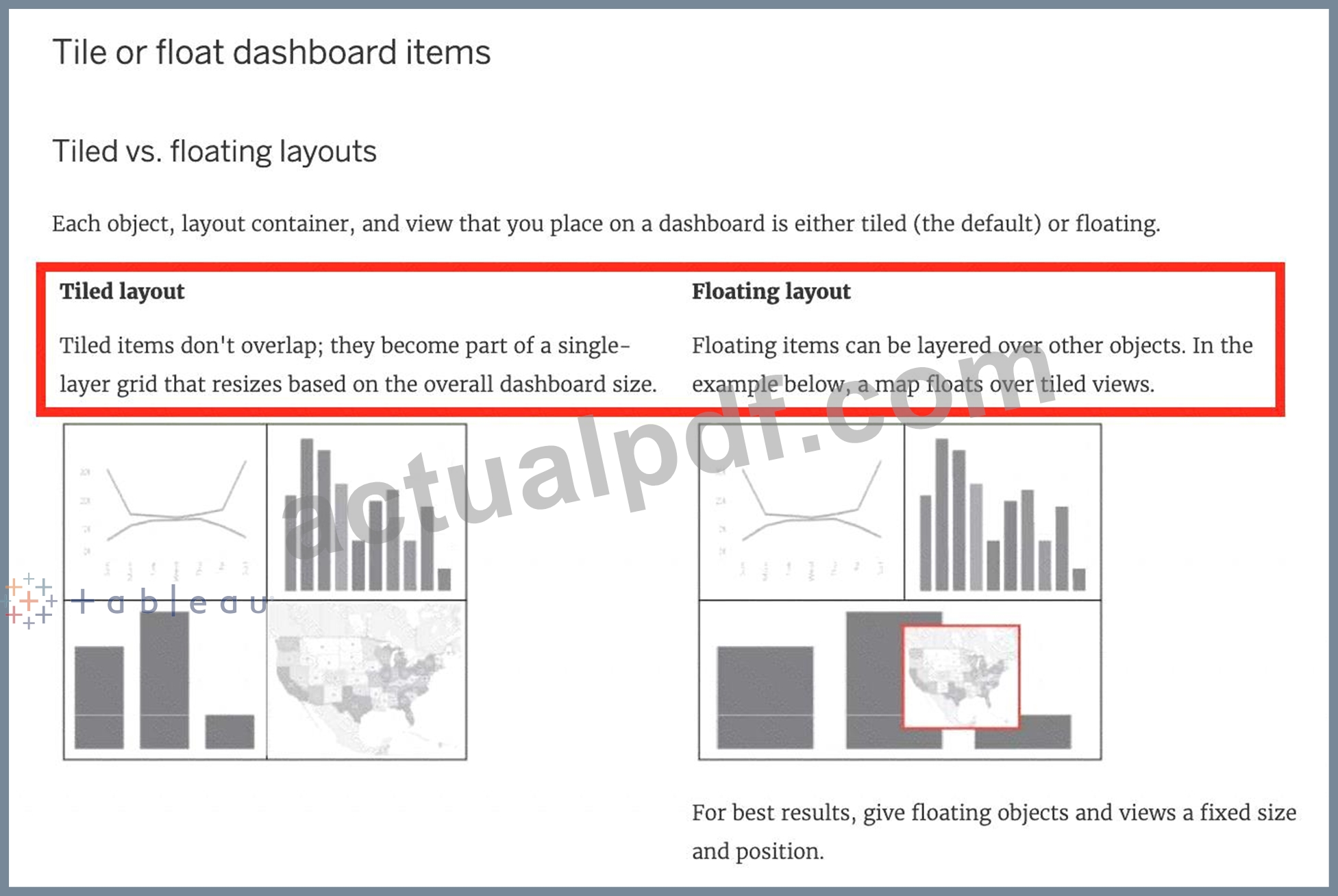
As we can see below, Bar charts can be used as a floating object.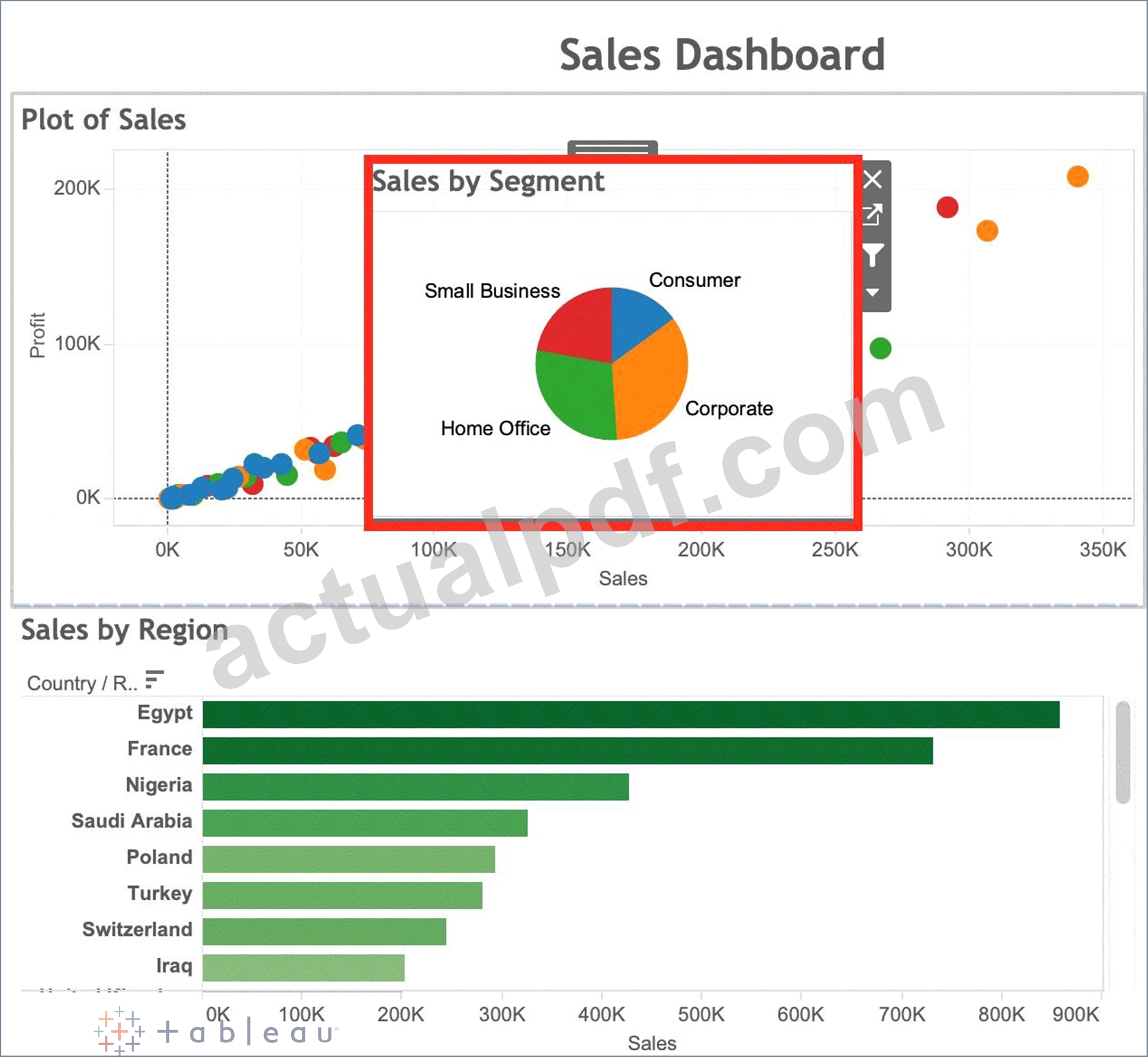
NEW QUESTION # 167
By default, measures placed in a view are aggregated by ______________
- A. COUNT
- B. MEDIAN
- C. AVERAGE
- D. SUM
Answer: D
Explanation:
Explanation
By default, measures placed in a view are aggregated by SUM, which means that the data for that field in all of the rows is combined. Measures can also be aggregated as average, median, count, or count distinct.
NEW QUESTION # 168
Using the Time Series Table, create a Line chart showing the Monthly Year over Year Growth for the Sales, broken down by Assortment. For the Electronics assortment, which Month had the most NEGATIVE value of Year over Year Growth?
Using the Time Series Table, create a Line chart showing the Monthly Year over Year Growth for the Sales, broken down by Assortment. For the Electronics assortment, which Month had the most NEGATIVE value of Year over Year Growth?
- A. September
- B. June
- C. July
- D. October
Answer: D
Explanation:
Follow along:
1) Drag Assortment and Year ID (choose Discrete Month) to Columns shelf, and Sales to the Columns Shelf.
For sales, click on the pill -> choose Quick Table calculation -> Year over Year growth.
The view should now look like: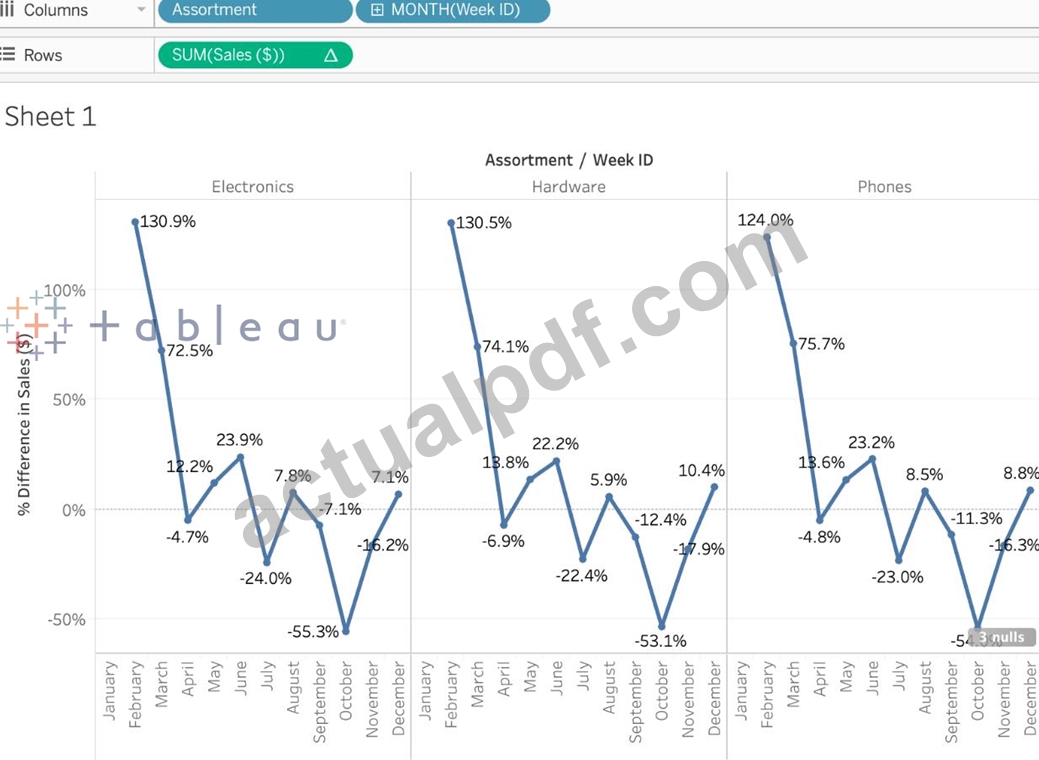
It is clear that October with -55.3% had the lowest Year on Year growth.
NEW QUESTION # 169
Yes or No: The number of marks will increase when you increase the number of Dimensions in a view
- A. Yes
- B. No
Answer: A
Explanation:
Of course! As an example, see below:
1) Using the Sample Superstore data, let's plot a bar chart showing the Sales for each Category: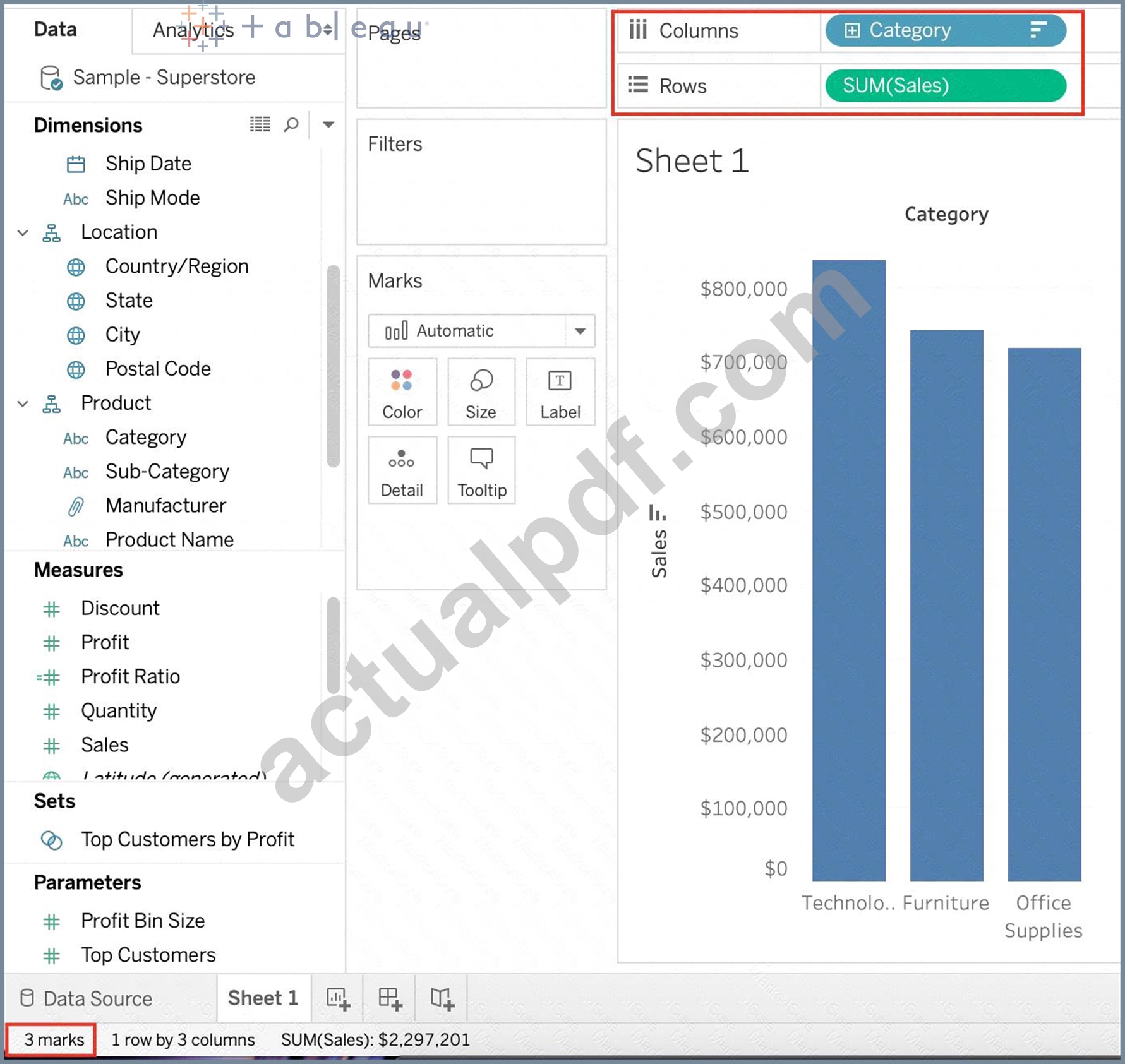
Observe that we have 3 marks - Each bar in a bar chart is called a mark. Similarly, each point in a scatter plot is also a mark , and so on for all charts.
1 row by 3 columns means that clearly on the y-axis (Sales), we have only a single mark - a single continous axis, but 3 different marks (Technology, Furniture and Office supplies ) on the x-axis.
2) Now let's add subcategory to the view as well (another dimension):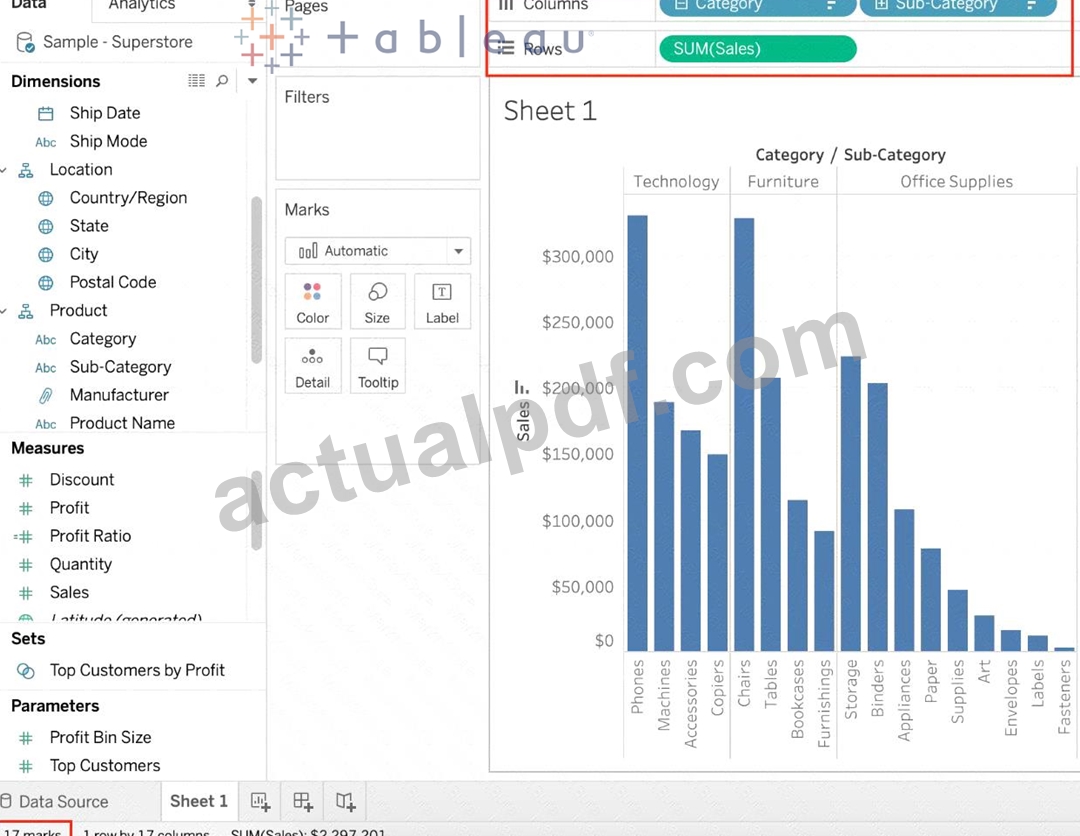
Observe that the number of marks has increased - i.e the number of Bars.
Also, notice we now have 1 row and 17 columns. Simply because 1 row = Sales (on the y-axis), and on the x-axis, we have 17 different columns (i.e product sub categories!!)
NEW QUESTION # 170
________________ is hosted by Tableau to share our visualisations publically with the world.
- A. Tableau Public
- B. Tableau Server
- C. Tableau Reader
- D. Tableau Desktop
Answer: A
Explanation:
Tableau Public is a free service that lets anyone publish interactive data visualizations to the web. Visualizations that have been published to Tableau Public ("vizzes") can be embedded into web pages and blogs, they can be shared via social media or email, and they can be made available for download to other users.
Check it out : https://public.tableau.com/en-us/s/
NEW QUESTION # 171
Which of the following are valid ways to make the font more readable in Tableau?
- A. Don't use backgrounds
- B. Make the Font color sharper / darker than the background
- C. Increase the font size
- D. use a clear and readable font
- E. Decrease the font size
Answer: B,C,D
Explanation:
This is one of the most common questions on the Tableau Desktop Specialist Exam.
Wrong options -
1) Don't use backgrounds - This is not a solution. What if we want to use backgrounds? We can't just stop using backgrounds to solve this problem.
2) Decrease the font size - Do you think using a smaller font will make the text more readable? No right? Hence, this is wrong too.
All other options are ways recommended to make your text more readable!
NEW QUESTION # 172
Is it possible to make a Measure discrete?
- A. Yes
- B. No
Answer: A
Explanation:
Of course! Follow along:
Right click on any measure, and choose Discrete as shown: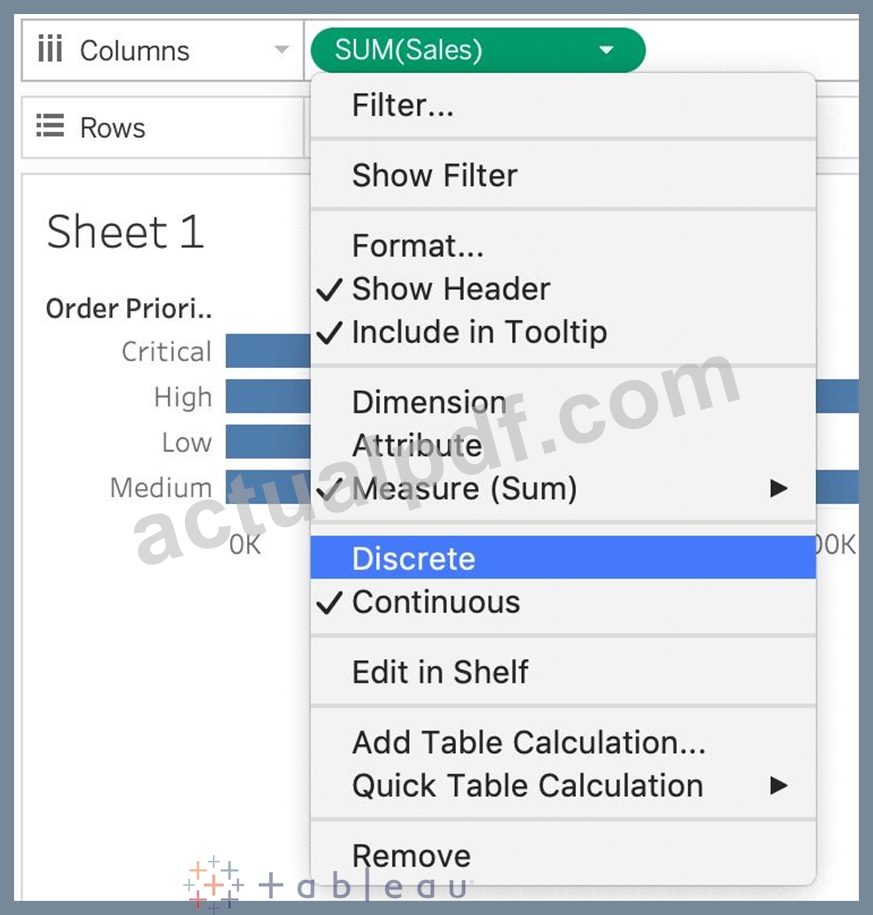
Once you do this, the green pill becomes blue in colour, indicating that it is now Discrete!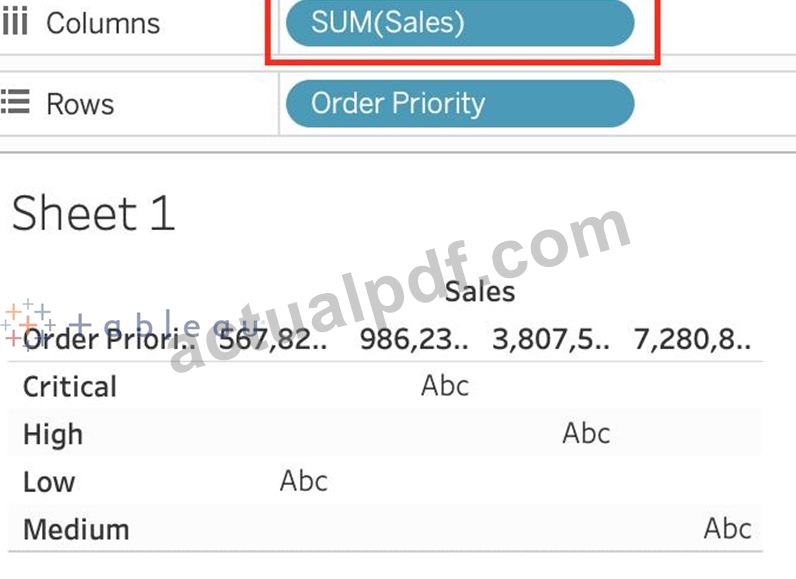
NEW QUESTION # 173
Which of the following are valid options to define the scope of a reference line? Choose 3.
- A. Axis
- B. Window
- C. cell
- D. Table
- E. Section
- F. Pane
Answer: C,D,F
Explanation:
When we create a reference line, we get the following 3 options for the scope:
Graphical user interface, chart Description automatically generated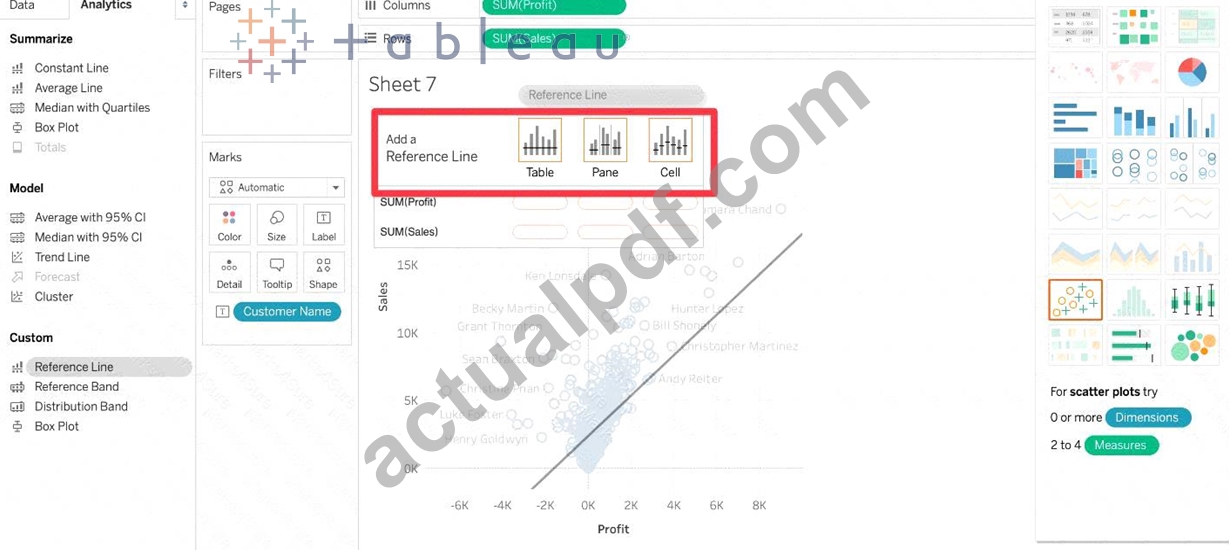
NEW QUESTION # 174
Which of the following is NOT a new feature introduced in Tableau 2020.1?
- A. Viz Animations
- B. Dynamic Paramaters
- C. Buffer Calculations
- D. Set Control
Answer: D
Explanation:
Explanation
Your Tableau Desktop Specialist exam will be based on the 2020.1 version.
Set controls are a new feature introduced in the 2020.2 version, and hence is the correct answer - it is not a part of 2020.1 For the 2020.1 version the new features were:
1) Viz animations:
Viz animations help you see and understand your changing data. It's easy to track the logical steps behind data's evolution and tell powerful data stories. Sorting, filtering, adding fields, and other actions will now smoothly animate your visualizations. Choose whether to turn Viz Animations on or off, and decide how you'd best like to apply animations to your new workbooks.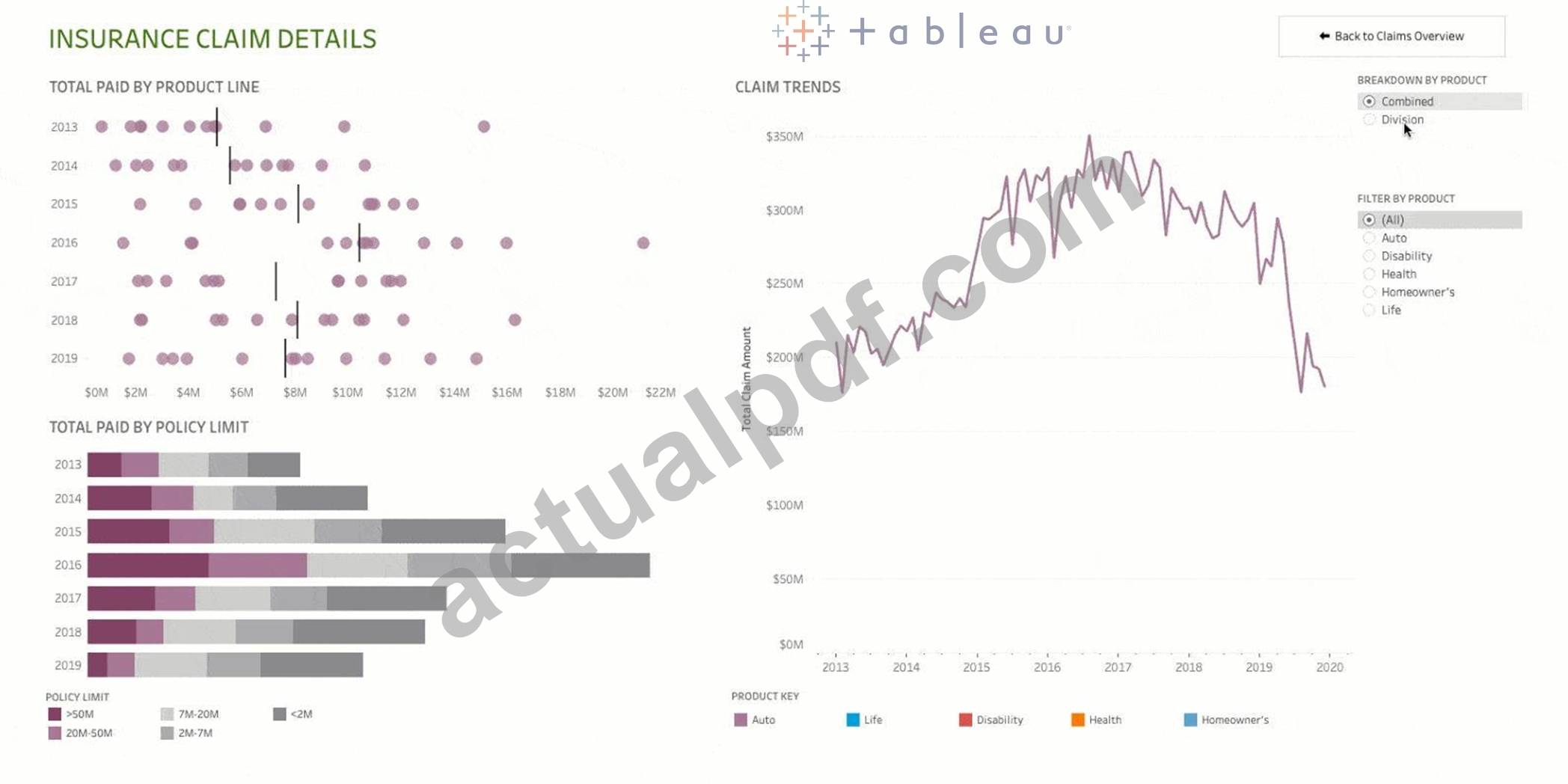
2) Dynamic Parameters:
Say goodbye to republishing workbooks with parameters every time the underlying data changes. Set your parameter once, and Tableau will automatically update the parameter's list of values every time someone opens the workbook.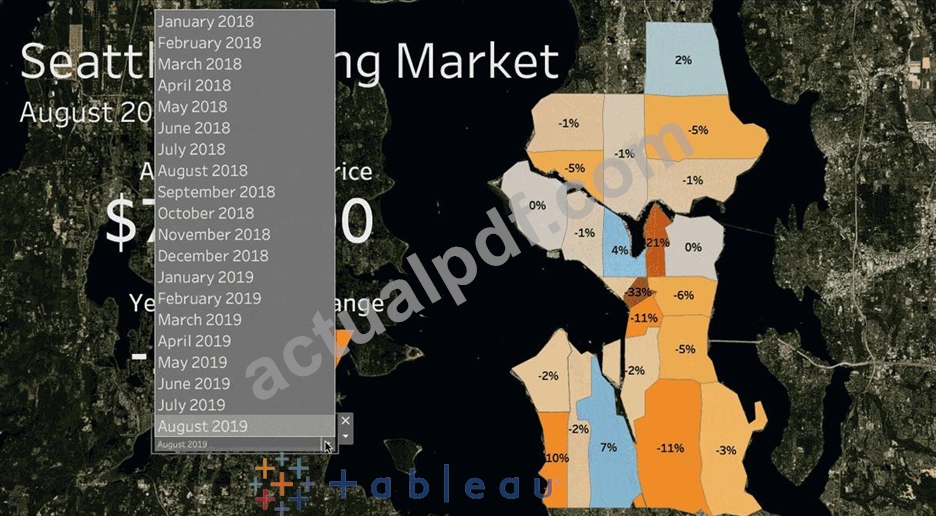
3) Buffer Calculations: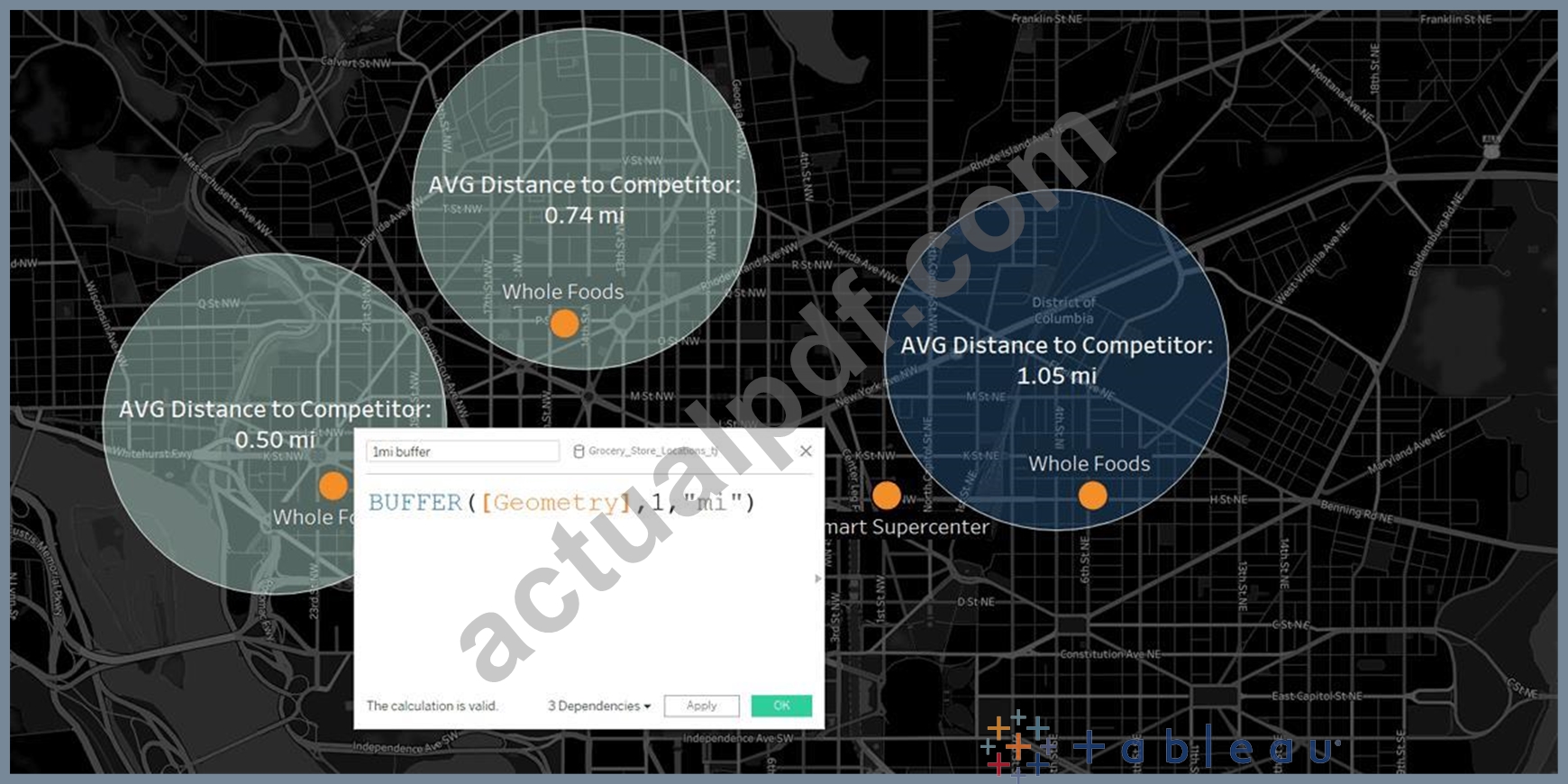
Buffer calculations allow you to visualize the distance around point locations. Give Tableau three parameters-location, distance, and a unit of measure-and a buffer, or boundary is instantly created.
Answering complex spatial questions becomes easier than ever before-visualize what properties are within
200 meters of a proposed transit site, or how many competitors' stores are within 1 mile of their store, and more.
NEW QUESTION # 175
......
Exam Questions for TDS-C01 Updated Versions With Test Engine: https://examsboost.actualpdf.com/TDS-C01-real-questions.html
