

Printable & Easy to Use SY0-701 Dumps 100% Same Q&A In Your Real Exam
SY0-701 Practice Test Give You First Time Success with 100% Money Back Guarantee!
NEW QUESTION # 148
Which of the following best describes the practice of researching laws and regulations related to information security operations within a specific industry?
- A. GDPR
- B. Attestation
- C. Due diligence
- D. Compliance reporting
Answer: C
Explanation:
Due diligence refers to the process of researching and understanding the laws, regulations, and best practices that govern information security within a specific industry. Organizations are required to conduct due diligence to ensure compliance with legal and regulatory requirements, which helps mitigate risks and avoid penalties.
* Compliance reporting involves generating reports to demonstrate adherence to legal or regulatory standards.
* GDPR is a specific regulation governing data privacy in the EU, not a general practice of researching laws.
* Attestation is a formal declaration that an organization is compliant with a set of standards but is not the act of researching the laws.
NEW QUESTION # 149
Which of the following provides the details about the terms of a test with a third-party penetration tester?
- A. Due diligence
- B. Rules of engagement
- C. Supply chain analysis
- D. Right to audit clause
Answer: B
Explanation:
Rules of engagement are the detailed guidelines and constraints regarding the execution of information security testing, such as penetration testing. They define the scope, objectives, methods, and boundaries of the test, as well as the roles and responsibilities of the testers and the clients. Rules of engagement help to ensure that the test is conducted in a legal, ethical, and professional manner, and that the results are accurate and reliable. Rules of engagement typically include the following elements:
* The type and scope of the test, such as black box, white box, or gray box, and the target systems, networks, applications, or data.
* The client contact details and the communication channels for reporting issues, incidents, or emergencies during the test.
* The testing team credentials and the authorized tools and techniques that they can use.
* The sensitive data handling and encryption requirements, such as how to store, transmit, or dispose of any data obtained during the test.
* The status meeting and report schedules, formats, and recipients, as well as the confidentiality and non- disclosure agreements for the test results.
* The timeline and duration of the test, and the hours of operation and testing windows.
* The professional and ethical behavior expectations for the testers, such as avoiding unnecessary damage, disruption, or disclosure of information.
Supply chain analysis, right to audit clause, and due diligence are not related to the terms of a test with a third- party penetration tester. Supply chain analysis is the process of evaluating the security and risk posture of the suppliers and partners in a business network. Right to audit clause is a provision in a contract that gives one party the right to audit another party to verify their compliance with the contract terms and conditions. Due diligence is the process of identifying and addressing the cyber risks that a potential vendor or partner brings to an organization.
References = https://www.yeahhub.com/every-penetration-tester-you-should-know-about-this-rules-of- engagement/
https://bing.com/search?q=rules+of+engagement+penetration+testing
NEW QUESTION # 150
Which of the following vulnerabilities is exploited when an attacker overwrites a register with a malicious address?
- A. VM escape
- B. SQL injection
- C. Race condition
- D. Buffer overflow
Answer: D
Explanation:
A buffer overflow is a vulnerability that occurs when an application writes more data to a memory buffer than it can hold, causing the excess data to overwrite adjacent memory locations. A register is a small storage area in the CPU that holds temporary data or instructions. An attacker can exploit a buffer overflow to overwrite a register with a malicious address that points to a shellcode, which is a piece of code that gives the attacker control over the system. By doing so, the attacker can bypass the normal execution flow of the application and execute arbitrary commands.
References: CompTIA Security+ SY0-701 Certification Study Guide, Chapter 2: Threats, Attacks, and Vulnerabilities, Section 2.3: Application Attacks, Page 76 1; Buffer Overflows - CompTIA Security+ SY0-
701 - 2.3 2
NEW QUESTION # 151
While considering the organization's cloud-adoption strategy, the Chief Information Security Officer sets a goal to outsource patching of firmware, operating systems, and applications to the chosen cloud vendor. Which of the following best meets this goal?
- A. Containerization
- B. Private cloud
- C. laaS
- D. PaaS
- E. Community cloud
- F. SaaS
Answer: F
Explanation:
Software as a Service (SaaS) is the cloud model that best meets the goal of outsourcing the management, including patching, of firmware, operating systems, and applications to the cloud vendor. In a SaaS environment, the cloud provider is responsible for maintaining and updating the entire software stack, allowing the organization to focus on using the software rather than managing its infrastructure.
Reference = CompTIA Security+ SY0-701 study materials, particularly the domains related to cloud security models.
NEW QUESTION # 152
A development team is launching a new public-facing web product. The Chief Information Security Officer has asked that the product be protected from attackers who use malformed or invalid inputs to destabilize the system. Which of the following practices should the development team implement?
- A. Continuous deployment
- B. Manual peer review
- C. Fuzzing
- D. Static code analysis
Answer: C
NEW QUESTION # 153
Which of the following is a primary security concern for a company setting up a BYOD program?
- A. VM escape
- B. End of life
- C. Jailbreaking
- D. Buffer overflow
Answer: C
Explanation:
Jailbreaking is a primary security concern for a company setting up a BYOD (Bring Your Own Device) program. Jailbreaking is the process of removing the manufacturer's or the carrier's restrictions on a device, such as a smartphone or a tablet, to gain root access and install unauthorized or custom software. Jailbreaking can compromise the security of the device and the data stored on it, as well as expose it to malware, viruses, or hacking. Jailbreaking can also violate the warranty and the terms of service of the device, and make it incompatible with the company's security policies and standards. Therefore, a company setting up a BYOD program should prohibit jailbreaking and enforce device compliance and encryption. Reference = CompTIA Security+ Study Guide with over 500 Practice Test Questions: Exam SY0-701, 9th Edition, Chapter 2, page 76. CompTIA Security+ SY0-701 Exam Objectives, Domain 2.4, page 11.
NEW QUESTION # 154
An employee from the accounting department logs in to a website. A desktop application automatically downloads on the employee's computer. Which of the following has occurred?
- A. XSS
- B. Typosquatting
- C. Watering hole
- D. Buffer overflow
Answer: C
Explanation:
This describes a watering hole attack, where an attacker compromises a website frequently visited by the target group and delivers malicious payloads, such as automatic downloads.
XSS (A) injects scripts into web pages, typosquatting (C) involves fake websites with misspelled URLs, and buffer overflow (D) exploits memory but does not involve website compromise with automatic downloads.
Watering hole attacks are well-known web-based threats covered in SY0-701#6:Chapter 2 CompTIA Security+ Study Guide#.
NEW QUESTION # 155
A user is attempting to patch a critical system, but the patch fails to transfer. Which of the following access controls is most likely inhibiting the transfer?
- A. Role-based
- B. Attribute-based
- C. Least privilege
- D. Time of day
Answer: C
Explanation:
The least privilege principle states that users and processes should only have the minimum level of access required to perform their tasks. This helps to prevent unauthorized or unnecessary actions that could compromise security. In this case, the patch transfer might be failing because the user or process does not have the appropriate permissions to access the critical system or the network resources needed for the transfer. Applying the least privilege principle can help to avoid this issue by granting the user or process the necessary access rights for the patching activity. Reference: CompTIA Security+ Study Guide: Exam SY0-701, 9th Edition, page 931
NEW QUESTION # 156
While updating the security awareness training, a security analyst wants to address issues created if vendors' email accounts are compromised. Which of the following recommendations should the security analyst include in the training?
- A. Require that invoices be sent as attachments.
- B. Be alert to unexpected requests from familiar email addresses.
- C. Delete emails from unknown service provider partners.
- D. Refrain from clicking on images included in emails from new vendors.
Answer: B
Explanation:
Compromised vendor email accounts often lead to business email compromise (BEC) attacks where attackers send malicious or unexpected requests appearing from trusted sources. Training users to be alert to unexpected requests even if they appear to come from familiar addresses is critical in preventing such attacks.
Refraining from clicking images (A) is less effective than being vigilant about suspicious content and requests. Deleting emails from unknown providers (B) is not practical, as some legitimate emails come from unknown senders. Requiring invoices as attachments (C) can increase risk by encouraging users to open potentially malicious attachments.
This user awareness tactic is emphasized in the Security Program Management and Security Awareness training in SY0-701#6:Chapter 16 CompTIA Security+ Study Guide#.
NEW QUESTION # 157
A systems administrator receives a text message from an unknown number claiming to be the Chief Executive Officer of the company. The message states an emergency situation requires a password reset. Which of the following threat vectors is being used?
- A. Pretexting
- B. Impersonation
- C. Smishing
- D. Typosquatting
Answer: C
Explanation:
Detailed Explanation:Smishing is a type of phishing attack that uses SMS text messages to deceive recipients into taking actions such as revealing sensitive information. The urgency in the text indicates this vector.
Reference: CompTIA Security+ SY0-701 Study Guide, Domain 2: Threats, Section: "Social Engineering Techniques".
NEW QUESTION # 158
Which of the following security concepts is accomplished when granting access after an individual has logged into a computer network?
- A. Identification
- B. Authorization
- C. Non-repudiation
- D. Authentication
Answer: B
Explanation:
Detailed Authorization refers to the process of granting or denying specific rights to a user after verifying their identity through authentication. Reference: CompTIA Security+ SY0-701 Study Guide, Domain 1: General Security Concepts, Section: "Authentication, Authorization, and Accounting (AAA)".
NEW QUESTION # 159
A data administrator is configuring authentication for a SaaS application and would like to reduce the number of credentials employees need to maintain. The company prefers to use domain credentials to access new SaaS applications. Which of the following methods would allow this functionality?
- A. LEAP
- B. PEAP
- C. MFA
- D. SSO
Answer: D
Explanation:
Explanation
SSO stands for single sign-on, which is a method of authentication that allows users to access multiple applications or services with one set of credentials. SSO reduces the number of credentials employees need to maintain and simplifies the login process. SSO can also improve security by reducing the risk of password reuse, phishing, and credential theft. SSO can be implemented using various protocols, such as SAML, OAuth, OpenID Connect, and Kerberos, that enable the exchange of authentication information between different domains or systems. SSO is commonly used for accessing SaaS applications, such as Office 365, Google Workspace, Salesforce, and others, using domain credentials123.
B: LEAP stands for Lightweight Extensible Authentication Protocol, which is a Cisco proprietary protocol that provides authentication for wireless networks. LEAP is not related to SaaS applications or domain credentials4.
C: MFA stands for multi-factor authentication, which is a method of authentication that requires users to provide two or more pieces of evidence to prove their identity. MFA can enhance security by adding an extra layer of protection beyond passwords, such as tokens, biometrics, or codes. MFA is not related to SaaS applications or domain credentials, but it can be used in conjunction with SSO.
D: PEAP stands for Protected Extensible Authentication Protocol, which is a protocol that provides secure authentication for wireless networks. PEAP uses TLS to create an encrypted tunnel between the client and the server, and then uses another authentication method, such as MS-CHAPv2 or EAP-GTC, to verify the user's identity. PEAP is not related to SaaS applications or domain credentials.
References = 1: Security+ (SY0-701) Certification Study Guide | CompTIA IT Certifications 2: What is Single Sign-On (SSO)? - Definition from WhatIs.com 3: Single sign-on - Wikipedia 4: Lightweight Extensible Authentication Protocol - Wikipedia : What is Multi-Factor Authentication (MFA)? - Definition from WhatIs.com : Protected Extensible Authentication Protocol - Wikipedia
NEW QUESTION # 160
A company is required to use certified hardware when building networks. Which of the following best addresses the risks associated with procuring counterfeit hardware?
- A. An in-depth penetration test of all suppliers and vendors
- B. A legally enforceable corporate acquisition policy
- C. A right to audit clause in vendor contracts and SOWs
- D. A thorough analysis of the supply chain
Answer: D
Explanation:
Counterfeit hardware is hardware that is built or modified without the authorization of the original equipment manufacturer (OEM). It can pose serious risks to network quality, performance, safety, and reliability. Counterfeit hardware can also contain malicious components that can compromise the security of the network and the data that flows through it. To address the risks associated with procuring counterfeit hardware, a company should conduct a thorough analysis of the supply chain, which is the network of entities involved in the production, distribution, and delivery of the hardware. By analyzing the supply chain, the company can verify the origin, authenticity, and integrity of the hardware, and identify any potential sources of counterfeit or tampered products.
NEW QUESTION # 161
Which of the following is the best way to validate the integrity and availability of a disaster recovery site?
- A. Develop requirements for database encryption.
- B. Conduct a tabletop exercise.
- C. Periodically test the generators.
- D. Lead a simulated failover.
Answer: D
Explanation:
A simulated failover tests the disaster recovery site's ability to handle a full transition of services.
This ensures all systems can function as expected during an actual disaster.
NEW QUESTION # 162
A client asked a security company to provide a document outlining the project, the cost, and the completion time frame. Which of the following documents should the company provide to the client?
- A. SLA
- B. BPA
- C. MSA
- D. SOW
Answer: D
Explanation:
An ISOW is a document that outlines the project, the cost, and the completion time frame for a security company to provide a service to a client. ISOW stands for Information Security Operations Work, and it is a type of contract that specifies the scope, deliverables, milestones, and payment terms of a security project. An ISOW is usually used for one-time or short-term projects that have a clear and defined objective and outcome. For example, an ISOW can be used for a security assessment, a penetration test, a security audit, or a security training.
The other options are not correct because they are not documents that outline the project, the cost, and the completion time frame for a security company to provide a service to a client. A MSA is a master service agreement, which is a type of contract that establishes the general terms and conditions for a long-term or ongoing relationship between a security company and a client. A MSA does not specify the details of each individual project, but rather sets the framework for future projects that will be governed by separate statements of work (SOWs). A SLA is a service level agreement, which is a type of contract that defines the quality and performance standards for a security service provided by a security company to a client. A SLA usually includes the metrics, targets, responsibilities, and penalties for measuring and ensuring the service level. A BPA is a business partnership agreement, which is a type of contract that establishes the roles and expectations for a strategic alliance between two or more security companies that collaborate to provide a joint service to a client. A BPA usually covers the objectives, benefits, risks, and obligations of the partnership. Reference = CompTIA Security+ Study Guide (SY0-701), Chapter 8: Governance, Risk, and Compliance, page 387. Professor Messer's CompTIA SY0-701 Security+ Training Course, Section 8.2: Compliance and Controls, video: Contracts and Agreements (5:12).
NEW QUESTION # 163
A security analyst is reviewing the following logs:
Which of the following attacks is most likely occurring?
- A. Password spraying
- B. Account forgery
- C. Brute-force
- D. Pass-t he-hash
Answer: A
Explanation:
Password spraying is a type of brute force attack that tries common passwords across several accounts to find a match. It is a mass trial-and-error approach that can bypass account lockout protocols. It can give hackers access to personal or business accounts and information. It is not a targeted attack, but a high-volume attack tactic that uses a dictionary or a list of popular or weak passwords12.
The logs show that the attacker is using the same password ("password123") to attempt to log in to different accounts ("admin", "user1", "user2", etc.) on the same web server. This is a typical pattern of password spraying, as the attacker is hoping that at least one of the accounts has a weak password that matches the one they are trying. The attacker is also using a tool called Hydra, which is one of the most popular brute force tools, often used in cracking passwords for network authentication3.
Account forgery is not the correct answer, because it involves creating fake accounts or credentials to impersonate legitimate users or entities. There is no evidence of account forgery in the logs, as the attacker is not creating any new accounts or using forged credentials.
Pass-the-hash is not the correct answer, because it involves stealing a hashed user credential and using it to create a new authenticated session on the same network. Pass-the-hash does not require the attacker to know or crack the password, as they use the stored version of the password to initiate a new session4. The logs show that the attacker is using plain text passwords, not hashes, to try to log in to the web server.
Brute-force is not the correct answer, because it is a broader term that encompasses different types of attacks that involve trying different variations of symbols or words until the correct password is found. Password spraying is a specific type of brute force attack that uses a single common password against multiple accounts5. The logs show that the attacker is using password spraying, not brute force in general, to try to gain access to the web server. References = 1: Password spraying: An overview of password spraying attacks
... - Norton, 2: Security: Credential Stuffing vs. Password Spraying - Baeldung, 3: Brute Force Attack: A definition + 6 types to know | Norton, 4: What is a Pass-the-Hash Attack? - CrowdStrike, 5: What is a Brute Force Attack? | Definition, Types & How It Works - Fortinet
NEW QUESTION # 164
Which of the following scenarios describes a possible business email compromise attack?
- A. An employee receives an email with a link to a phishing site that is designed to look like the company's email portal.
- B. An employee receives a gift card request in an email that has an executive's name in the display field of the email.
- C. Employees who open an email attachment receive messages demanding payment in order to access files.
- D. A service desk employee receives an email from the HR director asking for log-in credentials to a cloud administrator account.
Answer: B
Explanation:
A business email compromise (BEC) attack is a type of phishing attack that targets employees who have access to company funds or sensitive information. The attacker impersonates a trusted person, such as an executive, a vendor, or a client, and requests a fraudulent payment, a wire transfer, or confidential data. The attacker often uses social engineering techniques, such as urgency, pressure, or familiarity, to convince the victim to comply with the request12.
In this scenario, option A describes a possible BEC attack, where an employee receives a gift card request in an email that has an executive's name in the display field of the email. The email may look like it is coming from the executive, but the actual email address may be spoofed or compromised. The attacker may claim that the gift cards are needed for a business purpose, such as rewarding employees or clients, and ask the employee to purchase them and send the codes. This is a common tactic used by BEC attackers to steal money from unsuspecting victims34.
Option B describes a possible ransomware attack, where malicious software encrypts the files on a device and demands a ransom for the decryption key. Option C describes a possible credential harvesting attack, where an attacker tries to obtain the login information of a privileged account by posing as a legitimate authority. Option D describes a possible phishing attack, where an attacker tries to lure the victim to a fake website that mimics the company's email portal and capture their credentials. These are all types of cyberattacks, but they are not examples of BEC attacks. Reference = 1: Business Email Compromise - CompTIA Security+ SY0-701 - 2.2 2: CompTIA Security+ SY0-701 Certification Study Guide 3: Business Email Compromise: The 12 Billion Dollar Scam 4: TOTAL: CompTIA Security+ Cert (SY0-701) | Udemy
NEW QUESTION # 165
A security consultant needs secure, remote access to a client environment. Which of the following should the security consultant most likely use to gain access?
- A. IPSec
- B. EAP
- C. DHCP
- D. NAT
Answer: A
Explanation:
Explanation
IPSec is a protocol suite that provides secure communication over IP networks. IPSec can be used to create virtual private networks (VPNs) that encrypt and authenticate the data exchanged between two or more parties.
IPSec can also provide data integrity, confidentiality, replay protection, and access control. A security consultant can use IPSec to gain secure, remote access to a client environment by establishing a VPN tunnel with the client's network. References: CompTIA Security+ Study Guide: Exam SY0-701, 9th Edition, Chapter
8: Secure Protocols and Services, page 385 1
NEW QUESTION # 166
A systems administrator receives an alert that a company's internal file server is very slow and is only working intermittently. The systems administrator reviews the server management software and finds the following information about the server:
Which of the following indicators most likely triggered this alert?
- A. Resource consumption
- B. Network saturation
- C. Account lockout
- D. Concurrent session usage
Answer: A
NEW QUESTION # 167
A customer of a large company receives a phone call from someone claiming to work for the company and asking for the customer's credit card information. The customer sees the caller ID is the same as the company's main phone number. Which of the following attacks is the customer most likely a target of?
- A. Phishing
- B. Whaling
- C. Smishing
- D. Vishing
Answer: D
NEW QUESTION # 168
During a security incident, the security operations team identified sustained network traffic from a malicious IP address: 10.1.4.9. A security analyst is creating an inbound firewall rule to block the IP address from accessing the organization's network. Which of the following fulfills this request?
- A. access-list inbound deny ip source 0.0.0.0/0 destination 10.1.4.9/32
- B. access-list inbound deny ip source 10.1.4.9/32 destination 0.0.0.0/0
- C. access-list inbound permit ip source 10.1.4.9/32 destination 0.0.0.0/0
- D. access-list inbound permit ip source 0.0.0.0/0 destination 10.1.4.9/32
Answer: B
Explanation:
/32 would cover all possible subnets, & their communicating devices within the IP range, & destination 0.0.0.0/0 would cover the gateway surface of your network.
NEW QUESTION # 169
An administrator implements web-filtering products but still sees that users are visiting malicious links.
Which of the following configuration items does the security administrator need to review?
- A. Content categorization
- B. Intrusion prevention system
- C. Encryption
- D. DNS service
Answer: A
Explanation:
Web-filtering effectiveness heavily relies on content categorization to correctly identify and block access to malicious or inappropriate websites. If users are still visiting malicious links, it is likely that the categorization database or configuration needs updating or correction.
Intrusion prevention systems (A) protect against network attacks but do not filter web content by category.
Encryption (C) is unrelated to web filtering, and DNS services (D) assist with domain resolution but do not directly categorize content.
Proper configuration and maintenance of content categorization are essential to effective web filtering, as emphasized in the Security Operations domain of SY0-701#6:Chapter 12 CompTIA Security+ Study Guide#.
NEW QUESTION # 170
A systems administrator notices that a testing system is down. While investigating, the systems administrator finds that the servers are online and accessible from any device on the server network. The administrator reviews the following information from the monitoring system: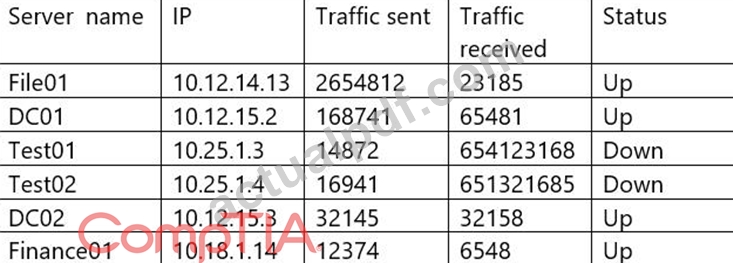
Which of the following is the most likely cause of the outage?
- A. Jamming
- B. ARP poisoning
- C. Denial of service
- D. Kerberoasting
Answer: C
Explanation:
This is clearly indicative of DoS attack where the two Test hosts are being overwhelmed with excessive traffic received causing them to become unresponsive and crash.
NEW QUESTION # 171
An IT security team is concerned about the confidentiality of documents left unattended in MFPs. Which of the following should the security team do to mitigate the situation?
- A. Deploy an authentication factor that requires ln-person action before printing.
- B. Educate users about the importance of paper shredder devices.
- C. Update the management software to utilize encryption.
- D. Install a software client m every computer authorized to use the MFPs.
Answer: A
Explanation:
To mitigate the risk of confidential documents being left unattended in Multi-Function Printers (MFPs), implementing an authentication factor that requires in-person action before printing (such as PIN codes or badge scanning) is the most effective measure. This ensures that documents are only printed when the authorized user is present to collect them, reducing the risk of sensitive information being exposed.
References = CompTIA Security+ SY0-701 study materials, particularly in the domain of physical security and access control.
NEW QUESTION # 172
A healthcare organization wants to provide a web application that allows individuals to digitally report health emergencies.
Which of the following is the most important consideration during development?
- A. Availability
- B. Scalability
- C. Ease of deployment
- D. Cost
Answer: A
Explanation:
Availability is the ability of a system or service to be accessible and usable when needed. For a web application that allows individuals to digitally report health emergencies, availability is the most important consideration during development, because any downtime or delay could have serious consequences for the health and safety of the users. The web application should be designed to handle high traffic, prevent denial-of-service attacks, and have backup and recovery plans in case of failures2.
References: CompTIA Security+ Study Guide: Exam SY0-701, 9th Edition, Chapter 2, page 41.
NEW QUESTION # 173
......
Fully Updated Free Actual CompTIA SY0-701 Exam Questions: https://examsboost.actualpdf.com/SY0-701-real-questions.html
