

[May-2026] Study resources for the Valid L5M6 Braindumps!
Updated L5M6 Tests Engine pdf - All Free Dumps Guaranteed!
NEW QUESTION # 35
Category Management and Strategic Sourcing are terms which are interchangeable. Is this statement TRUE?
- A. No - Category Management is a process most effectively applied when using a recognised framework and supporting tools
- B. Yes - Strategic Sourcing is a type of Category Management
- C. No - Category Management is a tactical form of sourcing
- D. Yes - they are synonyms and used interchangeably within most organisations
Answer: A
Explanation:
Although some organisations mistakenly use Category Management and Strategic Sourcing interchangeably, they are not the same. Strategic Sourcing is a philosophy or approach to procurement, while Category Management is a structured process, applied most effectively through recognised frameworks like Kraljic or Kearney's 7-step model. Category Management is strategic, not tactical, and focuses on long- term value creation, supply market management, and alignment with organisational objectives. A direct quote from L5M6 states: "Category Management is a process and is applied most effectively when using a recognised framework and supporting tools." This clarity ensures that organisations do not reduce Category Management to short-term sourcing exercises. Instead, it emphasises cross-functional collaboration, innovation, and market analysis to achieve sustainable value.
Reference: CIPS L5M6 Study Guide, p.49
NEW QUESTION # 36
What is the purpose of a Category Board?
- A. To develop and implement a category strategy
- B. To select the Category Manager
- C. To mitigate all risks
- D. To approve spending over a certain amount
Answer: A
Explanation:
A Category Board [sometimes called a Category Council or Committee] is a cross-functional group of stakeholders responsible for overseeing the development and implementation of a category strategy. It brings together representatives from procurement, finance, operations, and other relevant departments to ensure that sourcing decisions align with overall business objectives.
While boards may also review spending or risk, their main role is strategic governance. They provide input into category planning, approve strategies, resolve conflicts, and ensure stakeholder buy-in. This collaboration is essential, as category management is a cross-functional discipline that cannot succeed if procurement operates in isolation.
Options A and B are too narrow, while option D is unrealistic-no body can "mitigate all risks." Instead, the board ensures risks are recognised and addressed within the strategy.
The study guide highlights the importance of such structures in embedding category management within an organisation's governance framework.
[Ref: CIPS L5M6 Study Guide, pp.614 - Category Boards and governance in category management]
NEW QUESTION # 37
Which of the following is an example of a supply chain risk? Select TWO.
- A. Badly defined T&Cs in a contract cause a supplier to fail to deliver services effectively
- B. Lightning strikes the organisation's HQ
- C. A cargo ship is delayed due to strike action at a port of entry
- D. A consultant provides bad advice to a client as they are unaware of a legislation change
Answer: A,C
Explanation:
Supply chain risks are risks that involve suppliers or logistics networks and have a direct impact on procurement performance. Poorly defined contract terms (Option A) may cause service failure, while delays due to port strikes (Option D) disrupt inbound logistics. These are classic supply chain risks because they are linked to supplier performance or external logistics factors. By contrast, lightning striking HQ is an internal operational risk, and a consultant giving poor advice is a professional service risk rather than a direct supply chain issue. For procurement, identifying supply chain risks is critical to developing mitigation strategies such as alternative suppliers, buffer stock, or stronger contractual clauses. Risk assessment frameworks like the likelihood/severity matrix help prioritise which risks to address first.
Reference: CIPS L5M6 Study Guide, p.56
NEW QUESTION # 38
Ted is a potato farmer from Devon. He sells his potatoes to many local customers including restaurants, wholesalers and manufacturers. For one customer, Ted is keen to drive a premium price for his potatoes as he is confident the customer can afford to pay more. What type of customer is this to Ted?
- A. Core
- B. Development
- C. Exploitable
- D. Nuisance
Answer: C
Explanation:
This is an exploitable customer, according to the Supplier Preferencing Model. Suppliers may attempt to increase profit margins with customers they perceive as less important but who have fewer alternatives and can afford to pay more.
Reference: CIPS L5M6 Study Guide, p.99
NEW QUESTION # 39
The sale of ice-cream, bikinis and sunglasses usually follows which demand pattern?
- A. Stable
- B. Cyclical
- C. Growth
- D. Decline
Answer: B
Explanation:
These items follow a cyclical demand pattern, meaning that sales fluctuate in predictable cycles-typically aligned with seasons or climate conditions. For example, demand peaks in summer and falls sharply in winter. Recognising cyclical patterns allows procurement professionals to plan supply and inventory effectively, avoiding both shortages during peak demand and excess stock during low demand periods. This type of forecasting is particularly important in industries such as fashion, tourism, and consumer goods.
Failing to account for cyclical demand can lead to missed sales opportunities or increased storage costs. In category management, understanding demand cycles ensures efficient resource allocation, supplier scheduling, and financial planning. It also supports collaborative planning with suppliers to ensure capacity aligns with market needs.
Reference: CIPS L5M6 Study Guide, p.143
NEW QUESTION # 40
Which of the following forms of historical data can be used to inform Category Management expenditure?
Select THREE.
- A. Inflation Rate
- B. Spend Forecast
- C. Line Item Details
- D. Spend Analytics
- E. Ledger Code
Answer: C,D,E
Explanation:
In category management, reliable decision-making depends heavily on the analysis of historical spend data.
According to CIPS, the key forms of usable historical data include:
* Spend analytics: consolidated information showing how much has been spent, on what items, and with which suppliers.
* Line item details: transaction-level data that provides specific insight into products or services purchased.
* Ledger codes: financial classifications that group expenditure for reporting and control purposes.
These data sets allow category managers to identify trends, supplier dependency, opportunities for consolidation, and potential cost savings. In contrast, inflation rates and spend forecasts are forward-looking metrics, not historical data. Using accurate historical information is critical for preparing budgets, supporting negotiations, and identifying anomalies in expenditure. Organisations that fail to utilise this data often struggle to align their category strategies with financial realities, leading to overspending or missed opportunities.
Reference: CIPS L5M6 Study Guide, p.133
NEW QUESTION # 41
In Category Management, which of the following Models can be used for creating a step-by-step plan for Strategic Sourcing?
- A. Kearney's 7 Step Model
- B. Porter's 5 Forces
- C. Kraljic Matrix
- D. The Pareto Principle
Answer: A
Explanation:
Kearney's 7 Step Strategic Sourcing Model provides a structured, step-by-step approach for managing sourcing activities. The steps include profiling the category, assessing the supply market, developing sourcing strategies, and implementing them. This model ensures that sourcing is systematic, evidence-based, and aligned with strategic objectives. Unlike tools such as the Kraljic Matrix, which classifies items by risk and impact, Kearney's model provides an end-to-end process framework for sourcing execution. Similarly, Pareto and Porter's 5 Forces are useful analytical tools but not procedural sourcing frameworks. For category managers, the Kearney Model is valuable because it emphasises cross-functional collaboration, data-driven decision-making, and continuous improvement. Its structured approach reduces risks of ad-hoc decision- making and ensures alignment with organisational goals. This is why it is a central feature of L5M6 study material and often tested in exams.
Reference: CIPS L5M6 Study Guide, p.28-29
NEW QUESTION # 42
Frankie Burgers operates in the UK and USA. One supplier holds a monopoly, but the item supplied is low cost. According to the Kraljic Matrix, which type of item is this?
- A. Strategic
- B. Routine
- C. Bottleneck
- D. Leverage
Answer: C
Explanation:
This item is classified as a Bottleneck item in the Kraljic Portfolio Matrix. Bottleneck items are low-value in terms of spend but carry high supply risk, often because there are very few suppliers or a monopoly situation.
In this case, Frankie Burgers faces a monopoly supplier, meaning supply risk is high. Even though the item is low cost, its unavailability could disrupt operations, creating significant vulnerability.
By contrast:
* Leverage items are high-value but low risk, suited for competitive sourcing.
* Strategic items are high-value and high-risk, requiring partnerships.
* Routine items are low-value and low-risk, suitable for automated procurement.
Category managers facing bottleneck items often mitigate risk through strategies such as developing alternative suppliers, stockpiling, or long-term contracts to secure continuity of supply.
[Ref: CIPS L5M6 Study Guide, p.157 - Kraljic Matrix applications]
NEW QUESTION # 43
In which section of a balance sheet would you find the term "goodwill"?
- A. Current assets
- B. Non-current assets
- C. Non-current liabilities
- D. Current liabilities
Answer: B
Explanation:
Goodwill is found under Non-current assets in a balance sheet. Goodwill arises when one company acquires another for a value greater than its tangible assets, reflecting intangible benefits such as brand reputation, customer loyalty, patents, or strong supplier relationships.
For example, if a company is valued at £10 million based on tangible assets but is purchased for £15 million, the £5 million difference is recorded as goodwill. This asset remains on the balance sheet until impaired [e.g., if the acquired brand loses value].
It is not a current asset because it cannot be quickly liquidated within one year. Nor is it a liability [current or non-current] since it represents value, not debt.
For procurement and category managers, goodwill can signal a supplier's market position, brand strength, and long-term stability. It highlights how intangible assets, though harder to measure, play a role in supplier evaluation and business acquisitions.
[Ref: CIPS L5M6 Study Guide, p.183 - Financial terms and balance sheet analysis]
NEW QUESTION # 44
ABC Ltd wishes to ensure compliance across its supply chain.
Which of the following are steps that can be taken to ensure compliance with regulations and standards including CSR?
- A. Do not work with suppliers in low-cost countries
- B. Only work with large suppliers who have a CSR policy
- C. Make ethics and compliance a priority when qualifying new suppliers
- D. Communicate the company's values across the supply chain
Answer: C,D
Explanation:
* Making ethics and compliance a priority [B] ensures supplier selection considers regulatory and social responsibility aspects.
* Communicating values across the supply chain [C] builds alignment and accountability.
A and D are incorrect because having a CSR policy doesn't guarantee practice, and low-cost country sourcing does not automatically mean non-compliance.
[Ref: CIPS L5M6 Study Guide, p.107 - Ensuring compliance in supply chains]
NEW QUESTION # 45
The objective of negotiation with a supplier is to ensure the Five Rights of Procurement. Which of the following are part of the Five Rights? Select THREE.
- A. Right relationship
- B. Right supplier
- C. Right product
- D. Right price
- E. Right time
Answer: C,D,E
Explanation:
The Five Rights of Procurement are fundamental principles ensuring procurement delivers value. They are:
* Right product - ensuring goods/services meet requirements.
* Right quality - ensuring standards are appropriate.
* Right time - goods/services are available when needed.
* Right place - ensuring delivery is to the correct location.
* Right price - balancing cost efficiency with value.
Options B, C, and D reflect these principles. "Right supplier" and "right relationship" are not part of the traditional five rights, though they are important in broader supplier management. By aligning negotiations with the Five Rights, procurement professionals secure both operational efficiency and strategic value. These principles also provide benchmarks against which procurement performance can be measured.
Reference: CIPS L5M6 Study Guide, p.58
NEW QUESTION # 46
High exit barriers in a marketplace mean that rivalry between suppliers is low. Is this statement TRUE?
- A. No - rivalry between existing suppliers is high
- B. No - high exit barriers mean no new suppliers will enter the marketplace
- C. Yes - rivalry is low as buyer power is strong
- D. Yes - rivalry is low as supplier power is strong
Answer: A
Explanation:
The correct response is No - rivalry between existing suppliers is high. Exit barriers refer to the difficulty suppliers face when attempting to leave a market or industry. These barriers may include high investment in specialised assets, contractual obligations, redundancy costs, or reputational damage. When suppliers are unable or unwilling to exit, they remain within the industry regardless of declining profitability. This forces them to compete aggressively to retain market share, which increases rivalry among existing firms.
Options A and B are incorrect because the question relates to rivalry, not directly to buyer or supplier power.
Option D is also incorrect because exit barriers do not influence new suppliers entering; they affect current suppliers trying to leave.
A practical example is the oil and energy industry, where huge capital investments make it very costly to exit. Companies stay even during downturns, resulting in fierce rivalry.
[Ref: CIPS L5M6 Study Guide, p.114 - Porter's Five Forces: Exit Barriers and Rivalry]
NEW QUESTION # 47
When using the Kraljic Matrix to analyse the category of item, which of the following categories does Kraljic recommend be further analysed in conjunction with a comparison of the buyer's strength vs supply market strength?
- A. Bottleneck
- B. Non-critical
- C. Strategic
- D. Leverage
Answer: C
Explanation:
For strategic items, Kraljic recommends further analysis through a 3x3 supply positioning matrix, which compares buyer strength against market strength. This creates three possible strategies: exploit, balance, diversify.
Reference: CIPS L5M6 Study Guide, p.102
NEW QUESTION # 48
What is a General Ledger?
- A. An IT system that conducts tenders electronically
- B. An IT system that prepares information for financial reporting
- C. A catalogue of products to buy and/or sell
- D. A list of approved suppliers
Answer: B
Explanation:
A General Ledger [GL] is the central accounting record used by businesses to prepare financial reports. It categorises all financial transactions into cost codes, allowing managers to track expenditure, revenue, assets, and liabilities.
For category managers, the General Ledger provides visibility into spend categories. This information supports spend analysis and helps in mapping organisational costs against suppliers, categories, and business functions. It differs from line item detail by offering a higher-level financial view.
Other options are misleading:
* Option A [tenders] relates to e-procurement platforms, not financial records.
* Option C [catalogue] refers to item listings, not ledgers.
* Option D [supplier lists] relates to approved supplier databases.
By using GL data, procurement can ensure alignment with finance, strengthening compliance, budgeting, and strategic sourcing decisions.
[Ref: CIPS L5M6 Study Guide, p.135 - Use of General Ledger in procurement analysis]
NEW QUESTION # 49
What is contract leakage?
- A. The gap between benefits identified in the pre-award stage of the contract and those actually achieved
- B. When spend with a supplier is less than was forecast
- C. The gap between proposed KPI levels and those actually achieved by the supplier
- D. When spend with a supplier is more than was stated in the contract
Answer: A
Explanation:
Contract leakage refers to the difference between the benefits forecasted before awarding a contract and the actual benefits realised during its execution. For example, savings predicted during tendering may not materialise due to supplier underperformance, scope creep, or poor contract management. This phenomenon highlights the importance of post-contract management and continuous monitoring of supplier performance.
Category managers must ensure that expectations set during procurement are followed through by tracking delivery, compliance with terms, and value creation. Tools such as KPIs, SLAs, and audits help minimise leakage by ensuring accountability. Ultimately, failure to address leakage can lead to financial loss, reduced trust, and missed opportunities for improvement. By focusing on contract outcomes as well as initial savings, procurement ensures that strategic objectives are consistently met.
Reference: CIPS L5M6 Study Guide, p.145
NEW QUESTION # 50
Randoxx Ltd is a manufacturing company which has four main categories of expenditure:
* Category 1: The market of this category is highly innovative and has rapidly changed over the past five years. There are many suppliers who provide similar products at similar price points.
* Category 2: This category of spend is for highly specialised products and it is important to Randoxx that the products are carbon neutral. Because of this, there is a reduced number of suppliers who provide products to this category and Randoxx has little influence over the price that they pay.
* Category 3: This category of spend is for natural resources which are only found in very few parts of the world. Because of this Randoxx imports all of these items from one country abroad and currency fluctuations have a huge impact on the profit margin of this category spend.
* Category 4: This is a highly technical product which has a patent. It is used in the creation of laptops and phones and it would be impossible to make these with a different product. Due to the growing population Randoxx forecasts that demand for this product will increase.
Task:
Complete the table below by identifying each category's Porter's Force driver and STEEPLE factor challenge. Each response should be used only once.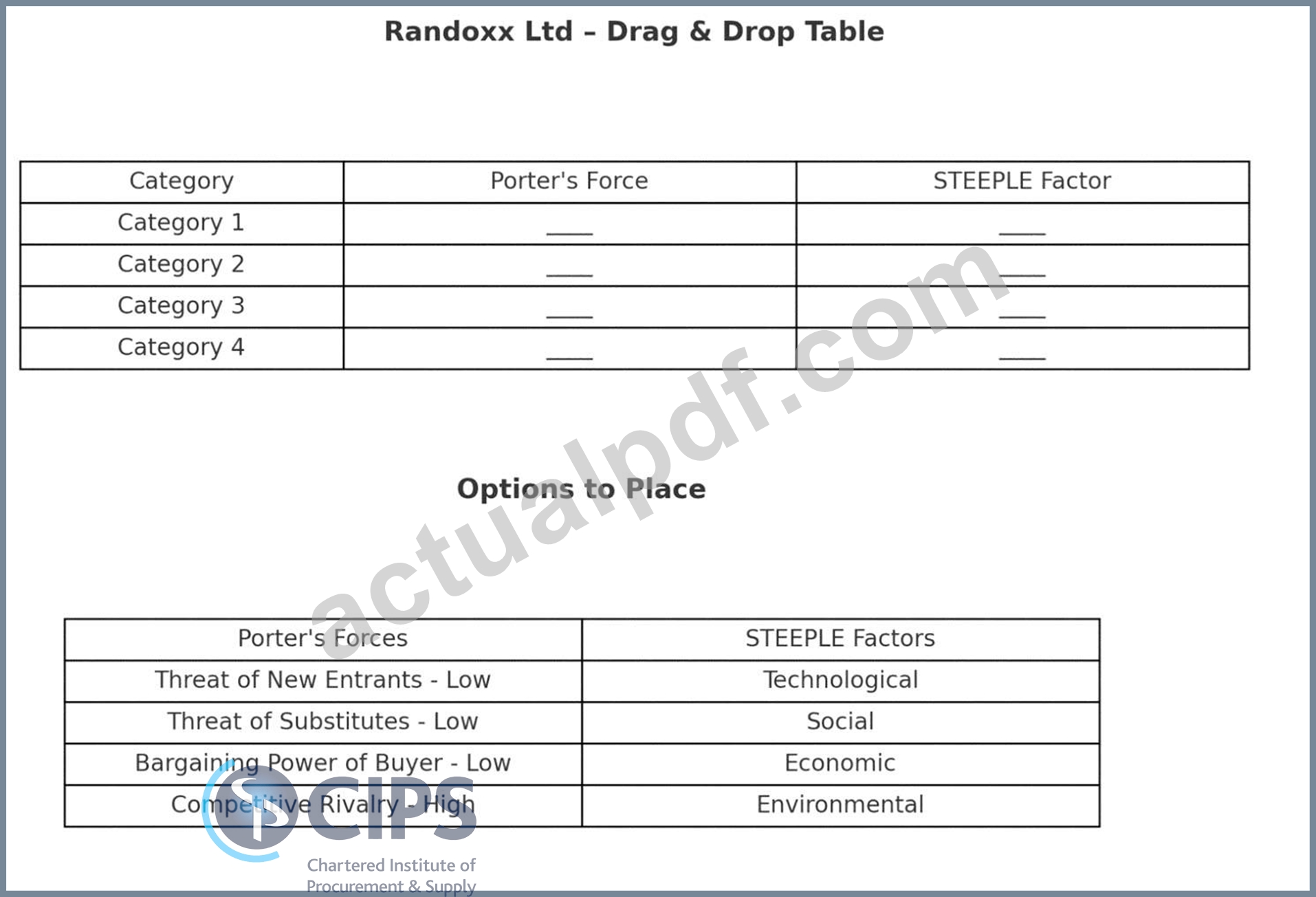
Answer:
Explanation: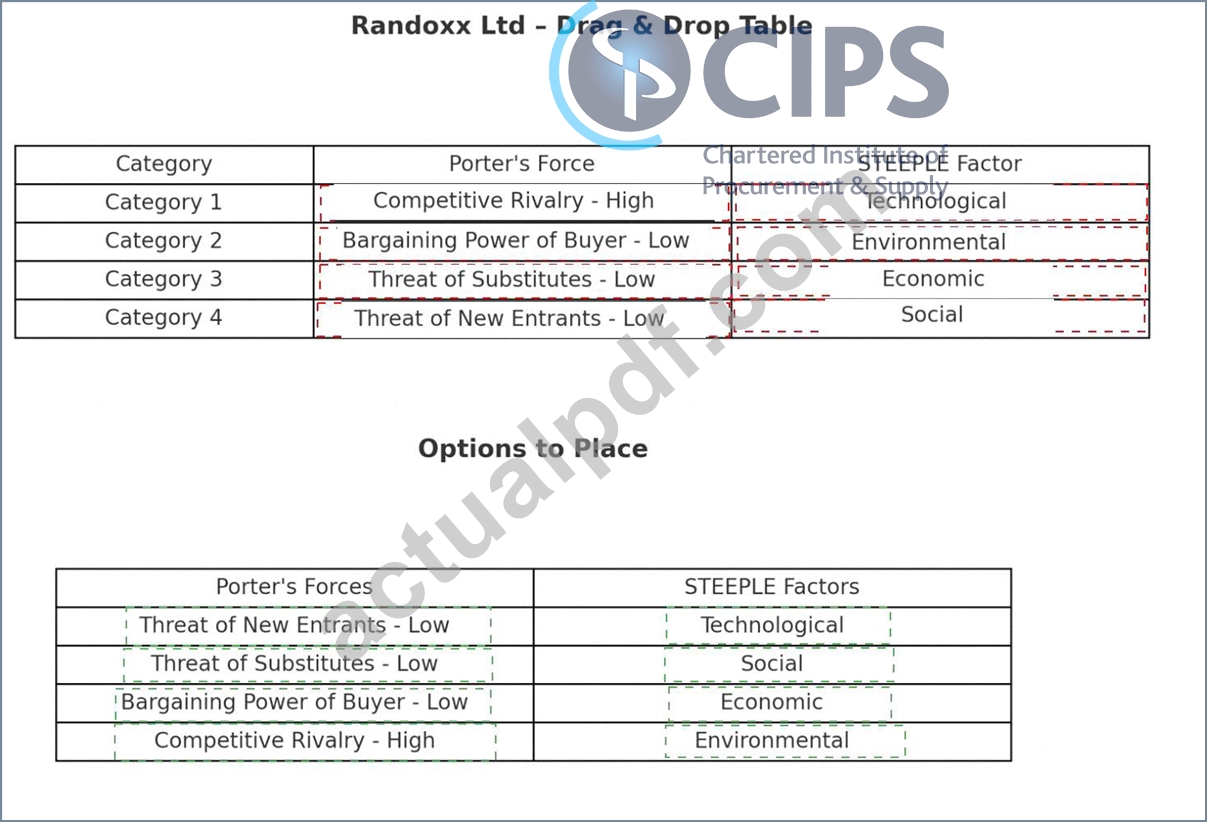
Explanation:
A close-up of a questionnaire AI-generated content may be incorrect.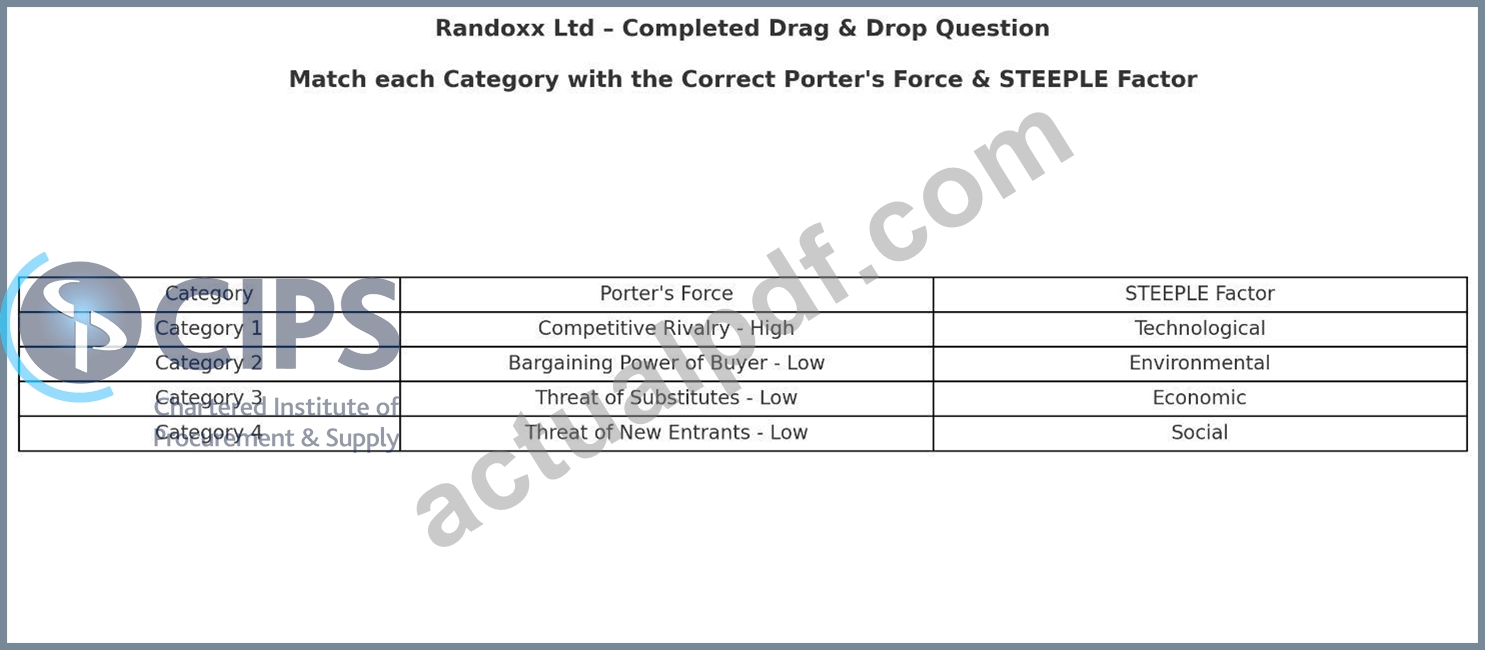
Category 1: Highly innovative, many suppliers with similar products at similar price points
* Porter's Force: Competitive Rivalry - High
* STEEPLE Factor: Technological
Explanation (150-200 words):
Category 1 operates in a market that is highly innovative and subject to rapid technological change.
Innovation means suppliers are constantly developing new features or solutions, making technology the primary STEEPLE factor. Additionally, because there are many suppliers offering similar products at similar price points, competitive rivalry is intense. Buyers can switch easily, and suppliers must compete aggressively on features, pricing, and differentiation.
This combination of high rivalry and technological change creates both opportunity and risk for Randoxx.
On one hand, innovation drives new solutions that can be leveraged; on the other hand, it increases pressure to manage supplier relationships strategically. Randoxx must monitor technological trends closely while maintaining competitive sourcing strategies to manage this highly dynamic category.
(Ref: CIPS L5M6 Study Guide - Porter's Five Forces, p.112-116; STEEPLED Analysis, p.109)
NEW QUESTION # 51
In A.T. Kearney's 7 Step Model of Strategic Sourcing, which of the following should be done first?
- A. Supplier portfolio generation
- B. Selection of implementation path
- C. Continuous benchmarking of supply market
- D. Competitive supplier selection
Answer: A
Explanation:
The first step in A.T. Kearney's 7 Step Model of Strategic Sourcing is Supplier Portfolio Generation. The model provides a structured approach to sourcing, beginning with an understanding of current spend and supplier landscape before progressing to strategy development and implementation.
The seven steps are:
* Profile spend and supply base.
* Develop sourcing strategy and cost comparison.
* Generate supplier portfolio.
* Select implementation path.
* Select competitive suppliers.
* Integrate operations with suppliers.
* Continuously benchmark supply market.
The reason supplier portfolio generation is first is because procurement must identify potential suppliers and the overall supply base structure before choosing strategies or engaging in competitive selection. Skipping this step risks building a strategy without understanding available market options.
Thus, while options C and D are important later in the process, they cannot occur without first mapping the supplier portfolio.
[Ref: CIPS L5M6 Study Guide, Chapter 1.2 - Strategic Sourcing Models, esp. p.31-32]
NEW QUESTION # 52
Which of the following are potential consequences for an organisation which fails to identify and address risk? Select TWO.
- A. Damage to brand image
- B. Lawsuits
- C. Financial loss
- D. Corruption
Answer: A,C
Explanation:
CIPS highlights that damage to brand reputation and financial loss are two major risks of failing to manage supply chain risks effectively. Legal issues such as lawsuits arise from illegal activity, which is separate from general risk exposure.
Reference: CIPS L5M6 Study Guide, p.111
NEW QUESTION # 53
XYZ Ltd is a manufacturing organisation based in the UK. They work with many suppliers of both direct and indirect goods. Below is a selection of four suppliers XYZ procures items from:
* Supplier 1: The sole supplier of a critical item for production. Market research shows no substitute exists. XYZ is a price taker, not a price setter.
* Supplier 2: Long-term relationship. Working together to reduce costs. Item has a high impact on profit but low supply risk.
* Supplier 3: Indirect items like stationery with little profit impact. Meetings focus on bulk discounts.
* Supplier 4: One-off capital expenditure item. Months of negotiations with supplier to reduce costs before manufacture begins.
Task:
Complete the table below. You are required, for each supplier, to determine the Cost Approach taken by XYZ Ltd and to identify the Item Type based on the Kraljic Matrix. Each response should only be used once.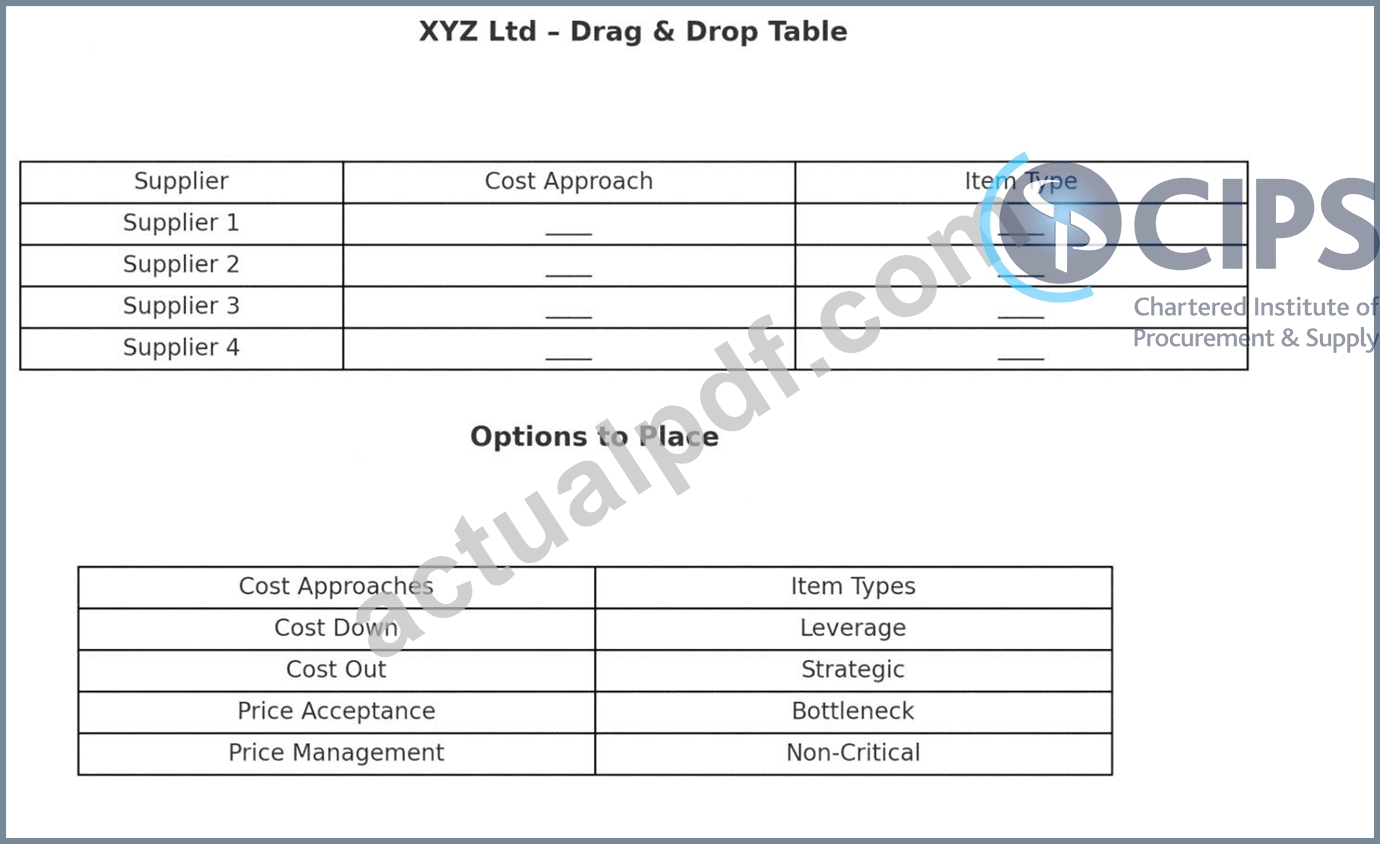
Answer:
Explanation: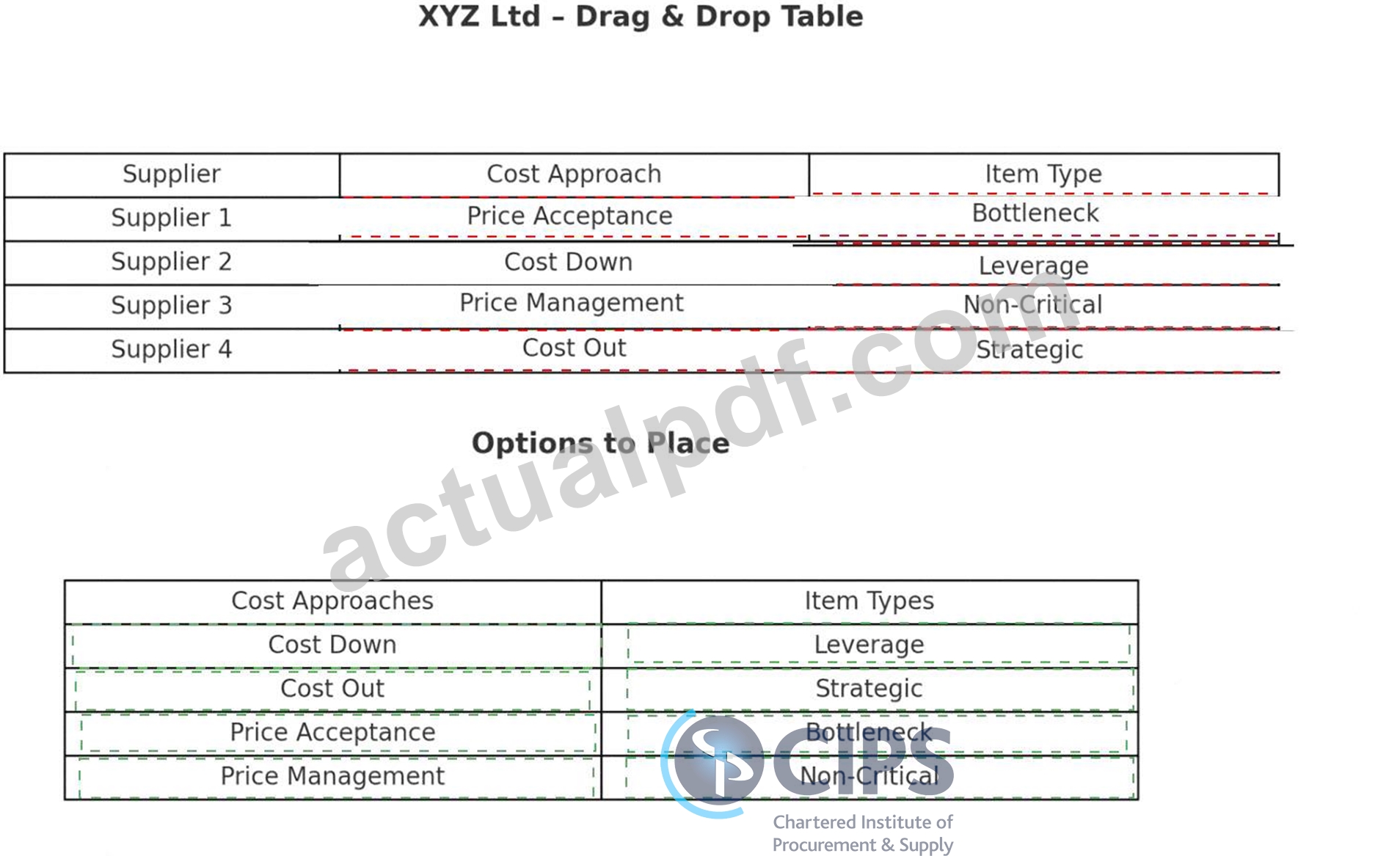
Explanation: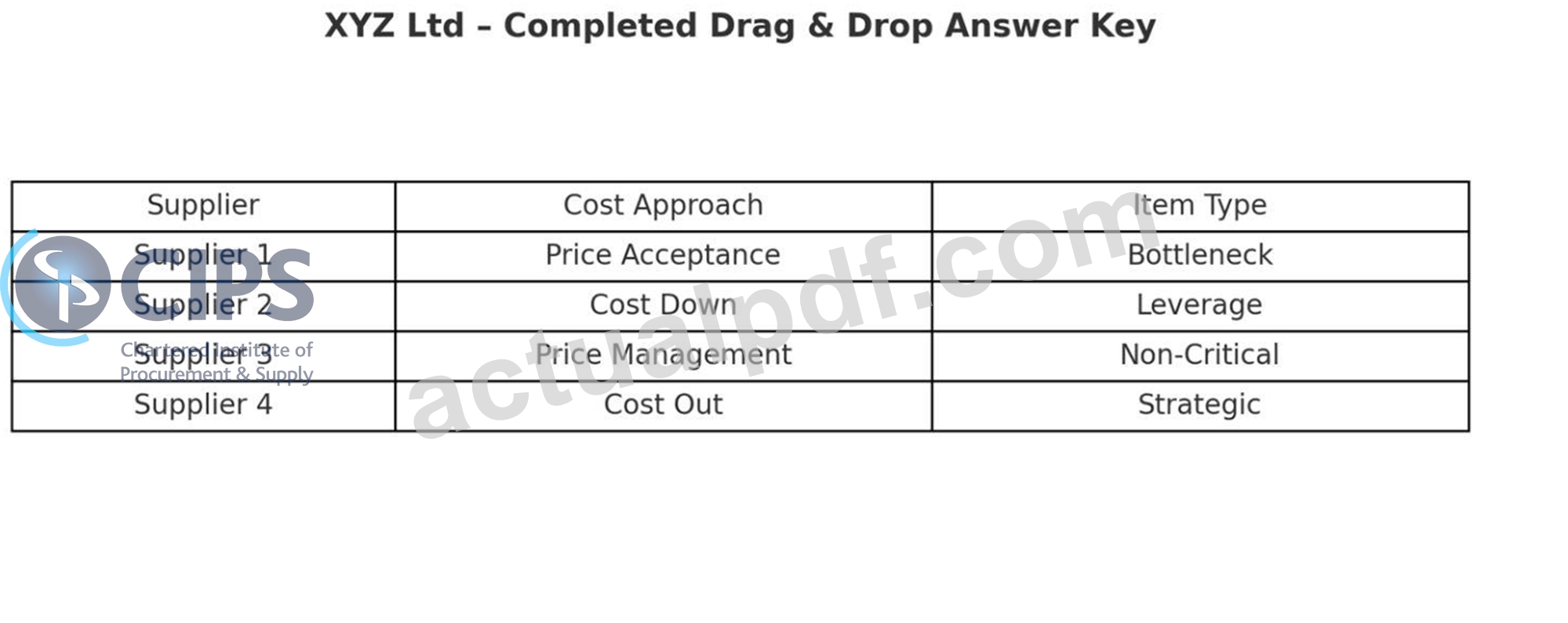
Supplier 1 # Price Acceptance + Bottleneck
Supplier 1 is the sole supplier of a critical item, and XYZ has confirmed through market research that there are no substitutes available. This places Supplier 1 in the Bottleneck quadrant of the Kraljic Matrix, which is defined by high supply risk but low profit impact (or limited ability to influence price). In bottleneck situations, buyers have limited leverage, making them price takers rather than price setters.
That's why the appropriate cost approach here is Price Acceptance-XYZ must accept the price dictated by the supplier because of the absence of alternatives. Procurement's role becomes risk mitigation, ensuring continuity of supply rather than focusing on negotiation power. The recommended strategies include maintaining strong supplier relationships, holding safety stock, and monitoring supply risks. Price cannot be influenced significantly, so procurement must accept the terms, reflecting a bottleneck scenario.
(Ref: CIPS L5M6 Study Guide, pp.80-83, 97-100 - Cost ApproachesKraljic Matrix) Supplier 2 # Cost Down + Leverage Supplier 2 provides items that, while not purchased in large volumes, have a high impact on profit and carry a low supply risk. These characteristics fit into the Leverage quadrant of the Kraljic Matrix: high profit impact, low risk. In such cases, buyers hold strong bargaining power and can use competition or collaborative cost reduction measures to secure better value. The chosen cost approach here is Cost Down, which involves working with suppliers to systematically reduce costs without reducing value. XYZ's long-term relationship with Supplier 2, combined with a focus on identifying where costs could be lowered, matches the cost-down philosophy. Examples might include value engineering, supplier process improvements, or volume consolidation. Leverage items are ideal for competitive sourcing, e-auctions, and bulk negotiation. By applying a cost-down approach, XYZ can ensure sustained profitability while keeping supply risk under control.
(Ref: CIPS L5M6 Study Guide, pp.80-81, 97-100 - Cost ManagementLeverage items) Supplier 3 # Price Management + Non-Critical Supplier 3 provides indirect goods such as stationery, which have little impact on company profits and are purchased regularly in small quantities. These fit into the Non-Critical quadrant of the Kraljic Matrix, which is characterised by low profit impact and low supply risk. In these cases, procurement's focus should be on administrative efficiency and price management, rather than extensive strategic negotiations. The chosen cost approach here is Price Management, since XYZ meets with the supplier regularly to discuss pricing and bulk discounts. This approach ensures that, although the spend is low-value, the company avoids unnecessary waste or inflated costs. Tools such as catalogues, e-procurement systems, or framework agreements are commonly used in this quadrant to manage spend efficiently. Price management helps free up procurement resources for more strategic categories while still ensuring best value in non-critical areas.
(Ref: CIPS L5M6 Study Guide, pp.80-82, 97 - Non-critical items and price management) Supplier 4 # Cost Out + Strategic Supplier 4 is supplying a one-off capital expenditure item. XYZ has engaged in months of negotiations regarding specifications, and both parties are collaborating to reduce costs before manufacturing begins.
This aligns perfectly with the Strategic quadrant of the Kraljic Matrix, where items have high profit impact and high supply risk. Strategic items require strong, long-term partnerships and close supplier collaboration. The appropriate cost approach here is Cost Out, which focuses on eliminating unnecessary costs during the design and specification stages, before production. This proactive approach ensures that efficiency and value are embedded in the product from the outset. Cost-out strategies often involve redesign, engineering collaboration, and innovation to reduce total cost of ownership. In such relationships, trust and partnership are critical, since both buyer and supplier must work together to achieve shared value and risk reduction.
(Ref: CIPS L5M6 Study Guide, pp.80, 97-99 - Strategic items and Cost-Out approach)
NEW QUESTION # 54
Which of the following parts of a SWOT analysis summarise activities and characteristics which are internal to the business? Select TWO.
- A. Strengths
- B. Weaknesses
- C. Opportunities
- D. Threats
Answer: A,B
Explanation:
A SWOT Analysis distinguishes between internal factors (strengths and weaknesses) and external factors (opportunities and threats). Strengths are internal capabilities, resources, or skills that give the organisation an advantage in the market-such as strong supplier relationships, unique expertise, or cost leadership.
Weaknesses are internal limitations, such as lack of investment, poor technology, or inadequate processes.
These are factors the organisation has direct control over and can improve. On the other hand, opportunities and threats are external influences outside the business's direct control, such as market trends, legislation, or competitor actions. For category management, applying SWOT allows managers to assess the current position of categories and design strategies that build on strengths and address weaknesses. This analysis also ensures that procurement strategies remain aligned with organisational goals and competitive environments. The correct recognition of internal versus external factors is essential to avoid misdiagnosis and wasted effort.
Reference: CIPS L5M6 Study Guide, p.121
NEW QUESTION # 55
Which of the following are legal aspects of a contract a Procurement Manager should know?
- A. Intellectual Property
- B. Relationship management
- C. Sustainability
- D. Liabilities
- E. TUPE
Answer: A,D,E
Explanation:
The three correct legal aspects are:
* Liabilities [C]: Define responsibility for damages, breaches, or non-performance.
* Intellectual Property [D]: Protects innovations, designs, and brand assets in supplier agreements.
* TUPE [E]: Transfer of Undertakings [Protection of Employment], a UK law ensuring employees retain rights when transferred between companies.
While sustainability and relationship management are important procurement considerations, they are not specifically legal aspects of contracts. Legal knowledge ensures procurement professionals protect their organisations from financial, reputational, and operational risks.
TUPE is particularly relevant in outsourcing agreements, where staff may move from one employer to another. Procurement managers must ensure compliance with local employment laws to avoid legal disputes.
CIPS stresses that category managers should not act as lawyers but must have sufficient legal awareness to identify risks and escalate issues to legal specialists.
[Ref: CIPS L5M6 Study Guide, p.57 - Legal aspects in procurement contracts]
NEW QUESTION # 56
......
L5M6 Dumps Updated Practice Test and 92 unique questions: https://examsboost.actualpdf.com/L5M6-real-questions.html
