

[Dec 16, 2025] Valid 300-710 Test Answers & 300-710 Exam PDF
Valid CCNP Security 300-710 Dumps Ensure Your Passing
Cisco 300-710 exam is designed to test the knowledge of individuals who are interested in securing networks using Cisco Firepower. 300-710 exam is an essential requirement for those who want to become Cisco certified professionals in this field. The Cisco 300-710 exam covers various topics, such as configuring and troubleshooting Cisco Firepower devices, implementing intrusion policies, and creating security intelligence policies.
NEW QUESTION # 219
An engineer has been tasked with providing disaster recovery for an organization's primary Cisco FMC. What must be done on the primary and secondary Cisco FMCs to ensure that a copy of the original corporate policy is available if the primary Cisco FMC fails?
- A. Place the active Cisco FMC device on the same trusted management network as the standby device
- B. Connect the primary and secondary Cisco FMC devices with Category 6 cables of not more than
10 meters in length. - C. Configure high-availability in both the primary and secondary Cisco FMCs
- D. Restore the primary Cisco FMC backup configuration to the secondary Cisco FMC device when the primary device fails
Answer: C
Explanation:
https://www.cisco.com/c/en/us/td/docs/security/firepower/620/configuration/guide/fpmc-config- guide-v62/firepower_management_center_high_availability.html
NEW QUESTION # 220
A security engineer is configuring an Access Control Policy for multiple branch locations. These locations share a common rule set and utilize a network object called INSIDE_NET which contains the locally significant internal network subnets at each location. What technique will retain the policy consistency at each location but allow only the locally significant network subnet within the application rules?
- A. utilizing policy inheritance
- B. utilizing a dynamic ACP that updates from Cisco Talos
- C. creating an ACP with an INSIDE_NET network object and object overrides
- D. creating a unique ACP per device
Answer: C
Explanation:
Section: Configuration
NEW QUESTION # 221
Which description of the file trajectory feature in Cisco AMP is true?
- A. Tracks information about policy updates that affect each file on a network
- B. Display information about the actions performed on each file on a network.
- C. Blocks the malware detected in a file sent across the network
- D. Excludes information about file transmissions across the network
Answer: B
Explanation:
https://blogs.cisco.com/security/uncover-the-where-when-and-how-of-an-attack-with-trajectory- from-cisco-amp-for-endpoints
NEW QUESTION # 222
When deploying a Cisco ASA Firepower module, an organization wants to evaluate the contents of the traffic without affecting the network. It is currently configured to have more than one instance of the same device on the physical appliance.
Which deployment mode meets the needs of the organization?
- A. inline tap monitor-only mode
- B. passive tap monitor-only mode
- C. inline mode
- D. passive monitor-only mode
Answer: A
Explanation:
For passive monitor-only mode we need extra switch with span port.
https://www.cisco.com/c/en/us/td/docs/security/asa/asa910/configuration/firewall/asa-910-firewall- config/access-sfr.html
NEW QUESTION # 223
An engineer is troubleshooting a file that is being blocked by a Cisco FTD device on the network.
The user is reporting that the file is not malicious.
Which action does the engineer take to identify the file and validate whether or not it is malicious?
- A. Use FMC file analysis to look for the file and select Analyze to determine its disposition.
- B. Use the context explorer to find the file and download it to the local machine for investigation.
- C. identify the file in the intrusion events and submit it to Threat Grid for analysis.
- D. Right click the connection event and send the file to AMP for Endpoints to see if the hash is malicious.
Answer: C
NEW QUESTION # 224
What is the role of the casebook feature in Cisco Threat Response?
- A. pulling data via the browser extension
- B. sharing threat analysts
- C. triage automaton with alerting
- D. alert prioritization
Answer: B
Explanation:
The casebook and pivot menu are widgets available in Cisco Threat Response. Casebook - It is used to record, organize, and share sets of observables of interest primarily during an investigation and threat analysis. You can use a casebook to get the current verdicts or dispositions on the observables.
NEW QUESTION # 225
A connectivity issue is occurring between a client and a server which are communicating through a Cisco Firepower device While troubleshooting, a network administrator sees that traffic is reaching the server, but the client is not getting a response.
Which step must be taken to resolve this issue without initiating traffic from the client?
- A. Use packet-tracer to validate that the packet passes through the firewall and is NATed to the corrected IP address.
- B. Use packet-tracer to ensure that traffic is not being blocked by an access list.
- C. Use packet capture to validate that the packet passes through the firewall and is NATed to the corrected IP address.
- D. Use packet capture to ensure that traffic is not being blocked by an access list.
Answer: A
Explanation:
If it is statefull firewall, then ACL can not block the response from server this exesting connection, only wrong NAT rule for this server could be the issue.
NEW QUESTION # 226
What is a valid Cisco AMP file disposition?
- A. known-good
- B. pristine
- C. non-malicious
- D. malware
Answer: D
Explanation:
Reference:
https://www.cisco.com/c/en/us/td/docs/security/firepower/60/configuration/guide/fpmc-config-guide-v60/Reference_a_wrapper_Chapter_topic_here.html
NEW QUESTION # 227
Refer to the exhibit.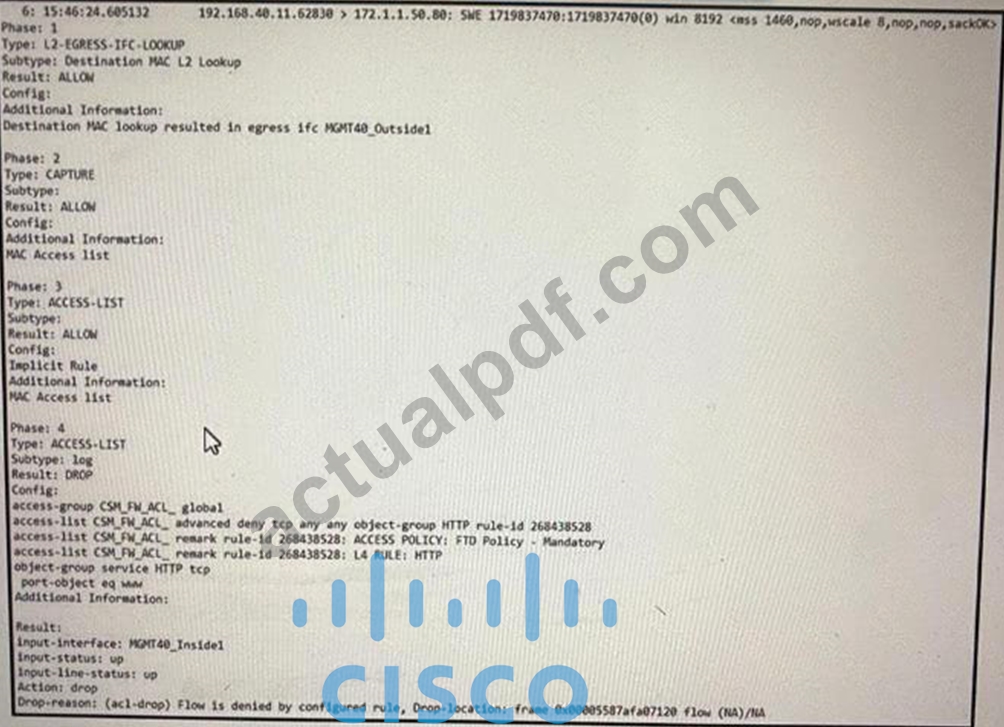
What must be done to fix access to this website while preventing the same communication to all other websites?
- A. Create an access control policy rule to allow port 80 to only 172.1.1 50.
- B. Create an access control policy rule to allow port 443 to only 172.1.1 50
- C. Create an intrusion policy rule to have Snort allow port 443 to only 172.1.1.50
- D. Create an intrusion policy rule to have Snort allow port 80 to only 172.1.1 50.
Answer: A
NEW QUESTION # 228
An administrator is creating interface objects to better segment their network but is having trouble adding interfaces to the objects. What is the reason for this failure?
- A. The administrator is adding interfaces of multiple types.
- B. The administrator is adding an interface that is in multiple zones.
- C. The interfaces are being used for NAT for multiple networks.
- D. The interfaces belong to multiple interface groups.
Answer: D
Explanation:
https://www.cisco.com/c/en/us/td/docs/security/firepower/620/configuration/guide/fpmc-config-guide-v62/reusa
"All interfaces in an interface object must be of the same type: all inline, passive, switched, routed, or ASA FirePOWER. After you create an interface object, you cannot change the type of interfaces it contains."
NEW QUESTION # 229
An engineer is attempting to add a new FTD device to their FMC behind a NAT device with a NAT ID of ACME001 and a password of Cisco388267669. Which command set must be used in order to accomplish this?
- A. configure manager add <FMC IP> registration key> ACME001
- B. configure manager add <FMC IP> ACME0O1 <registration key>
- C. configure manager add DONTRESOLVE <FMC IP> AMCE001 <registration key>
- D. configure manager add ACME001 <registration key> <FMC IP>
Answer: A
NEW QUESTION # 230
Refer to the exhibit.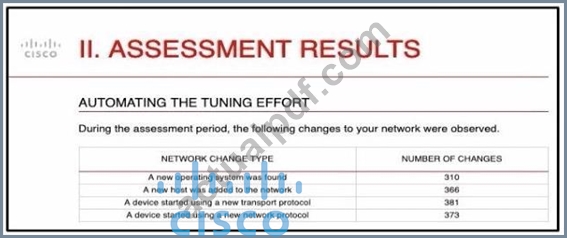
And engineer is analyzing the Attacks Risk Report and finds that there are over 300 instances of new operating systems being seen on the network How is the Firepower configuration updated to protect these new operating systems?
- A. The administrator requests a Remediation Recommendation Report from Cisco Firepower
- B. Cisco Firepower automatically updates the policies.
- C. Cisco Firepower gives recommendations to update the policies.
- D. The administrator manually updates the policies.
Answer: C
Explanation:
Ref: https://www.cisco.com/c/en/us/td/docs/security/firepower/60/configuration/guide/fpmc-config-guide-v60
/Tailoring_Intrusion_Protection_to_Your_Network_Assets.html
NEW QUESTION # 231
An engineer is setting up a new Cisco Secure Firewall Threat Defense appliance to replace the current firewall. The company requests that inline sets be used and that when one interface in an inline set goes down, the second interface in the inline set goes down. What must the engineer configure to meet the deployment requirements?
- A. Snort fail open
- B. strict TCP enforcement
- C. inline tap mode
- D. propagate link state
Answer: D
NEW QUESTION # 232
Refer to the exhibit.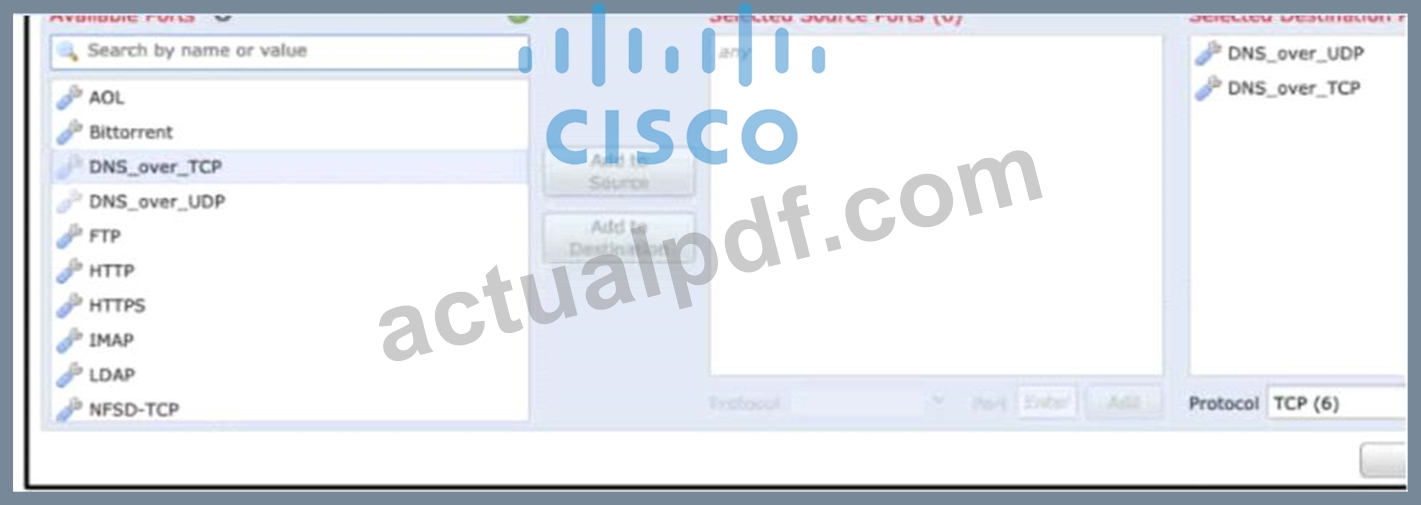
An engineer is modifying an access control policy to add a rule to Inspect all DNS traffic that passes it making the change and deploying the policy, they see that DNS traffic Is not being Inspected by the Snort engine. What is......
- A. The action of the rule is set to trust instead of allow.
- B. The rule Is configured with the wrong setting for the source port.
- C. The rule must define the source network for inspection as well as the port.
- D. The rule must specify the security zone that originates the traffic.
Answer: A
NEW QUESTION # 233
After using Firepower for some time and learning about how it interacts with the network, an administrator is trying to correlate malicious activity with a user Which widget should be configured to provide this visibility on the Cisco Firepower dashboards?
- A. Current Sessions
- B. Correlation Events
- C. Custom Analysis
- D. Current Status
Answer: B
NEW QUESTION # 234
A company has many Cisco FTD devices managed by a Cisco FMC. The security model requires that access control rule logs be collected for analysis. The security engineer is concerned that the Cisco FMC will not be able to process the volume of logging that will be generated. Which configuration addresses this concern?
- A. Send Cisco FTD connection events and security events to Cisco FMC and configure it to forward logs to SIEM for storage and analysis.
- B. Send Cisco FTD connection events directly to a SIEM system and forward security events from Cisco FMC to the SIEM system for storage and analysis.
- C. Send Cisco FTD connection events and security events to a cluster of Cisco FMC devices for storage and analysis.
- D. Send Cisco FTD connection events and security events directly to SIEM system for storage and analysis.
Answer: A
NEW QUESTION # 235
......
Cisco 300-710 certification exam is an intermediate-level exam that focuses on securing networks with Cisco Firepower. 300-710 exam is designed to test a candidate's knowledge and skills related to implementing and managing advanced security features on Cisco Firepower and Firepower Threat Defense platforms. 300-710 exam covers a wide range of topics, including firewall configuration, intrusion prevention, network access control, and advanced malware protection.
To pass the Cisco 300-710 certification exam, candidates need to demonstrate their understanding of various topics related to network security, including NGFW features, deployment, and configuration; FMC features and configuration; network access control policies; and threat intelligence and detection. 300-710 exam consists of 60-70 multiple-choice questions, and candidates have 90 minutes to complete it.
300-710 Dumps Real Exam Questions Test Engine Dumps Training: https://examsboost.actualpdf.com/300-710-real-questions.html
