

C-ABAPD-2507 Dumps with Free 365 Days Update Fast Exam Updates
Verified C-ABAPD-2507 dumps Q&As - 2025 Latest C-ABAPD-2507 Download
NEW QUESTION # 20
Which function call returns 0?
- A. find(val'FIND Found found' sub 'F' occ = -2 CASE = abap_true )
- B. find(val 'find FOUND Foundd' sub 'F' occ = -2 CASE = abap_false )
- C. find(val 'FIND FOUND FOUNND' sub = 'F' )
- D. find(val 'find Found FOUNDD' sub 'F' occ-2 -2)
Answer: C
NEW QUESTION # 21
What can be translated? Note: There are 3 correct answers to this question.
- A. Text symbol
- B. Message class
- C. Text literal
- D. Data element texts
- E. Content of a String variable
Answer: A,C,D
NEW QUESTION # 22
In ABAP SQL, which of the following retrieves the association field_Airline-Name of a CDS view?
- A. \_Airline-Name
- B. /_Airline Name
- C. "_Airline Name
- D. @_Airline-Name
Answer: D
Explanation:
In ABAP SQL, the syntax to retrieve the association field of a CDS view is to use the @ sign followed by the association name and the field name, separated by a period sign (.). For example, to retrieve the association field _Airline-Name of a CDS view, the syntax is @_Airline.Name. This syntax allows the access to the fields of the target data source of the association without explicitly joining the data sources1. The other options are incorrect because they use the wrong symbols or formats to access the association field.
NEW QUESTION # 23
What are some principles of encapsulation?
(Select 2 correct answers)
- A. Attributes can be changed through public class methods.
- B. Attributes can only be changed by the class.
- C. Attributes cannot be changed.
- D. Attributes can be changed by the client program directly.
Answer: A,B
Explanation:
Comprehensive and Detailed Explanation from Exact Extract:
Encapsulation in ABAP OO and ABAP Cloud ensures that internal object details are hidden from outside consumers.
* A. Attributes can be changed through public methods # # Correct, because controlled access is provided through getter/setter or other methods.
* B. Attributes can be changed by the client program directly # # Incorrect, this violates encapsulation.
* C. Attributes cannot be changed # # Incorrect, they can be changed, but only via allowed mechanisms.
* D. Attributes can only be changed by the class itself # # Correct, ensuring business logic consistency.
This aligns with RAP behavior definitions (BDEF) where internal attributes are encapsulated and only manipulated through behavior implementation methods.
Verified Study Guide Reference: ABAP Objects Programming Guide - Encapsulation Principles.
NEW QUESTION # 24
Which of the following models must you use to develop artifacts that expose ABAP-based backend services based on semantic data models? Note: There are 2 correct answers to this question.
- A. ABAP Cloud Development Model
- B. ABAP RESTful application programming model
- C. Cloud Application Programming Model
- D. ABAP Programming Model for SAP Fiori
Answer: B,D
NEW QUESTION # 25
In ABAP SQL, which of the following retneves the association field _Airline-Name of a CDS view?
- A. \ Airnline-Name
- B. *_Airline-Name
- C. /_Anine-Name
- D. @_Airline-Name
Answer: D
NEW QUESTION # 26
In a RESTful Application Programming object, where is the validation implementation code contained?
- A. Function
- B. Global class
- C. Local class
- D. Subroutine
Answer: C
NEW QUESTION # 27
Which of the following rules apply for dividing with ABAP SQL?
Note: There are 3 correct answers to this question.
- A. Numeric function div( numerator, denominator ) expects only integer input.
- B. Numeric function division( numerator, denominator, decimal places ) accepts floating point input.
- C. The division operator "/" accepts decimal input.
- D. The division operator "/" accepts floating point input.
- E. Numeric function division( numerator, denominator, decimal places ) accepts decimal input.
Answer: A,B,E
Explanation:
Comprehensive and Detailed Explanation From Exact Extract:
In ABAP SQL, the handling of arithmetic operations - especially division - is handled with care for data types and precision. Here's how each applies:
* B. Numeric function division(numerator, denominator, decimal places) accepts decimal inputThis is correct. The division function is designed for decimal-based calculations, where precision control is needed via the third parameter (number of decimal places). It supports packed numbers (DEC).
* C. Numeric function div(numerator, denominator) expects only integer inputThis is correct. The div function is an integer division operator, returning an integer result and only accepts integers as input types.
* E. Numeric function division(numerator, denominator, decimal places) accepts floating point inputThis is correct. In addition to decimals, division() can also work with floating point types (FLTP), enabling flexible division where decimals are not sufficient.
* A. The division operator "/" accepts decimal inputThis is incorrect in the context of ABAP SQL.
The / operator is not available as a built-in operator in Open SQL; arithmetic operations like this are not supported with native operators - only via functions.
* D. The division operator "/" accepts floating point inputAgain, this is incorrect, as / is not valid syntax in ABAP SQL queries. Only built-in functions like div or division are supported in the CDS/Open SQL layer.
Reference:ABAP CDS Development Guide, section 2.2 - Built-in functions in ABAP SQL and CDS expressions for numerical calculations, specifically division() and div().
NEW QUESTION # 28
In ABAP SQL, which of the following can be assigned an alias? Note: There are 2 correct answers to this question.
- A. group criterion (from group by clause)
- B. order criterion (from order by clause)
- C. database table
- D. field (from field list)
Answer: C,D
Explanation:
In ABAP SQL, an alias is a temporary name that can be assigned to a field or a database table in a query. An alias can be used to make the query more readable, to avoid name conflicts, or to access fields or tables with long names. An alias is created with the AS keyword and is only valid for the duration of the query1.
The following are examples of how to assign an alias to a field or a database table in ABAP SQL:
B . field (from field list): A field is a column of a table or a view that contains data of a certain type. A field can be assigned an alias in the field list of a SELECT statement, which specifies the fields that are selected from the data source. For example, the following query assigns the alias name to the field carrname of the table scarr:
SELECT carrid, carrname AS name FROM scarr.
The alias name can be used instead of carrname in other clauses of the query, such as WHERE, GROUP BY, ORDER BY, and so on2.
C . database table: A database table is a collection of data that is organized in rows and columns. A database table can be assigned an alias in the FROM clause of a SELECT statement, which specifies the data source that is selected from. For example, the following query assigns the alias c to the table scarr:
SELECT c.carrid, c.carrname FROM scarr AS c.
The alias c can be used instead of scarr in other clauses of the query, such as WHERE, JOIN, GROUP BY, ORDER BY, and so on3.
The following are not valid for assigning an alias in ABAP SQL:
A . order criterion (from order by clause): An order criterion is a field or an expression that is used to sort the result set of a query in ascending or descending order. An order criterion cannot be assigned an alias in the ORDER BY clause of a SELECT statement, because the alias is not visible in this clause. The alias can only be used in the clauses that follow the clause where it is defined1.
D . group criterion (from group by clause): A group criterion is a field or an expression that is used to group the result set of a query into subsets that share the same values. A group criterion cannot be assigned an alias in the GROUP BY clause of a SELECT statement, because the alias is not visible in this clause. The alias can only be used in the clauses that follow the clause where it is defined1.
NEW QUESTION # 29
You want to check the behavior of an ordinary class ZCL_ORDINARY with class LTCL_TEEST.
How do you specify LTCL_TEST as a test class?
- A. Create a parameter in the SETUP method of LTCL_TEST and set its value to "Test".
- B. Create LTCL_TEST in a special package that is reserved for test classes.
- C. Use the addition "FOR TESTTING" in the class declaration of LTCL_TEST.
- D. Use the addition "FOR TESTTING: LTCL_TEST" in the class declaration of ZCL_ORDINARY.
Answer: C
NEW QUESTION # 30
Refer to the exhibit.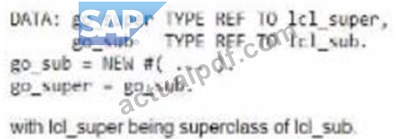
When accessing the subclass instance through go_super, what can you do? Note: There are 2 correct answers to this question.
- A. Call a subclass specific public method
- B. Call inherited public redefined methods.
- C. Access the inherited private components.
- D. Access the inherited public components.
Answer: C,D
Explanation:
When accessing the subclass instance through go_super, you can do both of the following:
Access the inherited private components: A subclass inherits all the private attributes and methods of its superclass, unless they are explicitly overridden by the subclass. Therefore, you can access the inherited private components of the superclass through go_super, as long as they are not hidden by other attributes or methods in the subclass12.
Access the inherited public components: A subclass inherits all the public attributes and methods of its superclass, unless they are explicitly overridden by the subclass. Therefore, you can access the inherited public components of the superclass through go_super, as long as they are not hidden by other attributes or methods in the subclass12.
You cannot do any of the following:
Call a subclass specific public method: A subclass does not have any public methods that are not inherited from its superclass. Therefore, you cannot call a subclass specific public method through go_super12.
Call inherited public redefined methods: A subclass does not have any public methods that are redefined from its superclass. Therefore, you cannot call inherited public redefined methods through go_super12.
NEW QUESTION # 31
Which function call produces the string 'LORE_IPSUM_FACTUM'?
- A. from_mixed( val = 'LorelpsumFactum' sep = '_' )
- B. to_mixed( val = 'LorelpsumFactum' sep = '_' )
- C. condense( to_upper( 'LorelpsumFactum' ) )
- D. to_upper( condense( 'LorelpsumFactum' ) )
Answer: A
Explanation:
Comprehensive and Detailed Explanation from Exact Extract:
* from_mixed converts a mixed-case string into uppercase with a chosen separator between words.
* Given input 'LorelpsumFactum', the function splits at uppercase letters, uppercases the parts, and joins them with _.
* Output: LORE_IPSUM_FACTUM.
* condense only removes extra spaces, to_upper only changes case, and to_mixed does the reverse of from_mixed.
Study Guide Reference: ABAP Keyword Documentation - String Functions (from_mixed, to_mixed).
NEW QUESTION # 32
Which of the following ABAP SQL statements are valid? Note: There are 2 correct answers to this question.
- A. SELECT FROM /dmo/connection FIELDS r-i carrid, airpfrom u GROUP BY carrid, connid INTO TABLE @DATA(It_hits).
- B. SELECT FROM /dmo/connection FIELDS carrid O airpfrom,
MAX(distance) AS dist_max, MIN( distance) AS dist_min GROUP BY carrid, airpfrom INTO TABLE @DATA(It_hits) - C. SELECT FROM /dmo/connection FIELDS V D MAX(distance) AS dist_max
MIN(distance) AS dist_min INTO TABLE @DATA(It_hits). - D. SELECT FROM /dmo/connection FIELDS \/ O carrid, airpfrom,
MAX( distance) AS dist_max, MIN(distance) AS dist_min INTO TABLE @DATA(It_hits)
Answer: B,D
Explanation:
The following are the explanations for each ABAP SQL statement:
A: This statement is valid. It selects the fields carrid, airpfrom, and the aggregate functions MAX(distance) and MIN(distance) from the table /dmo/connection, and groups the results by carrid and airpfrom. The aggregate functions are aliased as dist_max and dist_min. The results are stored in an internal table named It_hits, which is created using the inline declaration operator @DATA.
B: This statement is valid. It is similar to statement A, except that it does not specify the GROUP BY clause. This means that the aggregate functions are applied to the entire table, and the results are stored in an internal table named It_hits, which is created using the inline declaration operator @DATA.
C: This statement is invalid. It selects the aggregate functions MAX(distance) and MIN(distance) from the table /dmo/connection, but it does not specify any grouping or non-aggregate fields. This is not allowed in ABAP SQL, as the SELECT list must contain at least one non-aggregate field or a GROUP BY clause. The statement will cause a syntax error.
D: This statement is invalid. It selects the fields carrid and airpfrom from the table /dmo/connection, and groups the results by carrid and connid. However, the field connid is not included in the SELECT list, which is not allowed in ABAP SQL, as the GROUP BY clause must contain only fields that are also in the SELECT list. The statement will cause a syntax error.
NEW QUESTION # 33
Refer to the exhibit.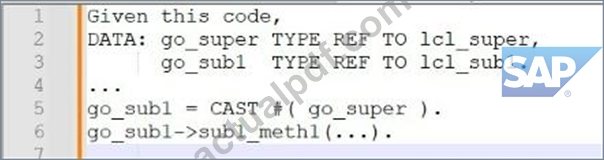
with which predicate condition can you ensure that the CAST will work?
- A. IS SUPPLIED
- B. IS NOT INITIAL
- C. IS INSTANCE OF
- D. IS BOUND
Answer: C
Explanation:
The predicate condition that can be used to ensure that the CAST will work is IS INSTANCE OF. The IS INSTANCE OF predicate condition checks whether the operand is an instance of the specified class or interface. This is useful when you want to perform a downcast, which is a conversion from a more general type to a more specific type. A downcast can fail if the operand is not an instance of the target type, and this can cause a runtime error. Therefore, you can use the IS INSTANCE OF predicate condition to check whether the downcast is possible before using the CAST operator12. For example:
The following code snippet uses the IS INSTANCE OF predicate condition to check whether the variable g_super is an instance of the class lcl_super. If it is, the CAST will work and the variable g_sub1 will be assigned the value of g_super.
DATA: g_super TYPE REF TO lcl_super, g_sub1 TYPE REF TO lcl_sub1. IF g_super IS INSTANCE OF lcl_super. g_sub1 = CAST #( g_super ). g_sub1->method( ... ). ENDIF.
You cannot do any of the following:
IS SUPPLIED: The IS SUPPLIED predicate condition checks whether an optional parameter of a method or a function module has been supplied by the caller. This is useful when you want to handle different cases depending on whether the parameter has a value or not. However, this predicate condition has nothing to do with the CAST operator or the type of the operand12.
IS NOT INITIAL: The IS NOT INITIAL predicate condition checks whether the operand has a non-initial value. This is useful when you want to check whether the operand has been assigned a value or not. However, this predicate condition does not guarantee that the CAST will work, because the operand may have a value but not be an instance of the target type12.
IS BOUND: The IS BOUND predicate condition checks whether the operand is a bound reference variable. This is useful when you want to check whether the operand points to an existing object or not. However, this predicate condition does not guarantee that the CAST will work, because the operand may point to an object but not be an instance of the target type12.
NEW QUESTION # 34
Given the following Core Data Service View Entity Data Definition:
1 @AccessControl.authorizationCheck: #NOT_REQUIRED
2 DEFINE VIEW ENTITY demo_flight_info_join
3 AS SELECT
4 FROM scarr AS a
5 LEFT OUTER JOIN scounter AS c
6 LEFT OUTER JOIN sairport AS p
7 ON p.id = c.airport
8 ON a.carrid = c.carrid
9 {
10 a.carrid AS carrier_id,
11 p.id AS airport_id,
12 c.countnum AS counter_number
13 }
In what order will the join statements be executed?
- A. scarr will be joined with scounter first and the result will be joined with sairport.
- B. sairport will be joined to scounter first and the result will be joined with scarr.
- C. scarr will be joined with sairport first and the result will be joined with scounter.
- D. scounter will be joined to sairport first and the result will be joined with scarr.
Answer: A
Explanation:
The order in which the join statements will be executed is:
scarr will be joined with scounter first and the result will be joined with sairport.
This is because the join statements are nested from left to right, meaning that the leftmost data source is joined with the next data source, and the result is joined with the next data source, and so on. The join condition for each pair of data sources is specified by the ON clause that follows the data source name. The join type for each pair of data sources is specified by the join operator that precedes the data source name. In this case, the join operator is LEFT OUTER JOIN, which means that all the rows from the left data source are included in the result, and only the matching rows from the right data source are included. If there is no matching row from the right data source, the corresponding fields are filled with initial values1.
Therefore, the join statements will be executed as follows:
First, scarr AS a will be joined with scounter AS c using the join condition a.carrid = c.carrid. This means that all the rows from scarr will be included in the result, and only the rows from scounter that have the same value for the carrid field will be included. If there is no matching row from scounter, the countnum field will be filled with an initial value.
Second, the result of the first join will be joined with sairport AS p using the join condition p.id = c.airport. This means that all the rows from the first join will be included in the result, and only the rows from sairport that have the same value for the id field as the airport field from the first join will be included. If there is no matching row from sairport, the id field will be filled with an initial value.
NEW QUESTION # 35
Which of the following are reasons to use the side-by-side extensibility pattern? Note: There are 3 correct answers to this question.
- A. An extension implements reactive (event based) process extensions
- B. An extension enhances an existing SAP Fiori UI
- C. An extension runs in the same logical unit of work (LUW) as an SAP S/4HANA application
- D. An extension is managed independently from SAP S/4HANA
- E. An extension uses its own data model with occasional consumption of data in SAP S/4HANA
Answer: A,D,E
NEW QUESTION # 36
In class ZCL_CLASS_A, you use the statement DATA var TYPE ***
What may stand in place of ***? Note: There are 2 correct answers to this question.
- A. The name of a domain from the ABAP Dictionary
- B. The name of a type defined privately in class ZCL_CLASS_A
- C. The name of a type defined privately in another class
- D. The name of a data element from the ABAP Dictionary
Answer: A,D
Explanation:
In class ZCL_CLASS_A, you use the statement DATA var TYPE *** to declare a data object named var with a data type specified by ***. The data type can be any of the following1:
A predefined ABAP type, such as i, f, c, string, xstring, and so on.
A data element from the ABAP Dictionary, such as matnr, carrid, bukrs, and so on. A data element defines the semantic and technical attributes of a data field, such as the domain, the length, the data type, the description, and the value range2.
A domain from the ABAP Dictionary, such as matnr_d, carrid_d, bukrs_d, and so on. A domain defines the technical attributes of a data field, such as the data type, the length, the output length, the number of decimal places, and the value range3.
A type defined globally in a class, an interface, or a type pool, such as zcl_class_b=>type_a, zif_interface_c=>type_b, ztype_pool_d=>type_c, and so on. A global type is a type that is defined in a global repository object and can be used in any program or class4.
A type defined locally in the current class, such as type_a, type_b, type_c, and so on. A local type is a type that is defined in the declaration part of a class and can only be used within the class5.
Therefore, the possible values for *** are B. the name of a data element from the ABAP Dictionary and D. the name of a domain from the ABAP Dictionary. The other options are not valid because:
A . The name of a type defined privately in class ZCL_CLASS_A is a local type and cannot be used with the DATA statement. A local type can only be used with the TYPES statement5.
C . The name of a type defined privately in another class is a private type and cannot be accessed from outside the class. A private type can only be used within the class that defines it.
NEW QUESTION # 37
Which of the following are features of Core Data Services (CDS)?
(Select 3 correct answers)
- A. Structured Query Language (SQL)
- B. Annotations
- C. Associations
- D. Delegation
- E. Inheritance
Answer: A,B,C
Explanation:
Comprehensive and Detailed Explanation from Exact Extract:
* Associations # # Supported in CDS to define relationships between entities without materializing joins.
* SQL (Structured Query Language) # # CDS is built on SQL semantics and supports declarative data modeling with SQL-based syntax.
* Annotations # # Used to enrich CDS artifacts with metadata for UI, OData exposure, and behavior.
* Delegation # # Not a CDS feature; belongs to OO or API design patterns.
* Inheritance # # Not supported in CDS entities; CDS focuses on associations and compositions.
Study Guide Reference: ABAP CDS User Guide - CDS View Features and Annotations.
NEW QUESTION # 38
......
Updated SAP Study Guide C-ABAPD-2507 Dumps Questions: https://examsboost.actualpdf.com/C-ABAPD-2507-real-questions.html
