

ActualPDF D-PST-MN-A-24 Dumps PDF - 100% Passing Guarantee
D-PST-MN-A-24 Braindumps Real Exam Updated on Jun 04, 2025 with 63 Questions
EMC D-PST-MN-A-24 Exam Syllabus Topics:
| Topic | Details |
|---|---|
| Topic 1 |
|
| Topic 2 |
|
| Topic 3 |
|
| Topic 4 |
|
| Topic 5 |
|
NEW QUESTION # 32
What safety equipment is critical to have on hand to avoid equipment failure before replacing any components in a Dell EMC PowerStore array?
- A. Maintenance Kit
- B. Rail Kit
- C. Stabilization Kit
- D. ESD Kit
Answer: D
Explanation:
When replacing any components in a Dell EMC PowerStore array, it is critical to have an Electrostatic Discharge (ESD) Kit on hand to avoid equipment failure. The ESD Kit typically includes tools like wristbands and gloves that help prevent static electricity from damaging the electronic components during the replacement process.
Before beginning any maintenance work on the PowerStore array, it is essential to:
Use the ESD wristband by attaching one end to your wrist and connecting the other end to a grounded object.
Wear ESD gloves to handle sensitive components.
Ensure that the work area is free from static-prone materials and conditions.
Follow the detailed safety precautions and procedures outlined in the PowerStore Installation and Service Guide1.
Using an ESD Kit is a standard safety practice in the maintenance of electronic equipment, as static electricity can cause irreparable damage to sensitive components. The Dell PowerStore Installation and Service Guide provides comprehensive safety instructions, including the use of ESD protection, to ensure the safe handling of replaceable units2.
NEW QUESTION # 33
Order the NDU operational steps.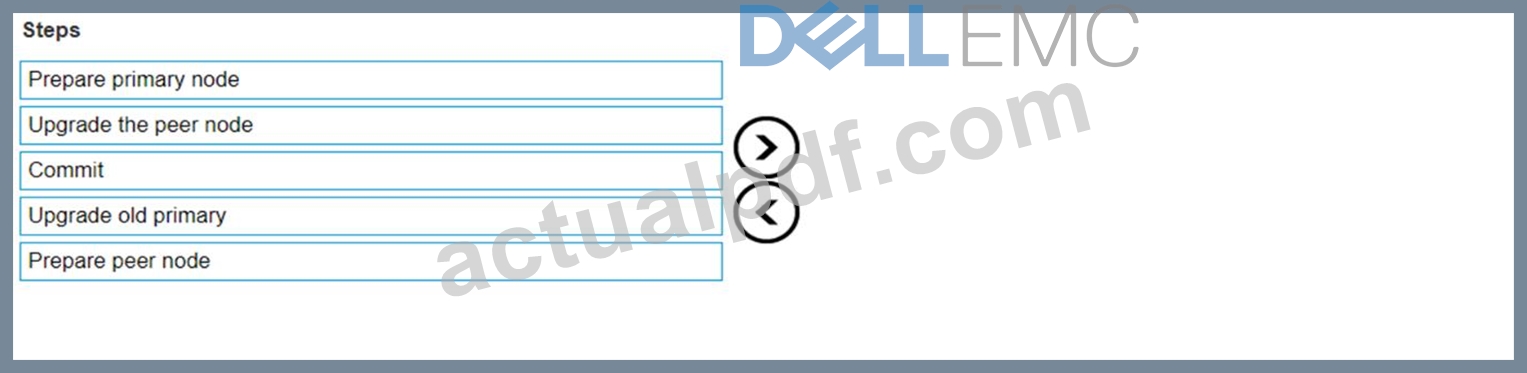
Answer:
Explanation: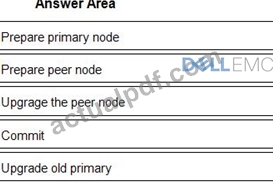
1 - Prepare primary node
2 - Prepare peer node
3 - Upgrage the peer node
4 - Commit
5 - Upgrade old primary
NEW QUESTION # 34
What is the default log collection schedule?
- A. Weekly
- B. As scheduled during install
- C. Hourly
- D. Daily
Answer: A
Explanation:
The default log collection schedule for Dell PowerStore is set to a weekly basis. This schedule is designed to balance the need for regular monitoring with the storage and processing considerations of collecting logs. Collecting logs on a weekly basis provides a sufficient overview of the system's performance and any potential issues that may arise, without overwhelming the system administrators with too much data.
The log collection process includes gathering various logs that may be required for troubleshooting PowerStore issues, such as Support Materials, Performance Metrics Archives, Dump Files, and others. The process can be initiated through the PowerStore Manager user interface or using the CLI in an SSH session1.
For more detailed information on log collection schedules and procedures, administrators should refer to the official Dell PowerStore documentation, which provides comprehensive instructions on how to generate, collect, and manage logs for effective system maintenance and troubleshooting1.
NEW QUESTION # 35
How many fan module failures can a node tolerate?
- A. 0
- B. 1
- C. 2
- D. 3
Answer: A
Explanation:
A Dell EMC PowerStore node can tolerate one fan module failure. The system is designed with redundancy to ensure that if a single fan module fails, the remaining fan modules can compensate for the loss and maintain proper cooling to prevent overheating1. The system will increase the speed of the remaining fans to ensure continued cooling.
When a fan module failure occurs, the system will generate an alert to notify the administrator of the fault. The administrator should then take the following steps:
Acknowledge the alert in the PowerStore Manager.
Plan for the replacement of the faulted fan module as soon as possible to restore full redundancy.
Follow the replacement procedures as outlined in the Dell PowerStore Installation and Service Guide1.
It is important to address fan module failures promptly to ensure the long-term health and performance of the PowerStore system. The increased fan speed is a temporary measure to maintain operations until the faulted fan module can be replaced.
NEW QUESTION # 36
In which step of the ICW can the configuration details be exported?
- A. License Configuration
- B. Support Assist
- C. Cluster Configuration
- D. Cluster Details
Answer: C
Explanation:
The configuration details can be exported during the Cluster Configuration step of the Initial Configuration Wizard (ICW) for Dell PowerStore. This step allows the user to review the chosen configuration information, validate the configuration, and initiate the cluster creation. It is at this point that the option to export the configuration details is provided1.
For a detailed guide on how to navigate the ICW and export configuration details, users should refer to the official Dell PowerStore Manager Overview documentation or the PowerStore Info Hub, which includes product documentation and videos that assist with PowerStore deployment and maintenance12. It is important to follow the official documentation to ensure that the process is carried out correctly and to maintain system integrity and compliance with warranty and support agreements.
NEW QUESTION # 37
How is a service laptop IP configured to connect to the Service LAN port of a Dell EMC PowerStore node?
- A. Static IP: 128.221.1.249 and netmask: 255.255.255.0
- B. Obtain IP address from DHCP on PowerStore
- C. Static IP: 169.254.1.249 and netmask: 255.0.0.0
- D. Leave IP address and netmask unconfigured
Answer: A
Explanation:
To connect a service laptop to the Service LAN port of a Dell EMC PowerStore node, the laptop's Ethernet interface should be configured with a static IP address and netmask. The correct configuration is:
IP: 128.221.1.249
Netmask: 255.255.255.0
Gateway: None1
This configuration allows the service laptop to communicate with the PowerStore nodes for SSH and PowerStore Manager (UI) access. It's important to note that the laptop can be physically connected to one of the PowerStore nodes at a time, or to both nodes' Service LAN ports using a small switch or hub. However, multiple appliances should never be connected to the same hub or switch as the nodes use the same internal IPs1.
Once the IP is configured as shown above and the physical connection is established, you can ping the relevant IPs:
Node A: 128.221.1.250
Node B: 128.221.1.251
You should only be able to ping the IPs where you are physically connected to. If you can ping, you can proceed to use SSH to connect to the IPs over port 22 using your preferred SSH client. For file transfers, SCP protocol must be used1.
For more detailed instructions on how to connect to the system over the Service LAN Ports for SSH and PowerStore Manager access, refer to the Dell Support Knowledge Base Article1.
NEW QUESTION # 38
Refer to the exhibit.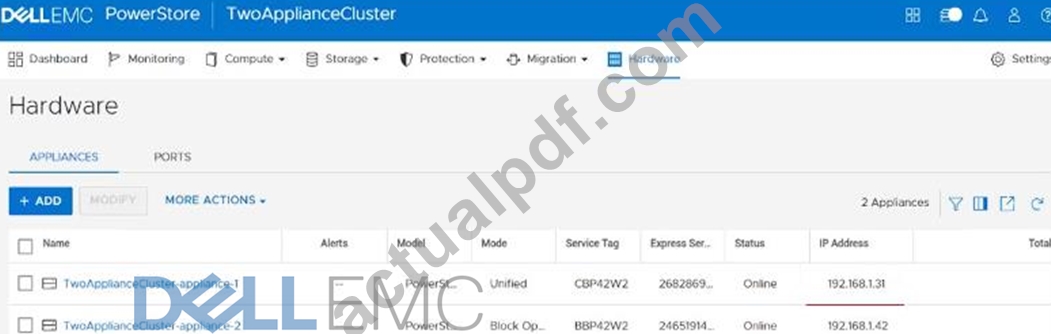
Which column indicates the primary appliance?
- A. Mode
- B. Service Tag
- C. Model
- D. IP Address
Answer: A
Explanation:
In the Dell EMC PowerStore system, the primary appliance is typically indicated by the 'Mode' column within the system's user interface. The 'Mode' column shows the operational mode of the appliance, which can include states such as 'Primary', 'Secondary', or 'Standby'. The primary appliance is the one that is actively servicing workloads and managing operations within the PowerStore cluster1.
The 'Service Tag' column represents the unique identifier for each physical appliance, the 'Model' column indicates the specific model of the appliance, and the 'IP Address' column shows the network address assigned to the appliance. While these columns provide important information, they do not indicate the role of the appliance within the cluster.
For more detailed information on identifying the primary appliance and understanding the role of each appliance in a PowerStore cluster, users can refer to the Dell PowerStore Clustering and High Availability documentation1. This documentation provides insights into the clustering architecture of PowerStore and how the primary appliance is determined during the initial configuration process.
NEW QUESTION # 39
Under which condition does the Dell EMC PowerStore equipment in the rack require additional stability?
- A. Unstable humidity
- B. High temperatures
- C. When shipping the system
- D. Low temperatures
Answer: C
Explanation:
When shipping the system, additional stability is necessary to ensure that the equipment remains secure and undamaged during transportation. Proper stabilization prevents any potential movement or impact that could harm the delicate components of the system.
NEW QUESTION # 40
Which network traffic is encrypted using IPsec?
- A. Internal network
- B. Storage network
- C. Service network
- D. Management network
Answer: D
Explanation:
In Dell PowerStore systems, IPsec is used to encrypt traffic for the management network. IPsec (Internet Protocol Security) is a suite of protocols designed to ensure the integrity, confidentiality, and authentication of data communications over an IP network. Encrypting the management network traffic with IPsec is a best practice to secure communication between the management console and the storage system, protecting against potential eavesdropping and unauthorized access1.
The management network is responsible for the overall administration and operation of the storage system, including configuration management, performance monitoring, and system updates. By encrypting this traffic, Dell PowerStore ensures that sensitive management operations are secured.
For detailed information on configuring IPsec for the management network and other best practices for network security within Dell PowerStore environments, users should refer to the official Dell PowerStore documentation, such as the Deployment KB: PowerStore: User Network Firewall Rules Tool and the Dell PowerStore Best Practices Guide12. These documents provide comprehensive guidelines on network configurations, including firewall rules and encryption settings, to maintain the highest levels of security and system integrity.
NEW QUESTION # 41
When looking at the base enclosure front view, what does a solid amber drive LED indicate?
- A. Discover new drive
- B. Rebuild activity
- C. Normal activity
- D. Faulted drive
Answer: D
Explanation:
When observing the base enclosure front view of a Dell PowerStore system, a solid amber drive LED is an indication of a faulted drive. This LED status is used to alert the storage administrator that there is a fault within the drive that requires attention12.
The LED states for the Dell PowerStore base enclosure are as follows:
Blue: Power is on, and no fault has occurred.
Solid Amber: Power is on, and a fault has occurred within the enclosure.
Blue after Amber Alternating: Power is on, but the system is not initialized.
Off: Power is off.
In the event of a solid amber LED, the recommended steps are:
Identify the faulted drive: Look for the drive with the solid amber LED.
Check the PowerStore Manager: Use the PowerStore Manager to identify the specific error or fault code associated with the drive.
Follow the troubleshooting steps: Refer to the Dell PowerStore Troubleshooting Guide for detailed steps on resolving the issue with the faulted drive.
Replace the drive if necessary: If the drive is determined to be faulty and cannot be recovered, follow the Dell PowerStore Hardware Information Guide for instructions on safely replacing the drive.
For more detailed information and guidance, refer to the official Dell PowerStore documentation, such as the PowerStore Hardware Information Guide and the PowerStore Troubleshooting Guide, or contact Dell support directly
NEW QUESTION # 42
What is the protocol used for the storage network?
- A. FC
- B. iSCSI
- C. NFS
- D. SMB
Answer: A
Explanation:
The protocol used for the storage network in Dell PowerStore systems is Fibre Channel (FC). FC is a high-speed network technology primarily used for storage networking. Dell PowerStore utilizes FC as part of its all-NVMe design, which also includes NVMe-over-fabric networking to deliver low latency performance for storage workloads1.
Fibre Channel provides several benefits for storage networks, including:
High throughput and low latency for storage operations.
Support for long-distance networking, which is beneficial for disaster recovery and remote backups.
A mature and widely supported ecosystem with a variety of hardware and software options.
For detailed information on configuring and using FC with Dell PowerStore, administrators should refer to the Dell PowerStore Networking Guide for Storage Services and the Dell PowerStore Best Practices Guide. These documents provide comprehensive instructions on network configurations, including best practices for setting up and managing FC networks within Dell PowerStore environments23. Following these guidelines ensures optimal performance and reliability of the storage network.
NEW QUESTION # 43
What does the command "svc_journalctl -f -g "st_io_monitor""do?
- A. Deletes all logs before the specified error
- B. Ignores log messages from the specified error and re-occurring errors
- C. Retrieves log messages from the specified error and watches for re-occurrence
- D. Rotates the log based on the specified error
Answer: C
Explanation:
The command svc_journalctl -f -g "st_io_monitor" is used within the Dell PowerStore environment to retrieve log messages that are associated with the specified error, in this case, "st_io_monitor", and to monitor for their re-occurrence. The -f flag is typically used to follow the log, meaning it will continue to output new log messages as they are appended to the journal. The -g flag is used to filter the log output based on a specific pattern1.
This command is part of the suite of service scripts provided by Dell for system maintenance and troubleshooting. It enables service technicians and system administrators to view log messages from the system journal in a consistent and easy-to-read format, which is crucial for diagnosing and resolving issues1.
For more detailed information on using this command and understanding the system journal logs, users should refer to the Dell PowerStore Service Scripts Guide or contact Dell Support for technical assistance1. It's important to use these commands as per the guidelines provided in the official documentation to ensure proper system maintenance and to avoid any unintended consequences.
NEW QUESTION # 44
Under which condition does the Dell EMC PowerStore equipment in the rack require additional stability?
- A. Unstable humidity
- B. High temperatures
- C. When shipping the system
- D. Low temperatures
Answer: C
Explanation:
The Dell EMC PowerStore equipment in the rack requires additional stability when shipping the system.
When preparing Dell EMC PowerStore equipment for shipping, it is crucial to ensure that the system is stable and secure to prevent any damage during transit.
Additional stability measures might include securing the equipment within the rack using appropriate brackets, using pallets designed for shipping heavy equipment, and ensuring that the rack is properly balanced.
The need for additional stability is not typically associated with environmental conditions such as humidity or temperature but is a standard precaution during the physical movement of the system to safeguard against vibrations, shocks, and impacts that can occur during shipping1.
For detailed procedures and best practices regarding the shipping and handling of Dell EMC PowerStore equipment, it is recommended to consult the official Dell EMC PowerStore documentation or contact Dell EMC support.
NEW QUESTION # 45
What is the result of setting a VLAN ID of 0 on a network when running ICW for Dell EMC PowerStore?
- A. Default route is set
- B. Network will pass tagged traffic
- C. Network will pass untagged traffic
- D. Static route is set
Answer: C
Explanation:
Setting a VLAN ID of 0 on a network when running the Initial Configuration Wizard (ICW) for Dell EMC PowerStore indicates that the network will pass untagged traffic. In the context of VLANs, an ID of 0 is typically reserved to identify priority frames and is often used to indicate that a frame is not associated with a specific VLAN; hence, it is untagged1.
In practice, this means that when VLAN ID 0 is set during the ICW, the PowerStore system will treat the traffic as belonging to the native VLAN, which carries untagged traffic. This is important for network configurations where certain ports are expected to handle traffic that is not tagged for any specific VLAN.
For more detailed information on VLAN configurations and the implications of setting different VLAN IDs during the ICW, administrators should refer to the official Dell PowerStore Network Administration documentation. This documentation provides guidelines on network settings, including VLAN configurations, to ensure proper communication and operation within the storage network infrastructure.
NEW QUESTION # 46
Which account credentials are needed to run diagnostic commands?
- A. admin
- B. service
- C. console
- D. root
Answer: B
Explanation:
The account credentials needed to run diagnostic commands on Dell PowerStore Maintenance are for the service account.
The service account is specifically designed for performing specialized service functions, including running diagnostic commands1.
To run service commands, you would typically:
Enable SSH in PowerStore Manager under Settings.
Use an SSH client to connect to the management IP.
Log in using the username and password for the service account2.
The service account has the necessary permissions to execute service scripts and commands that are used for diagnostics and troubleshooting3.
It is important to note that the service account password should be changed from the default during the initial configuration of the appliance for security purposes1.
For more detailed information on using the service account for diagnostics and other service tasks, refer to the Dell PowerStore Service Scripts Guide or contact Dell Support.
NEW QUESTION # 47
What is the maximum number of expansion enclosures that a single Dell EMC PowerStore 9000T appliance supports?
- A. 0
- B. 1
- C. 2
- D. 3
Answer: A
Explanation:
The maximum number of expansion enclosures that a single Dell EMC PowerStore 9000T appliance supports is three. This is consistent with the design and specifications provided by Dell for the PowerStore series, which allows for scalability within the storage environment1.
The expansion enclosures are used to increase the storage capacity of the PowerStore system beyond what is available in the base enclosure. Each expansion enclosure connects to the base appliance and adds additional drive slots for storage expansion.
For detailed information on the configuration and limitations of expansion enclosures for the PowerStore 9000T model, administrators should refer to the official Dell PowerStore Hardware Information Guide and the Dell PowerStore Technical Primer. These documents provide comprehensive guidelines on the physical and logical expansion capabilities of the PowerStore systems23. Adhering to these specifications is crucial to ensure proper system performance and to avoid unsupported configurations.
NEW QUESTION # 48
......
D-PST-MN-A-24 Dumps With 100% Verified Q&As - Pass Guarantee or Full Refund: https://examsboost.actualpdf.com/D-PST-MN-A-24-real-questions.html
