

2025 Correct and Up-to-date Juniper JN0-637 BrainDumps
Current JN0-637 dumps Preparation through Our Practice Test
NEW QUESTION # 10
In a multinode HA environment, which service must be configured to synchronize between nodes?
- A. Advanced policy-based routing
- B. IPsec VPN
- C. IDP
- D. PKI certificates
Answer: D
NEW QUESTION # 11
Exhibit
Referring to the exhibit, which two statements are true about the CAK status for the CAK named
"FFFP"? (Choose two.)
- A. CAK is not used for encryption and decryption of the MACsec session.
- B. SAK is successfully generated using this key.
- C. CAK is used for encryption and decryption of the MACsec session.
- D. SAK is not generated using this key.
Answer: C,D
NEW QUESTION # 12
You are enabling advanced policy-based routing. You have configured a static route that has a next hop from the inet.0 routing table. Unfortunately, this static route is not active in your routing instance.
In this scenario, which solution is needed to use this next hop?
- A. Use RIB groups.
- B. Use policies.
- C. Use transparent mode.
- D. Use filter-based forwarding.
Answer: A
Explanation:
To enable advanced policy-based routing in Junos OS and activate a static route with a next-hop address in the inet.0 table within your routing instance, you should utilize RIB groups. RIB groups allow you to import routes from one routing table to another. In this scenario, the static route within the routing instance needs access to the inet.0 routes, which is facilitated by configuring a RIB group. Juniper's documentation outlines RIB groups as a necessary component for handling instances where routes need to be shared across routing tables, thereby ensuring seamless traffic flow through specified routes. For more details, refer to the Juniper Networks Documentation on RIB Groups.
NEW QUESTION # 13
Exhibit: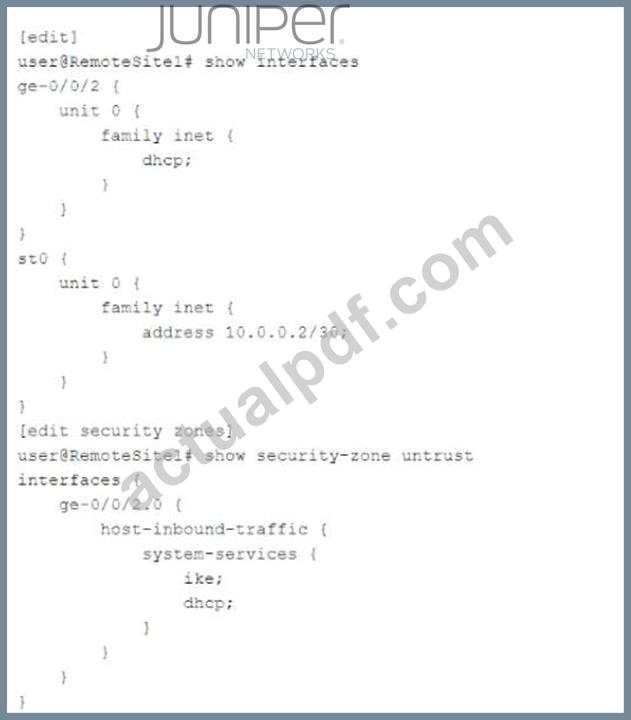
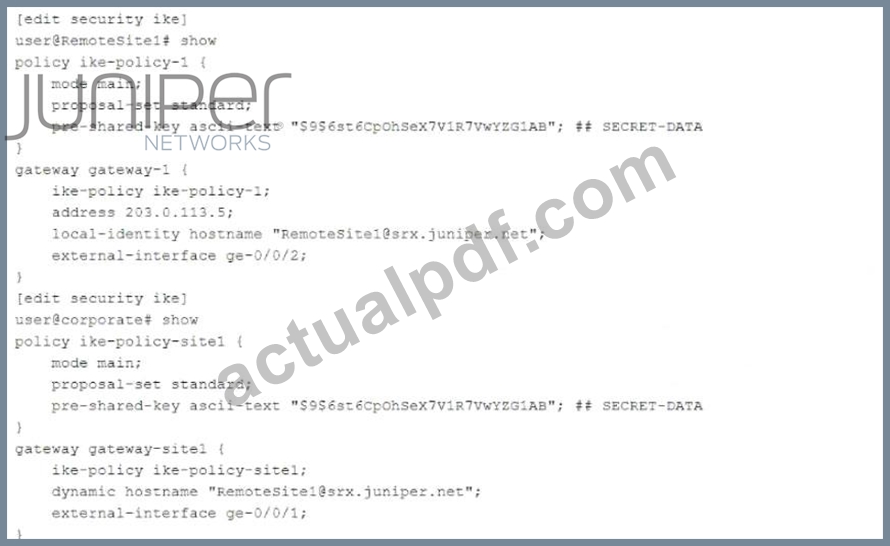
You are troubleshooting a new IPsec VPN that is configured between your corporate office and the RemoteSite1 SRX Series device. The VPN is not currently establishing. The RemoteSite1 device is being assigned an IP address on its gateway interface using DHCP.
Which action will solve this problem?
- A. On both devices, change the IKE policy mode to aggressive.
- B. On the RemoteSite1 device, change the IKE gateway external interface to st0.0.
- C. On both devices, change the IKE version to use version 2 only.
- D. On both devices, change the IKE policy proposal set to basic.
Answer: A
Explanation:
Aggressive mode is required when an IP address is dynamically assigned, such as through DHCP, as it allows for faster establishment with less identity verification. More details are available in Juniper IKE and IPsec Configuration Guide.
The configuration shown in the exhibit highlights that the RemoteSite1 SRX Series device is using DHCP to obtain an IP address for its external interface (ge-0/0/2). This introduces a challenge in IPsec VPN configurations when the public IP address of the remote site is not static, as is the case here.
Aggressive mode in IKE (Internet Key Exchange) is designed for situations where one or both peers have dynamically assigned IP addresses. In this scenario, aggressive mode allows the devices to exchange identifying information, such as hostnames, rather than relying on static IP addresses, which is necessary when the remote peer (RemoteSite1) has a dynamic IP from DHCP.
* Correct Action (D): Changing the IKE policy mode to aggressive will resolve the issue by allowing the two devices to establish the VPN even though one of them is using DHCP. In aggressive mode, the initiator can present its identity (hostname) during the initial handshake, enabling the VPN to be established successfully.
* Incorrect Options:
* Option A: Changing the external interface to st0.0 is incorrect because the st0 interface is used for the tunnel interface, not for the IKE negotiation.
* Option B: Changing to IKE version 2 would not resolve the dynamic IP issue directly, and IKEv1 works in this scenario.
* Option C: Changing the IKE proposal set to basic doesn't address the dynamic IP challenge in this scenario.
Juniper References:
* Juniper IKE and VPN Documentation: Provides details on when to use aggressive mode, especially when a dynamic IP address is involved.
NEW QUESTION # 14
According to the log shown in the exhibit, you notice the IPsec session is not establishing.
What is the reason for this behavior?
- A. Mismatched peer ID
- B. Mismatched preshared key
- C. Mismatched proxy ID
- D. Incorrect peer address.
Answer: A
Explanation:
https://www.juniper.net/documentation/en_US/release-independent/nce/topics/example/policy-based- vpn-using-j-series-srxseries-device-configuring.html
NEW QUESTION # 15
Exhibit: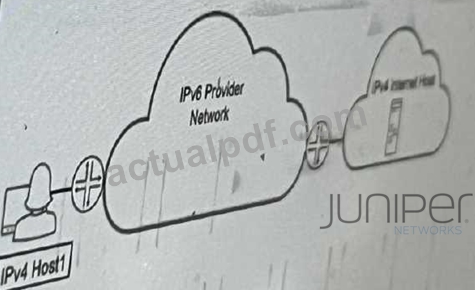
Referring to the exhibit, which technology would you use to provide communication between IPv4 host1 and ipv4 internal host
- A. full cone NAT
- B. DS-Lite
- C. NAT46
- D. NAT444
Answer: B
NEW QUESTION # 16
Exhibit
Referring to the exhibit, which two statements are true about the CAK status for the CAK named
"FFFP"? (Choose two.)
- A. CAK is not used for encryption and decryption of the MACsec session.
- B. SAK is successfully generated using this key.
- C. CAK is used for encryption and decryption of the MACsec session.
- D. SAK is not generated using this key.
Answer: C,D
NEW QUESTION # 17
You need to generate a certificate for a PKI-based site-to-site VPN. The peer is expecting to user your domain name vpn.juniper.net.
Which two configuration elements are required when you generate your certificate request?
(Chose two,)
- A. email [email protected]
- B. domain-name vpn.juniper.net
- C. ip-address 10.100.0.5
- D. subject CN=vpn.juniper.net
Answer: B,D
NEW QUESTION # 18
Exhibit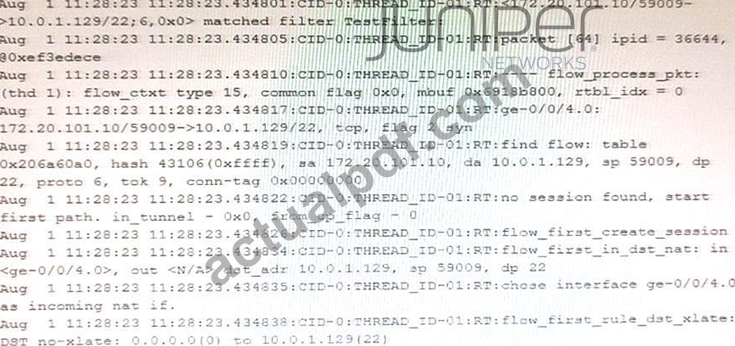
The exhibit shows a snippet of a security flow trace.
In this scenario, which two statements are correct? (Choose two.)
- A. This packet arrived on interface ge-0/0/4.0.
- B. The capture is a packet from the source address 172.20.101.10 destined to 10.0.1.129.
- C. Destination NAT occurs.
- D. An existing session is found in the table.
Answer: B,D
NEW QUESTION # 19
You are deploying a virtualization solution with the security devices in your network Each SRX Series device must support at least 100 virtualized instances and each virtualized instance must have its own discrete administrative domain.
In this scenario, which solution would you choose?
- A. virtual router instances
- B. logical systems
- C. tenant systems
- D. VRF instances
Answer: B
NEW QUESTION # 20
Exhibit: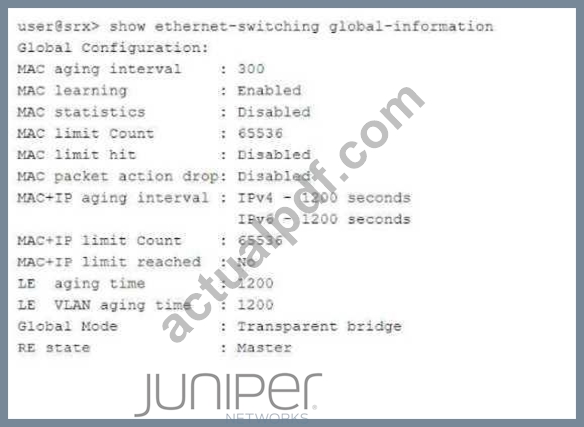
Referring to the exhibit, which two statements are correct? (Choose two.)
- A. The device cannot pass Layer 2 and Layer 3 traffic at the same time.
- B. You can secure inter-VLAN traffic with a security policy on this device.
- C. The device can pass Layer 2 and Layer 3 traffic at the same time.
- D. You cannot secure intra-VLAN traffic with a security policy on this device.
Answer: B,C
Explanation:
The exhibit provides information about an SRX Series device operating in transparent mode (Layer 2) and Layer 3 routing at the same time.
The SRX device can secure inter-VLAN traffic because it supports security policies for Layer 3 traffic between different VLANs. In this case, traffic moving between different VLANs (i.e., Layer 3 traffic) can be processed and controlled using security policies.
The SRX device can handle both Layer 2 and Layer 3 traffic simultaneously. In mixed mode, the device is capable of switching traffic at Layer 2 (intra-VLAN) while also routing traffic at Layer 3 (inter-VLAN). This is evident from the global configuration showing transparent bridge mode and Layer 3 interfaces.
NEW QUESTION # 21
You have noticed a high number of TCP-based attacks directed toward your primary edge device.
You are asked to configure the IDP feature on your SRX Series device to block this attack.
Which two IDP attack objects would you configure to solve this problem? (Choose two.)
- A. Signature
- B. host
- C. Network
- D. Protocol anomaly
Answer: A,D
NEW QUESTION # 22
Exhibit: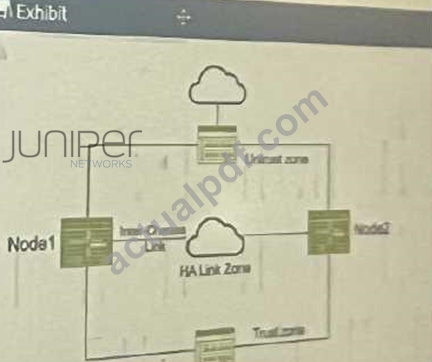
You have deployed a pair of SRX series devices in a multimode HA environment. You need to enable IPsec encryption on the interchassis link.
Referring to the exhibit, which three steps are required to enable ICL encryption? (Choose three.)
- A. Install the Junos IKE package on both nodes.
- B. Enable HA link encryption in the IKE profile on both nodes,
- C. Configure a VPN profile for the HA traffic and apply to both nodes.
- D. Enable OSPF for both interchassis link interfaces and tum on the dynamic-neighbors parameter.
- E. Enable HA link encryption in the IPsec profile on both nodes.
Answer: A,C,E
Explanation:
A: Install the Junos IKE package on both nodes. While I previously stated that IKE is usually included in the base Junos OS image, it's essential to ensure that the necessary IKE package is indeed installed and enabled on both SRX nodes to support ICL encryption. C. Configure a VPN profile for the HA traffic and apply it to both nodes. This dedicated VPN profile defines the security parameters (encryption algorithms, authentication, etc.) specifically for the ICL traffic.
NEW QUESTION # 23
Exhibit: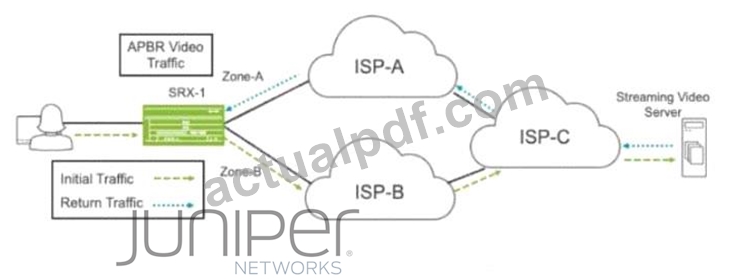
Referring to the exhibit, a default static route on SRX-1 sends all traffic to ISP-A. You have configured APBR to send all requests for streaming video traffic to ISP-B. However, the return traffic from the streaming video server is coming through ISP-A, and the traffic is being dropped by SRX-1. You can only make changes on SRX-1.
How do you solve this problem?
- A. Enable AppTrack to keep track of the sessions and zones for the streaming video traffic.
- B. Change the APBR routing instance from a forwarding instance to a virtual router instance.
- C. Configure BGP to control the return path of the streaming video traffic.
- D. Place both ISP-facing interfaces in the same zone.
Answer: B
Explanation:
A virtual router instance allows for independent routing tables, which helps manage asymmetric routing issues in APBR configurations. This ensures both initial and return traffic follow the same path, resolving session issues. Further details: Juniper APBR Configuration.
The issue in the scenario stems from asymmetric routing. The SRX-1 device sends streaming traffic to ISP-B (as intended) using APBR, but the return traffic is coming back through ISP-A due to the default route.
Because APBR uses forwarding instances, the traffic is dropped when it returns through a different zone.
To solve this:
* Change APBR routing instance to a virtual router (Answer B): By changing the APBR routing instance to a virtual router, the SRX will maintain separate routing tables for each ISP, ensuring proper bidirectional traffic flow. Virtual routers provide independent routing tables and are ideal for ensuring traffic symmetry in multi-homed environments.
Example Command:
bash
Copy code
set routing-instances ISP-B instance-type virtual-router
set routing-instances ISP-B routing-options static route 0.0.0.0/0 next-hop 192.0.2.1 By implementing virtual routing instances, you can resolve the asymmetry and ensure that both outbound and return traffic use the same ISP.
NEW QUESTION # 24
Exhibit: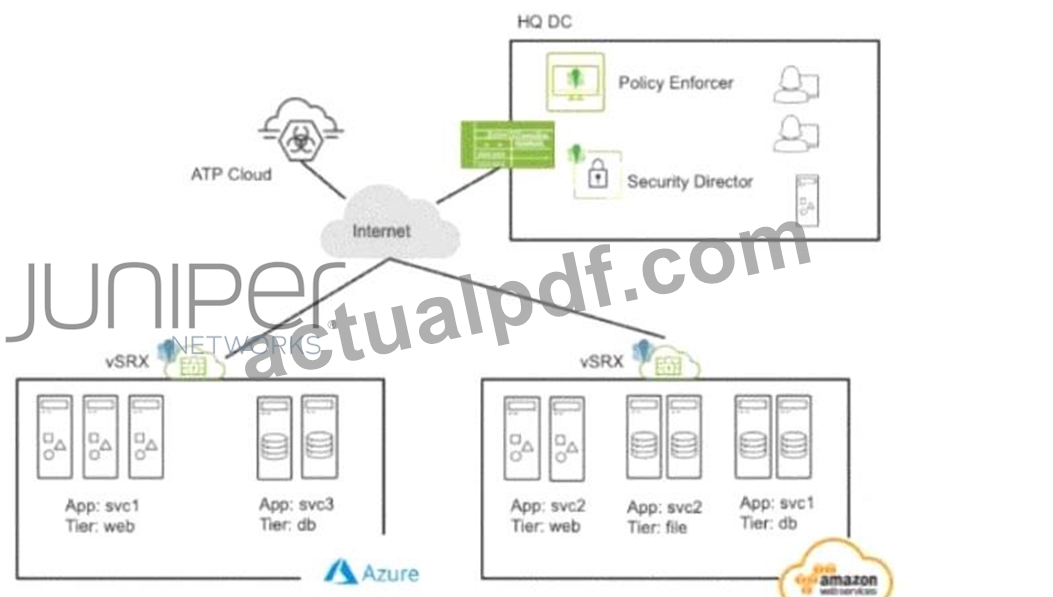
Referring to the exhibit, what do you use to dynamically secure traffic between the Azure and AWS clouds?
- A. You can dynamically secure traffic between the clouds by using security tags in the security policies.
- B. You can dynamically secure traffic between the clouds by using advanced connection tracking in the security policies.
- C. You can dynamically secure traffic between the clouds by using user identities in the security policies.
- D. You can dynamically secure traffic between the clouds by using URL filtering in the security policies.
Answer: A
Explanation:
Security tags facilitate dynamic traffic management between cloud environments like Azure and AWS. Tags allow flexible policies that respond to cloud-native events or resource changes, ensuring secure inter-cloud communication. For more information, see Juniper Cloud Security Tags.
In the scenario depicted in the exhibit, where traffic needs to be dynamically secured betweenAzureandAWS clouds, the best method to achieve dynamic security is by usingsecurity tagsin the security policies.
* Explanation of Answer C (Security Tags in Security Policies):
* Security tagsallow dynamic enforcement of security policies based on metadata rather than static IP addresses or zones. This is crucial in cloud environments, where resources and IP addresses can change dynamically.
* Using security tags in the security policies, you can associate traffic flows with specific applications, services, or virtual machines, regardless of their underlying IP addresses or network locations. This ensures that security policies are automatically updated as cloud resources change.
Juniper Security Reference:
* Dynamic Security with Security Tags: This feature allows you to dynamically secure cloud-based traffic using metadata and tags, ensuring that security policies remain effective even in dynamic environments. Reference: Juniper Security Tags Documentation.
NEW QUESTION # 25
You configured two SRX series devices in an active/passive multimode HA setup.
In this scenario, which statement is correct?
- A. Both devices start in the undiscovered state until the activeness determination process is completed.
- B. Both devices are in the active state until the activeness determine determination process is completed.
- C. Both devices start in a hold state until the activeness determination process is completed.
- D. Both devices are in the passive state until the activeness determination process is completed.
Answer: B
NEW QUESTION # 26
You are configuring an interconnect logical system that is configured as a VPLS switch to allow two logical systems to communicate.
Which two parameters are required when configuring the logical tunnel interfaces? (Choose two.)
- A. Encapsulation ethernet-vpls must be used.
- B. The virtual tunnel interfaces should only be configured with two logical unit pairs per logical system interconnect.
- C. The logical tunnel interfaces should be configured with two logical unit pairs per logical system interconnect.
- D. Encapsulation ethernet must be used.
Answer: C,D
Explanation:
When configuring interconnect logical systems to act as a VPLS switch between two logical systems, the following configurations are necessary:
* Encapsulation Ethernet (Answer A): The logical tunnel interface must be configured with encapsulation ethernet. This allows the interface to carry Ethernet traffic between the logical systems.
Command Example:
bash
Copy code
set interfaces lt-0/0/0 encapsulation ethernet
* Two Logical Unit Pairs (Answer C): Each logical tunnel interface should have two logical unit pairs defined to facilitate communication between the two logical systems. One logical unit pair connects each logical system.
Command Example:
bash
Copy code
set interfaces lt-0/0/0 unit 0 family ethernet-switching
set interfaces lt-0/0/0 unit 1 family ethernet-switching
These settings are necessary for creating a logical tunnel for VPLS and allowing traffic between the logical systems.
NEW QUESTION # 27
......
Juniper JN0-637 Exam Syllabus Topics:
| Topic | Details |
|---|---|
| Topic 1 |
|
| Topic 2 |
|
| Topic 3 |
|
| Topic 4 |
|
| Topic 5 |
|
| Topic 6 |
|
| Topic 7 |
|
100% Reliable Microsoft JN0-637 Exam Dumps Test Pdf Exam Material: https://examsboost.actualpdf.com/JN0-637-real-questions.html
