

ActualPDF HPE6-A70 Exam Questions | Real HPE6-A70 Practice Dumps
Verified HPE6-A70 Exam Dumps Q&As - Provide HPE6-A70 with Correct Answers
How to schedule Aruba Certified Mobility Associate (HP HPE6-A70) Professional Exam
To apply for the Aruba Certified Mobility Associate (HP HPE6-A70) Professional Exam, You have to follow these steps:
- Step 1: Go to the Aruba Certified Mobility Associate (HP HPE6-A70) Professional Official Site. You must first create an account, use your email address to register. You must purchase your training through your local distributor. If you are a partner, you must first create an account on the Partner Portal. You must use your company email address to register.
- Step 2: Read the instruction Carefully
- Step 3: Follow the given steps
- Step 4: Apply for the Aruba Certified Mobility Associate (HP HPE6-A70)-Professional Exam
For queries, contact your regional training team:
Exam Topics for Aruba Certified Mobility Associate (HP HPE6-A70) Professional Exam
The following will be practiced in HP HPE6-A70 practice exam and HP HPE6-A70 practice exams:
- AP Provisioning
- Guest Access
- Control and monitor Aruba solutions
HP HPE6-A70 Exam Syllabus Topics:
| Topic | Details |
|---|---|
| Topic 1 |
|
| Topic 2 |
|
| Topic 3 |
|
| Topic 4 |
|
| Topic 5 |
|
| Topic 6 |
|
| Topic 7 |
|
| Topic 8 |
|
| Topic 9 |
|
| Topic 10 |
|
| Topic 11 |
|
| Topic 12 |
|
| Topic 13 |
|
NEW QUESTION 73
Exhibit 1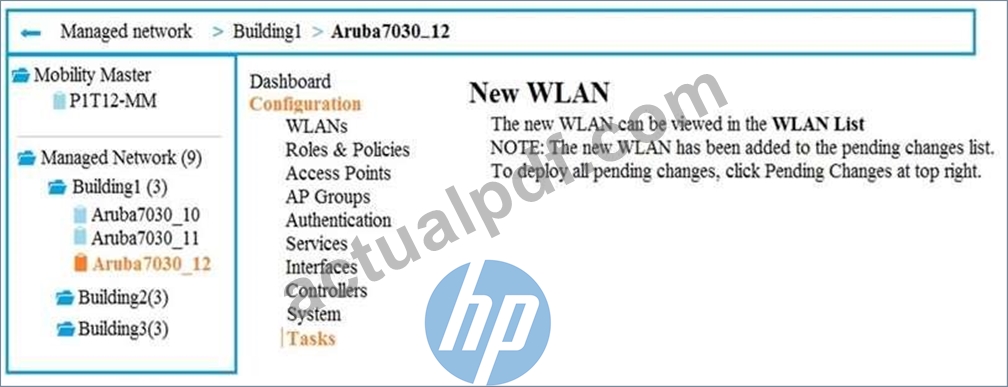
Exhibit 2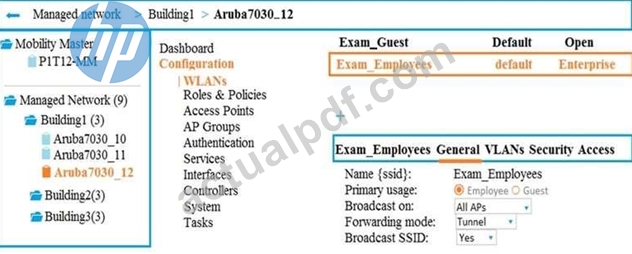
A company has an Aruba Mobility Master (MM)-based solution and needs a new WLAN for the corporate campus. A network administrator completes the creation of this WLAN, as shown in Exhibit 1. When the administrator tries to test a connection to the WLAN in various locations, the WLAN sometimes shows up in the list of WLANs on the client but sometimes does not. The administrator can see the WLAN in the list, as shown in Exhibit 2.
What is the error?
- A. The Mobility Master (MM) does not have an active PEFNG license.
- B. The WLAN is configured as a hidden SSID.
- C. The WLAN is configured at a lower level in the Managed Network hierarchy.
- D. The configuration is not deployed to the Mobility Controller (MC).
Answer: C
NEW QUESTION 74
A company currently uses 802.11ac Wave 1 as a wireless solution. They want to upgrade to 802.11ac Wave2.
Which new feature will now be available with this upgrade?
- A. band steering
- B. multiple spatial streams
- C. 40MHz channel bonding
- D. multi-user MIMO (MU-MIMO)
Answer: D
NEW QUESTION 75
What are two criteria that distinguish different Aruba Mobility Controller (MC) models from each other?
- A. firewall speed and ability to act as a standalone controller or not
- B. number of supported users and firewall throughput
- C. number of supported APs and ability to support 802.11ac APs or not
- D. number of supported users and ability to support 802.11ac APs or not
Answer: B
NEW QUESTION 76
What is one reason for a network administrator to visit the Dashboard > Usage window on an Aruba Mobility Master (MM)?
- A. to view system usage statistics for the MM and troubleshoot potential issues
- B. to check license usage and determine the need for additional licenses
- C. to generate reports about traffic patterns and network usage over the past several months
- D. to analyze short terms trends in network usage by client, AP, and application
Answer: D
NEW QUESTION 77
Assume that administrators accept the default forwarding mode for WLANs. How does wireless user traffic flow in a master-local architecture, and how does it flow in a Mobility Master (MM) architecture?
- A. In the master-local architecture, all traffic is tunneled to the master controller to handle. In a MM architecture, all traffic is tunneled to the MM to handle.
- B. In both architectures, traffic is tunneled to a Mobility Controller (MC) to handle.
- C. In both architectures, APs forward corporate user traffic locally and tunnel guest user traffic to a Mobility Controller (MC) to handle.
- D. In the master-local architecture, traffic is tunneled to a local Mobility Controller (MC) to handle. In a MM architecture, all traffic is tunneled to the MM to handle.
Answer: B
NEW QUESTION 78
Refer to the exhibits.
Exhibit 1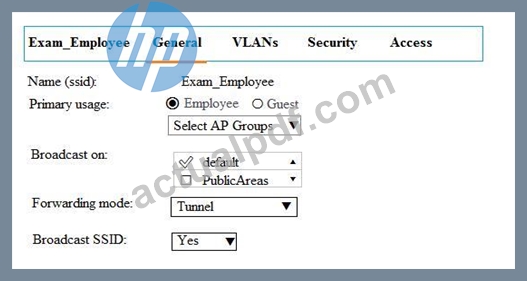
Exhibit 2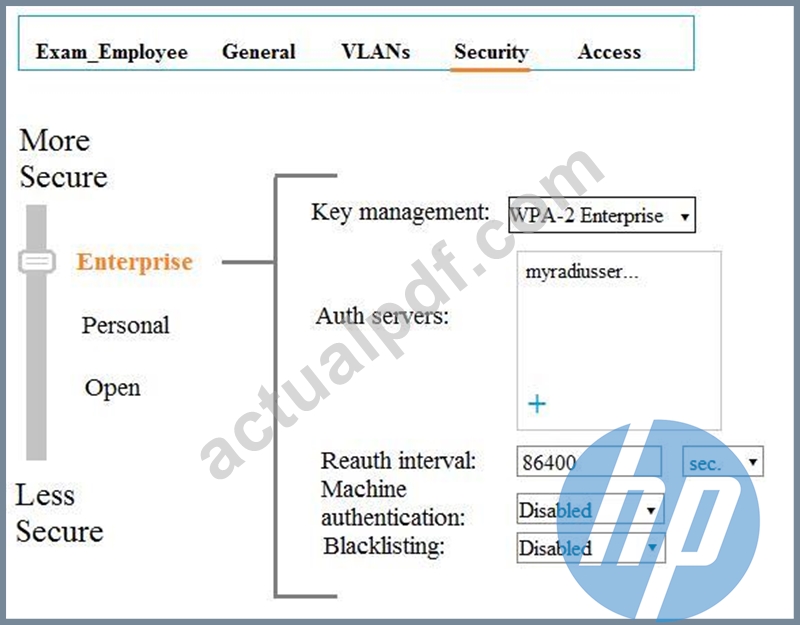
Network administrators use the Aruba Mobility Master (MM) wizard to create a WLAN and do not manually alter any of the profiles for that WLAN. The exhibits show some of the settings for the WLAN. Some wireless users cannot successfully connect to the WLAN. Network administrators attempt to connect on their own machines with a test account, and the connection is successful. They attempt to connect with the same account on user clients, and the connection fails.
Which issue could prevent authentication from completing correctly?
- A. The user clients have unauthorized MAC addresses, so the RADIUS server rejects the authentication even though the username and password are correct.
- B. The user clients do not trust the RADIUS server certificate and are configured not to prompt users to trust new certificates.
- C. Some access points (APs) are not configured as clients on the RADIUS server, so user clients connected to them cannot authenticate.
- D. The RADIUS server has reached the maximum number of RADIUS clients that it can support, so it rejects new wireless clients.
Answer: B
NEW QUESTION 79
Refer to the exhibit.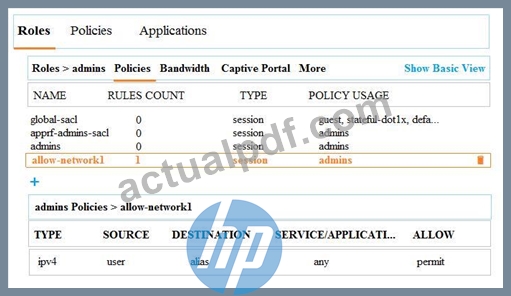
The alias in the rule shown in the exhibit is network 10.1.1.0/24.
A wireless client is assigned IP address 10.1.2.10/24 and the "admins" role. The wireless client at 10.1.2.10 attempts to initiate a Web session with a server at 10.1.1.2. A wired client at 10.1.1.3 attempts to initiate an SSH session with the wireless client at 10.1.2.10.
How does the Aruba firewall handle these attempts?
- A. The firewall permits the traffic from the wireless client and also permits the return traffic from the server. The firewall permits the traffic from the wired client and also permits the return traffic from the wireless client.
- B. The firewall permits the traffic from the wireless client, but drops the return traffic from the server. The firewall drops the traffic from the wireless client.
- C. The firewall permits the traffic from the wireless client and also permits the return traffic from the server. The firewall drops the traffic from the wired client.
- D. The firewall drops the traffic from the wireless client. The firewall drops the traffic from the wired client.
Answer: A
NEW QUESTION 80
An Aruba solution runs ArubaOS 8 and uses a standalone controller architecture. Which feature can administrators use to optimize the channel and power plan for the APs?
- A. AppRF
- B. ARM
- C. Rule Based Client Match
- D. AirMatch
Answer: B
NEW QUESTION 81
A network administrator configures an Aruba Mobility Master (MM)-based solution to provide wireless access to employees. The solution must meet these criteria:
* Authenticate users to a network RADIUS server
* Enforce different Aruba firewall rules based on the user department
How can the administrator meet these criteria in the simplest way?
- A. Create multiple zones on the MM. Assign different departments and sets of firewall policies to different zones.
- B. Have the RADIUS server assign users in different departments to different VLANs. Apply firewall policies based on IP ranges.
- C. Have the RADIUS server send different roles for users in different departments. Apply role-based firewall policies.
- D. Create a different WLAN and SSID for each department. Apply different firewall policies to each WLAN.
Answer: C
NEW QUESTION 82
Which feature is unique to 802.11ac Wave 2 access points?
- A. band steering
- B. multiple spatial streams
- C. 40MHz channel bonding
- D. multi-user MIMO (MU-MIMO)
Answer: D
NEW QUESTION 83
A company deploys an Aruba wireless solution for the first time. In which deployment is clustering supported?
- A. deployment in 7000 Series standalone mode
- B. deployment as Mobility Masters (MMs)
- C. deployment as a standalone VMC
- D. deployment in master-local mode
Answer: B
NEW QUESTION 84
A company has an Aruba solution with a guest WLAN named exam_guest. A network administrator creates the guest WLAN with the wizard and does not change any of the default roles. The authentication server does not send particular role assignments for authorized users. The company wants to deny guests access to specific IP ranges after the guest authenticate.
For which role should the administrator create the rule to deny this traffic?
- A. exam_guest-guest-logon
- B. authorized
- C. guest-logon
- D. guest
Answer: C
Explanation:
Explanation/Reference:
NEW QUESTION 85
A network administrator needs to configure firewall rules for three roles:
* Finance
* Sales
* Employee
Several rules apply to both the Employee and Sales roles, but not to the Finance role. What is the simplest way to configure these rules?
- A. Apply these rules as a subnet-based policy, and then ensure that only Employee and Sales users are assigned IP addresses in that subnet.
- B. Create a policy with these rules, and then apply that policy to the Employee and Sales roles.
- C. Select either the Employee or Sales role, and then configure these rules within the global policy.
- D. Define the Employee and Sales roles as internal roles, and then configure the rules as global rules for internal users.
Answer: B
NEW QUESTION 86
A company has a Mobility Master (MM)-based solution. A network administrator wants to monitor data transfer speed ranges of all currently connected clients.
Which dashboard page in the MM interface should the administrator visit?
- A. Traffic Analysis
- B. Security
- C. Performance
- D. Network
Answer: A
NEW QUESTION 87
Refer to the exhibits.
Exhibit 1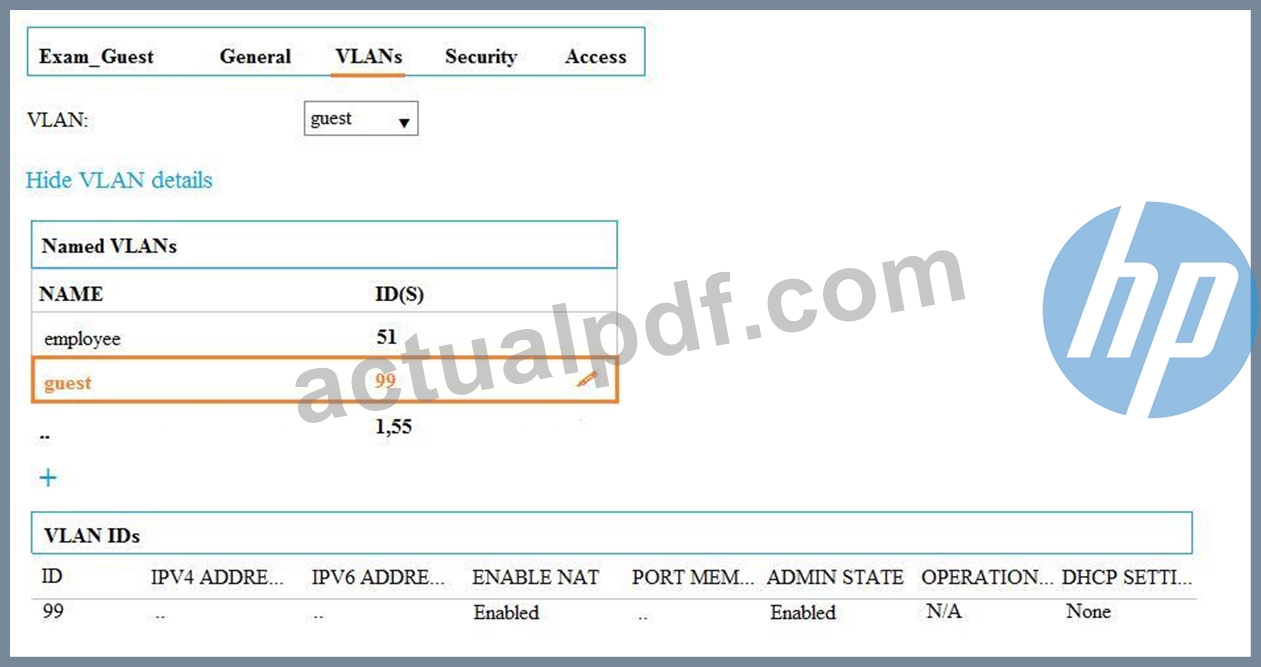
Exhibit 2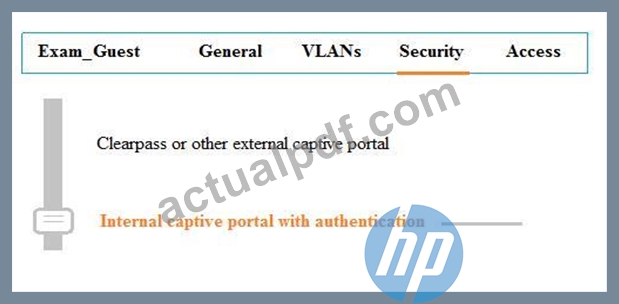
A network administrator configures a guest WLAN on an Aruba Mobility Master (MM)-based solution. The exhibits show some of the settings for this WLAN.
Which settings must the administrator configure on each Mobility Controller (MC) at the device level for this configuration to function properly?
- A. CPSec certificates
- B. an IPsec preshared key
- C. VLAN 99 IP settings
- D. a portal page
Answer: C
NEW QUESTION 88
What is the difference between how a network administrator can monitor clients in the Mobility (MM) interface and in the AirWave Management Platform?
- A. AirWave shows the current signal level for the client connection, while MM does not show RF statistics.
- B. AirWave combines information from more sources, such as RADIUS authenticating servers and APs.
- C. MM shows user and role information associated with clients, while AirWave does not.
- D. AirWave shows trends for the past several minutes, while MM shows longer trends.
Answer: B
NEW QUESTION 89
When an Aruba solution uses AirMatch, which device generates the channel and power plan for an AP?
- A. the AirWave Management Platform
- B. the Mobility Controller (MC) for the AP
- C. the Mobility Master (MM)
- D. the AP itself
Answer: C
NEW QUESTION 90
......
Get Top-Rated HP HPE6-A70 Exam Dumps Now: https://examsboost.actualpdf.com/HPE6-A70-real-questions.html
